
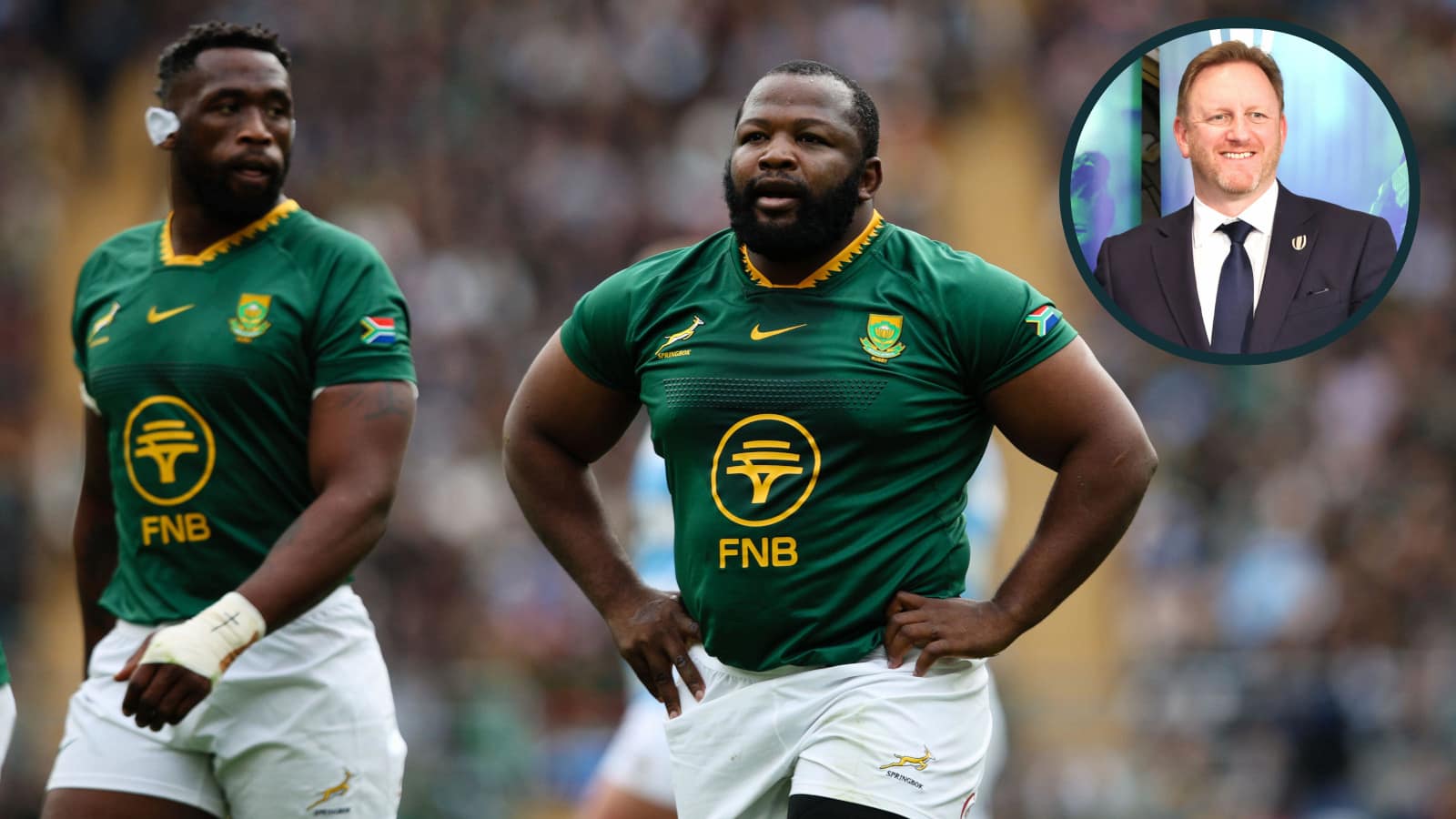
World Rugby chief executive Alan Gilpin has admitted that there is a player welfare issue when it comes to a number of Springboks stars due to the current schedule.
When South Africa’s franchises were ousted from Super Rugby and joined the United Rugby Championship, that effectively resulted in a fair few of their internationals playing the whole year round.
The likes of Malcolm Marx, Pieter-Steph du Toit and Cheslin Kolbe, who are all in Japan, are not affected, but for those in Europe and South Africa, it is demanding on the body.
With them aligned to the northern hemisphere club season but the Boks still involved in the south’s Rugby Championship, the players have to be managed carefully.
Moving the Rugby Championship
There has been talk of moving the annual southern hemisphere Test tournament to run alongside the Six Nations in February and March, but there is a reluctance from New Zealand to do that.
Should it happen, a significant step would have been taken to create the much desired global calendar, but currently nothing is close to being agreed.
“What we haven’t been able to do in the men’s global calendar discussion for as long as I’ve been involved in the game, which is more than 20 years, is get to full alignment where the international windows are aligned across the globe,” Gilpin told the Rugby Unity podcast.
“It’s challenging because there are conditions in different parts of the world. There are different professional domestic competitions being played and they’ve built their economic models around the calendar as it is.
“Moving one piece requires compromise in other areas and that’s the challenging debate.
“What I can say about that, which is really positive, is there is real alignment on, firstly, what alignment is needed to create a better player welfare outcome.
“Players are at the heart of that. If you’re a South African player playing your domestic rugby in Europe and playing for the Springboks in their international competitions, including the Rugby Championship, that’s an 11-month season and it’s not sustainable at the level the game’s being played.”
Gilpin insists that it is World Rugby’s desire to get the calendar aligned but admits that it is a time-consuming process.
“We’ve got to try and find those solutions, so there’s really good recognition of that. And then of course, what does the fan want? The fan wants more alignment and more coherent global calendar,” he said.
“There’s been good discussions but more work to do. We want to play a role as a facilitator and a driving force from a World Rugby perspective in those discussions as I think we have over a number of years and just continue to bring people together.
“There’s a commitment to continue looking at that which I think is really powerful.”
Timeframe
Asked for a timeframe and whether it would take another few years for a global calendar to be implemented, Gilpin responded: “I hope not to be honest”, but admitted it won’t be until 2028 at the very earliest.
“Everyone knows what the issues are, which is important, so that doesn’t mean they’re easy to resolve, but I think they’re identified. And then it’s what changes are possible in what timeframe?” World Rugby’s CEO added.
“Obviously, TV rights in competitions have been sold for a number of years, which make it harder to move. Any change would be 2028 onwards and there’s a recognition of that.
“If we could agree in 2026 what the next set of changes on that journey could look like, that would be a strong outcome.”
Gilpin states that the global calendar is “one of rugby’s great puzzles”, but insists they are making strides.
The governing body claims that the Nations Championship is evidence of their progress, with the inaugural competition set to begin in July.
“We did a lot of work a few years ago in this area that led to the changes which enabled the Nations Championship to be launched,” he said.
“We’re thrilled we’ve got that part moving; to turn the July and November internationals into a meaningful competition – hopefully fans are excited about that.
“We’ve also done a lot of work in the last couple of years to try and get a more coherent global calendar in the women’s XVs game, and their Nations Championship has been the WXV Global Series.
“We’ve got the developing and emerging models that support global elite rugby, support men’s and women’s World Cups being expanded.”