
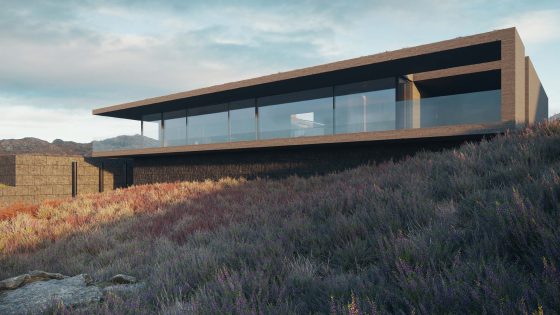
The proposal for a clifftop home in the West Highlands has been recommended for approval by Highland Council officers, despite racking up more than 50 objections since it was first submitted in February 2023.
Concerns were mainly raised over the impact on landscape views and local wildlife on the site on the southern edge of Loch Ailort.
In late 2023, Brown & Brown wrote to the council disputing the claims about potential biodiversity destruction – including the loss of native Scots pine trees and interference with an otter holt.
The practice subsequently amended its plans in summer 2024 to slightly move the site of the house to avoid the loss of five of the pine trees.
However, this change has not satisfied ecological groups ahead of the upcoming decision next Wednesday. Woodland Trust Scotland maintains its objection and argues that the majority of its concerns raised in 2023 remain.
Even so, the planning officer’s report, recommending approval, concluded: ‘The impact on trees has been satisfactorily addressed through the amended siting, which means that none of the group of pines on the rock are now directly affected by the development.’
Concerns have also persisted over the impact on nearby otter holts – burrows used by the mammals for sleeping in – with a recent survey recommending that particular attention be paid to protecting these sites during construction.
Brown & Brown hit back at several objections relating to the scheme’s scale and location on Commando Rock, a viewpoint about 34 miles west of Fort William. The practice, which has studios in Aberdeenshire and Inverness, argued the feared impact on views from some surrounding properties was overblown.
Responding to concerns the dark grey stone-walled home would be visible from two neighbouring properties, Brown & Brown insisted in 2023 that the existing topography and forestry of the site would make it impossible for the building to be visible.
The contemporary Modernist house design includes a single-storey main building with a lower ground floor and a connected side building. The home would have one en-suite master bedroom with four other bedrooms, plus a covered terrace, living area, snug and pantry.
The initial proposals made national headlines when they first emerged in late 2023, coming under fire from residents of the remote area. One objector described the home as a ‘carbuncle on the bluff’ that would ‘spoil’ the landscape, and another said it was ‘out of keeping, in style and in scale, with the other buildings nearby’.
The planning officers report noted: ‘The design is starkly modern, however, it is a very secluded, contained site that will not be conspicuous from any neighbouring properties or from any public vantage points.’
It also said that it was ‘unlikely to be seen from any neighbouring houses’, and presents an acceptable view from the nearby Roshven Bay area.
The application, submitted by McCartney and her husband Alasdhair Willis, whose name is on the planning application, will go in front of a planning committee on 1 April.
Brown & Brown said in a submitted design statement: ‘The secluded nature of the site would be retained, with the house being largely unseen out with the site, and primarily only visible from the water.’ It added that it was also proposing a green roof.
Scottish architect Alan Dunlop previously argued in favour of the scheme, describing it as ‘an exceptional project from an equally exceptional firm of young architects, which needs support’.
Planning permission had previously been granted for a home on the site back in 2000 and construction work had started before being abandoned in 2004 with walls rising to 1m. Brown & Brown’s initial proposal did not overlap the previous development footprint. However, the amended plan does now partly overlie the site of the half-built structure.
Brown & Brown has been contacted for comment.