
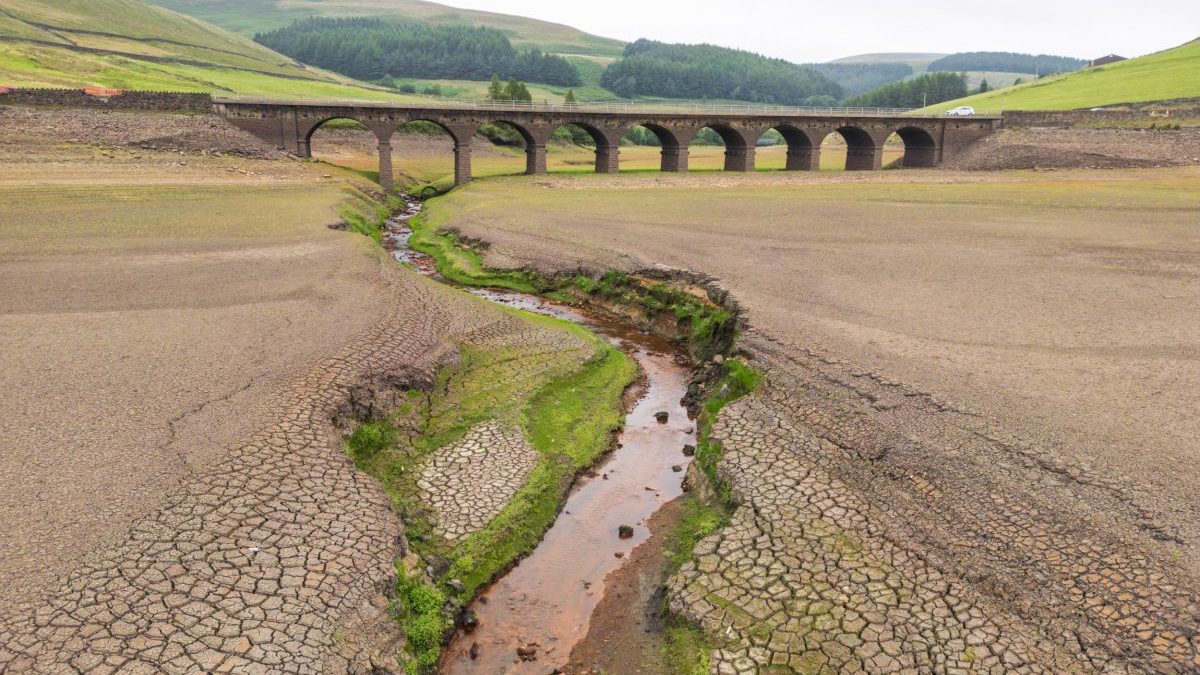
Over a quarter of England is at risk of not having enough water to meet demand by 2035, an analysis of water company data has found.
Climate change, population growth and underinvestment in infrastructure means experts are becoming increasingly concerned over Britain’s water resources.
Parts of the country are already experiencing pressures on supply, particularly the South East where there have been repeated shortages due to infrastructure problems.
New FeatureIn ShortQuick Stories. Same trusted journalism.
Analysis by the consultancy Public First has identified 36 areas in England that are facing a shortfall in their water supply by 2035.
While this does not necessarily mean the taps will run dry in these areas, it is likely to lead to housing developments becoming stalled and businesses being refused a water connection, Public First warned.
Businesses such as breweries, data centres and golf courses are already having their access to water blocked in some areas due to constraints on supply.
“There used to be a situation where water was a resource that people could readily tap into. That’s no longer the case,” said Bertie Wnek, director of housing and infrastructure at Public First.
The 36 areas facing water shortages
The Environment Agency has predicted that England faces a shortfall of nearly five billion litres of water per day by 2050 if nothing is done to curtail use and boost supply.
The Department for Energy, Food and Rural Affairs (Defra) has set a goal to reduce non-household water consumption by nine per cent between 2020 and 2038, and this target is being used to make future planning decisions.
However, Public First’s analysis found that businesses are not reducing their usage at the rate expected of them, meaning parts of the country could be facing constraints on supply within the next decade.
There are 128 water resource zones in England and Wales and Public First’s analysis found 36 are facing “water deficits” by 2035 if business use remains flat, which is in line with recent trends.
This essentially means there will be less water in the system than planners are currently preparing for, which will have a knock-on effect on new housing developments and businesses.
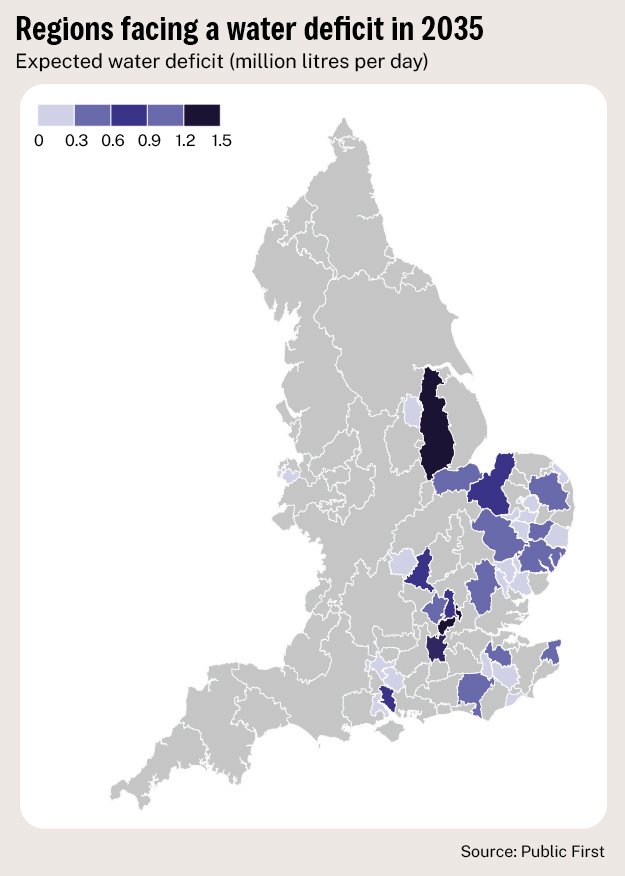
The areas facing the largest deficits include Lincolnshire, and the areas surrounding the River Pinn in west London, and the River Wey in Surrey.
These water deficits could block between £5.1bn and £10.1bn of economic growth by 2035, the research predicts.
The research was funded by the Market Improvement Fund, an initiative by MOSL, which oversees the market that businesses use to access water supply.
What would water shortages look like?
In this context, water shortages mean that there would not be enough water to meet the expected demand of households and businesses in the area, while at the same remaining resilient to drought and protecting the environment.
It does not mean that households would be unable to access water, but it does mean new businesses or housing developments might struggle to get a water connection.
Water companies have to ensure they have enough supply in their system in order to be prepared for a one-in-200-year drought. These regulations are getting tougher, to force them to be prepared for a one-in-500-year drought by 2040, in order to prepare for intensified climate change.
Rules are also tightening around how much water companies are allowed to abstract from rivers as overabstraction destroys ecosystems.
Experts and businesses are becoming increasingly concerned about the availability of water in England, with some firms already feeling the impact.
In the Hartismere Water Resources Zone – one of four water supply areas managed by Essex & Suffolk Water, there has been a moratorium on new non-domestic water connections in the Hartismere since 2023, impacting breweries, distilleries and food manufacturing companies.
In a recent report on water resources, the Environment Agency said “some water companies are already removing guarantees to reliable supplies from mains connections to leisure companies – golf courses, horse racing, sports fields – as pressure on their networks grow”.
What is being done to prevent shortages?
To reduce the chance of shortages, water companies have committed to developing nine new reservoirs and a number of other supply projects by 2050. However, many of these are in the early stages and water companies are still figuring out how to fill them.
Billions of pounds is being spent on fixing pipes, as around a fifth of the country’s water supply is currently being lost to leakage.
Regulator Ofwat is also planning a £75m national educational campaign this summer to encourage households in England and Wales to use less water.
A Defra spokesperson said: “We are committed to improving water efficiency to maintain supplies for households and industry, along with protecting the environment. As part of this, we will help drive reuse and rainwater management uptake for commercial developments and businesses to future-proof industrial water needs.
“This is underpinned by over £104bn in private investment to upgrade water infrastructure, including building nine new reservoirs for the first time in 30 years, ensuring water security is safeguarded for the future.”