
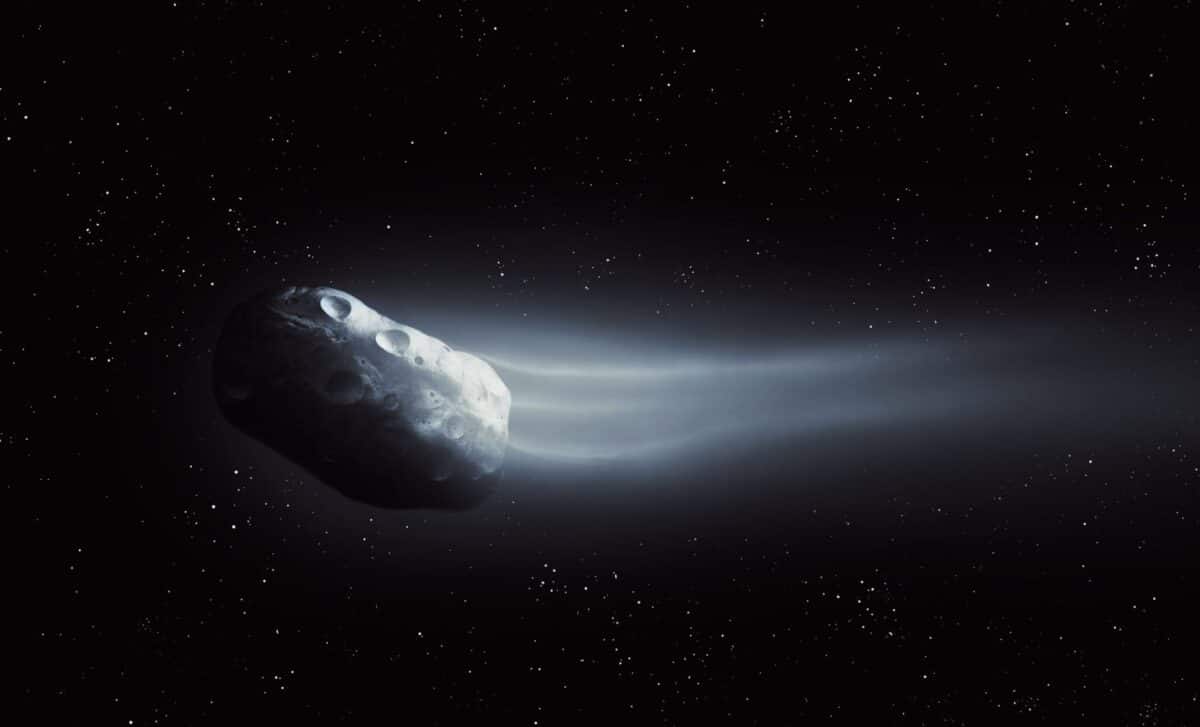
A small comet has stunned astronomers by reversing the direction of its rotation. Observations from NASA’s Hubble Space Telescope reveal that this object slowed down, nearly stopped, and then began spinning the other way. The discovery highlights how fragile and dynamic these icy bodies can be.
Comet 41P/Tuttle-Giacobini-Kresák, or 41P, orbits the Sun every 5.4 years after being diverted from the Kuiper Belt by Jupiter’s gravity. Its compact size, about 1 kilometer across, makes it especially vulnerable to changes driven by solar heating and gas release.
A Sudden Slowdown Followed By A Reversal
Early observations in March 2017 from the Discovery Channel Telescope showed the comet rotating at a steady rate. By May, data from NASA’s Neil Gehrels Swift Observatory indicated that its spin had slowed to roughly three times its previous period.
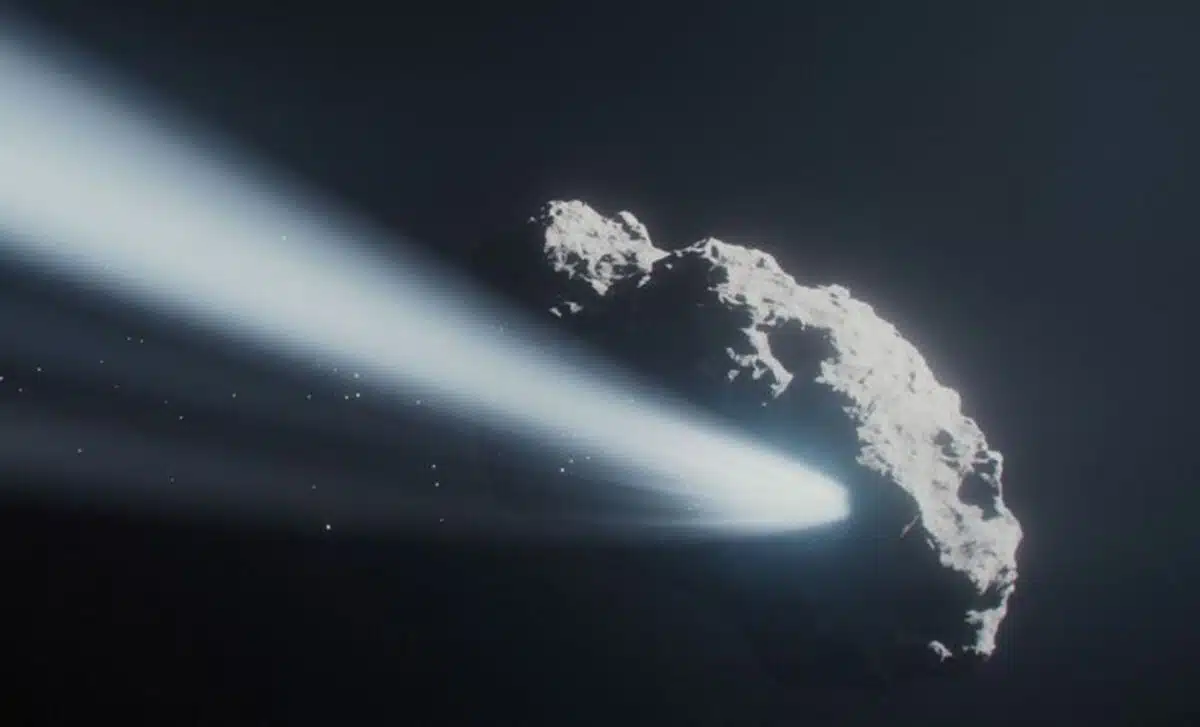 This artist’s view shows comet 41P/Tuttle–Giacobini–Kresák releasing material as it warms near the Sun. Credit: NASA, ESA, CSA, Ralf Crawford (STScI)
Later observations changed the picture again. According to Hubble data collected in December 2017, the comet’s rotation period had dropped to about 14 hours, compared to the 46 to 60 hours measured earlier. Researchers interpret this as evidence that the small solar system body nearly stopped spinning before restarting in the opposite direction. As reported in The Astronomical Journal, this is the first time such a reversal has been documented in a comet.
Outgassing Jets Driving The Change
The mechanism behind this shift is linked to jets of gas released from the icy body’s surface. As sunlight heats the nucleus, frozen materials sublimate and escape into space, producing thrust. As explained by David Jewitt of UCLA, these jets can act like small thrusters.
“If those jets are unevenly distributed, they can dramatically change how a comet, especially a small one, rotates.” He added, “It’s like pushing a merry-go-round. If it’s turning in one direction, and then you push against that, you can slow it and reverse it.”
Because 41P is relatively small, these forces have an outsized impact. Its weak gravity and low structural strength allow even modest jets to reshape its rotational state.
🚨“A comet just did something scientists have NEVER seen before 👀☄️
Using Hubble Space Telescope, researchers found comet 41P/Tuttle-Giacobini-Kresák actually slowed down… stopped… and reversed its spin 😳
This tiny comet is basically being pushed around by its own gas… pic.twitter.com/XPXpq7Lwd6
— 3I/ATLAS updates (@Defence12543) March 26, 2026
A Comet Changing On A Human Timescale
The study also pointed to a sharp decline in the comet’s activity. As stated by the research, 41P was highly active during its 2001 perihelion, yet by 2017 its gas production had dropped by about an order of magnitude. Scientists suggested that this decrease may result from the depletion of near surface volatiles or the accumulation of insulating dust. These changes can affect how material escapes from the nucleus and how forces are distributed across its surface.
“Modeling based on the measured torques and mass loss rates suggest that continued rotational changes could eventually lead to structural instability for comet 41P. If a comet spins too rapidly, centrifugal forces can overcome its weak gravity and strength, potentially causing fragmentation or even disintegration,” based on findings from NASA.
Despite these rapid changes, 41P has likely occupied its current orbit for around 1,500 years, making this behavior unusually fast and observable within a human lifetime.