
Summary of the day so far…
It has just gone past 16:50pm in Tehran, and 16:20pm in Tel Aviv and Beirut. Here is a quick recap of events:
Iran’s parliament speaker, Mohammad Bagher Ghalibaf, said Iranian forces “are waiting for the arrival of American troops on the ground to set them on fire”.
Ghalibaf said the US is secretly plotting a ground attack despite a message of diplomacy coming out of the White House.
The Pentagon is reportedly preparing for weeks of possible “ground operations” in Iran, as thousands of US soldiers and marines arrive in the Middle East.
Diplomatic talks in Islamabad between the foreign ministers of Egypt, Turkey, Saudi Arabia and Pakistan – which are aimed at de-escalating regional tensions -have begun.
The talks, however, do not appear to include any American or Iranian representatives, casting doubt on persistent US claims of diplomatic progress.
Israel has continued to launch airstrikes across the Iranian capital of Tehran, and Iran has been firing missiles at Israel, with strikes also being launched across the Gulf region.
US-Israeli strikes hit a quay at an Iranian port city on Sunday near the strategic strait of Hormuz, killing five people, Iranian state media reported.
A funeral has been held for three Lebanese journalists killed in an Israeli airstrike on a car yesterday that the Iranian foreign minister, Abbas Araghchi, condemned earlier today as a “targeted assassination” and “flagrant violation of international law”.
Updated at 09.23 EDT
Key events
Show key events only
Please turn on JavaScript to use this feature
Iran envoy reportedly refuses to leave Lebanon despite expulsion
Iran’s ambassador will not leave Lebanon despite being declared persona non grata and ordered to leave the country by Sunday, an Iranian diplomatic source has told Agence France-Presse.
“The ambassador will not leave Lebanon in accordance with the wishes of the speaker of parliament Nabih Berri and of Hezbollah,” the unnamed source said.
Hezbollah has denounced the decision while Berri’s Amal party joined Hezbollah ministers in boycotting a cabinet session this week in protest at the order to expel Mohammad Reza Sheibani.
The foreign ministry this week gave Tehran’s envoy until Sunday to leave in the latest unprecedented step by Lebanese authorities since a fresh conflict erupted on 2 March between Israel and Hezbollah.
The foreign ministry accused him of making statements “interfering in Lebanon’s internal politics”.
ShareNetanyahu orders expansion of invasion of southern Lebanon
Israel’s prime minister Benjamin Netanyahu has announced an expansion of his invasion of southern Lebanon, saying that he has instructed the military to further expand the so-called “buffer zone” and vowing to fundamentally change the security situation there.
“I have just instructed to further expand the existing security buffer zone. We are determined to fundamentally change the situation in the north,” Netanyahu said in a video statement from the Northern Command.
He said the decision is aimed strengthening Israel’s security posture along the northern frontier during ongoing tensions along Israel’s northern border, where cross-border hostilities have raised fears of a broader regional escalation.
Benjamin Netanyahu speaks during a press conference in Jerusalem on 19 March. Photograph: Ronen Zvulun/AFP/Getty ImagesShareIran supreme leader ‘thanks Iraqi people for their support’, state media reports
Iran’s supreme leader Mojtaba Khamenei has thanked the Iraqi people and religious leadership for their support of Iran “in the face of aggression”, Iran’s state media reported on Sunday, without saying how this message was conveyed.
More than three weeks on from his appointment as supreme leader, Khamenei has still not been seen or heard from in public since he was injured in the US-Israeli airstrike that killed his father, the late ayatollah Ali Khamenei, his wife and son on the first day of the war. He has issued two written statements that have been delivered via state media, fuelling speculation about the extent of his injuries.
A man holds an image of Mojtaba Khamenei during a demonstration in Beirut, Lebanon. Photograph: Alkis Konstantinidis/ReutersShare
Updated at 12.00 EDT
Fire and rescue teams have been working to seal and contain damaged chemical storage units after a huge blaze broke out and led to fears of a hazardous materials leak at a factory at the Neot Hovav industrial complex in Israel.
The IDF said the fire may have been caused by “a weapon fragment or interceptor fragment”.
Footage and images showed fires burning and plumes of thick black smoke rising from the site, which houses more than 30 factories belonging to different companies and is located six miles south of the city of Beersheba.
Israel’s fire and rescue service said it was working to “prevent an explosion or additional leaks” and warned the public not to approach the area due to the “presence of hazardous materials”.
It urged nearby residents to lock themselves in their homes, close windows and vents, and follow the instructions of the security and rescue forces.
No casualties have yet been reported, said Israel’s national emergency service, Magen David Adom, and nearby factories have been evacuated.
ShareKuwait says Iranian attack injured 10 military personnel
Ten Kuwaiti military personnel were injured in an Iranian missile attack on a military camp in the Gulf country, the Kuwaiti army said on Sunday, without giving a location.
The camp sustained material damage, the army said in a post on X, adding that Kuwait had dealt with 14 ballistic missiles and 12 drones over the past 24 hours.
Updated at 11.48 EDT
Bahrain has said it is imposing a ban on “maritime movement” for seafarers using fishing and “leisure” vessels between the hours of 18:00 and 04:00 local time until further notice. In a statement, the country’s interior ministry said:
double quotation markIn the interest of safeguarding seafarers amid the blatant Iranian aggression against the Kingdom of Bahrain, using missiles and drones, and the serious risks this poses to the safety of citizens and residents, the interior ministry announced a ban on maritime movement for seafarers using fishing and leisure vessels, as part of the measures taken to protect Bahrain’s coasts.
The interior ministry urged all seafarers to comply with the maritime ban timings and avoid approaching the coasts to ensure their safety and avoid legal accountability, affirming that these measures are being taken as part of efforts to enhance maritime safety and raise preparedness under the current circumstances.
Pakistan’s foreign minister Ishaq Dar said in a post on X that Iran had agreed to allow 20 more Pakistani-flagged ships through the strait of Hormuz, the vital shipping route which Iran is effectively blocking as leverage against the US (although some ships from “friendly” countries – such as China and Thailand – have been allowed through with Tehran’s permission).
“Two ships will cross the strait daily,” Dar said. “This is a welcome and constructive gesture by Iran and deserves appreciation. It is a harbinger of peace and will help usher stability in the region.”
The UK has in recent days offered to host an international security summit to draw up a “viable, collective plan” to reopen the strait of Hormuz as economic fallout from the US-Israeli war on Iran continues.
Strait of Hormuz map.Share William Christou
The US has only destroyed about a third of Iran’s missile and drone arsenal after a month of its war against Iran which aimed to degrade the country’s ballistic missile capabilities, according to a report by Reuters.
About a third of Tehran’s missiles have been destroyed, and another third was likely to be damaged or buried in underground tunnels and bunkers, the report suggested. A similar assessment was made about the country’s drone arsenal.
The report, based on five people familiar with US intelligence, suggests that while most of Iran’s missiles are immediately inaccessible, the country still has a sizeable stockpile.
That contradicts Donald Trump’s statement on Thursday that Tehran had “very few rockets left” and statements from other US officials that the war has eliminated its ballistic missile capabilities. You can read more in this story here:
The Tasnim news agency is reporting that law enforcement officials have arrested 35 people in the western Iranian province of Lorestan.
Sixteen people were reportedly arrested on charges of illegally filming sensitive areas, such as military sites, and collaborating with so-called “hostile media networks”, with 19 others detained on “charges of spreading rumours, creating an unsafe psychological environment among citizens and spreading false news”.
Iranian civilians have faced intensified domestic repression since the US-Israeli war was launched on 28 February, including expanded arbitrary arrests and restrictive security controls, according to Human Rights Activists in Iran.
ShareSummary of the day so far…
It has just gone past 16:50pm in Tehran, and 16:20pm in Tel Aviv and Beirut. Here is a quick recap of events:
Iran’s parliament speaker, Mohammad Bagher Ghalibaf, said Iranian forces “are waiting for the arrival of American troops on the ground to set them on fire”.
Ghalibaf said the US is secretly plotting a ground attack despite a message of diplomacy coming out of the White House.
The Pentagon is reportedly preparing for weeks of possible “ground operations” in Iran, as thousands of US soldiers and marines arrive in the Middle East.
Diplomatic talks in Islamabad between the foreign ministers of Egypt, Turkey, Saudi Arabia and Pakistan – which are aimed at de-escalating regional tensions -have begun.
The talks, however, do not appear to include any American or Iranian representatives, casting doubt on persistent US claims of diplomatic progress.
Israel has continued to launch airstrikes across the Iranian capital of Tehran, and Iran has been firing missiles at Israel, with strikes also being launched across the Gulf region.
US-Israeli strikes hit a quay at an Iranian port city on Sunday near the strategic strait of Hormuz, killing five people, Iranian state media reported.
A funeral has been held for three Lebanese journalists killed in an Israeli airstrike on a car yesterday that the Iranian foreign minister, Abbas Araghchi, condemned earlier today as a “targeted assassination” and “flagrant violation of international law”.
Updated at 09.23 EDT
The funeral has taken place in Lebanon for three journalists killed by an Israeli strike on Saturday, an attack which Beirut called a “blatant crime”.
Ali Shoeib, a veteran correspondent for Hezbollah’s Al Manar TV, Fatima Ftouni of the pro-Hezbollah Al Mayadeen channel and her brother, cameraman Mohammad Ftouni, were all killed when their vehicle was hit in Jezzine in southern Lebanon.
Israel’s military in a statement alleged that Shoeib “operated within the Hezbollah terrorist organisation under the guise of a journalist for the Al Manar network”, without providing evidence.
It did not comment on the deaths of Ftouni and her brother.
A woman holds a poster showing Ali Shoeib, centre, Fatima Ftouni, left, and Mohammad Ftouni as mourners gather for their funeral in Dahiyeh, in southern Beirut Photograph: Hassan Ammar/APShare
Two India-bound liquefied petroleum gas tankers carrying about 94,000 metric tons of the cooking gas have safely passed through the strait of Hormuz and are heading towards India, its government has said.
The carriers BW Tyr and BW Elm are expected to arrive in Mumbai on 31 March and New Mangalore on 1 April respectively, the petroleum ministry said in a statement.
The war has all but halted shipping through the strait, but Iran has said “non-hostile vessels” may use the waterway if they coordinate with Iranian authorities.
Reuters reports that the ships are the latest Indian-flagged vessels to make it through. Four LPG tankers have already completed the crossing, while three more are still in the western section of the strait, LSEG ship tracking data showed on Friday.
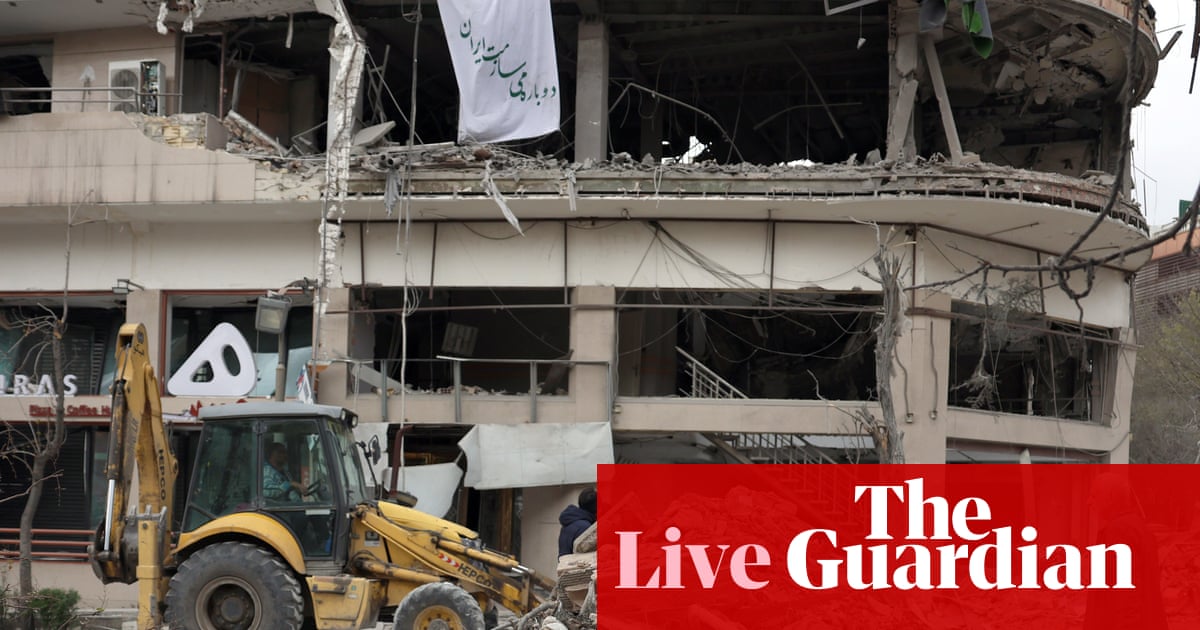
Qatari news channel Al Araby has condemned the strike on its Tehran office building (see earlier post)
The channel said in a statement to AFP that it “condemns this attack on a civilian commercial building and affirms that endangering journalists or considering them targets runs counter to international law”.
It added that, according to the Iranian Red Crescent 10 people, had been injured in the Sunday morning strike.
The Qatari Al Araby TV building damaged in Tehran Photograph: Majid Asgaripour/ReutersShare
In a post on X, Anwar Gargash, the diplomatic adviser to the UAE’s president, wrote:
double quotation markAny political solution addressing the Iranian aggression against the Arab Gulf states must include clear guarantees to prevent future violations, uphold the principle of non-aggression, and mandate Iranian reparations for targeting civilian and vital facilities as well as civilians.
Iran deceived its neighbors about its intentions before the war and revealed premeditated aggression despite their sincere efforts to avoid it, making these two paths essential in confronting a regime that has become the primary threat to the security of the Arab Gulf.
Here are some lines from an interesting analysis piece by my colleague Saeed Shah about Pakistan’s mediation role in the war:
double quotation markPakistan’s diplomatic efforts intensified on Saturday, with the country’s prime minister, Shehbaz Sharif, calling the Iranian president, Masoud Pezeshkian, and the announcement the foreign ministers of Turkey, Egypt, Saudi Arabia and Pakistan will hold talks in Islamabad on Sunday and Monday about how to end the war.
These four countries are emerging as a new alignment within the Muslim world, packing three of the biggest armies in the region, nuclear weapons and Saudi Arabia’s financial heft. But officials from Saudi Arabia, which has been repeatedly hit by Iran, have privately said that they want the bombardment to continue.
Islamabad expects any talks to be indirect, with Pakistani officials shuttling between the US and Iranian delegations in different rooms. Tehran refuses to sit down face-to-face with US officials.
Pakistan is nuclear-armed with a large army that could secure a venue for talks, while its air force could provide Iranian officials with an escort to fly in.
Iran says Washington is again trying to deceive, having twice bombed them over the past year in the midst of talks. A buildup of US troops in the region suggests peace talks may not be the US’s plan.
Pakistan’s de facto leader, military chief Field Marshal Asim Munir, has Donald Trump’s ear. Photograph: APShare