
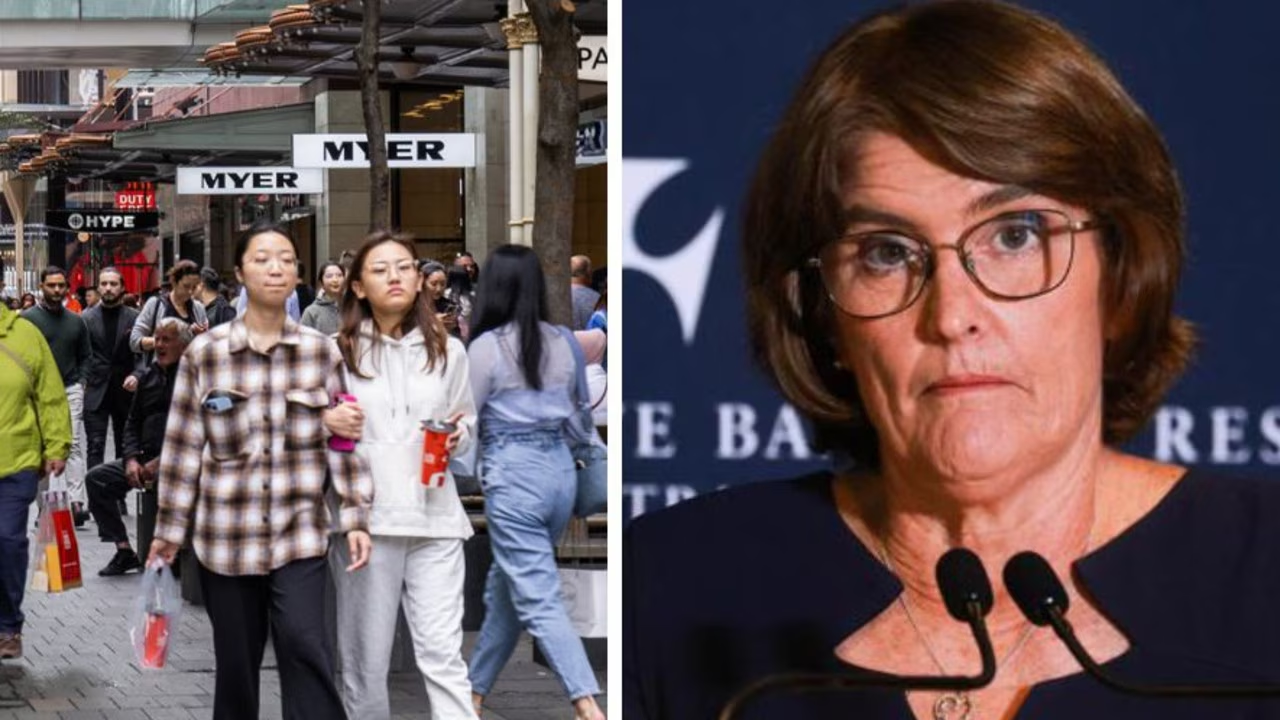
Australian mortgage holders could face another three interest rate hikes in 2026, a mark not seen since the global financial crisis, as a leading property expert predicted house prices to flatline or fall across the major cities.
Soaring fuel prices have smashed the economy amid a new conflict in the Middle East, with added costs and general economic anxieties appearing to soften housing demand.
Now major bank Westpac has forecast another triple rate hike by the end of this year, which would take the cash rate to 4.85 per cent, and no cuts until 2028.
Property researcher and consultant Cameron Kusher said falling auction clearances and weak price growth in Sydney and Melboure were indicators the market was already struggling ahead of more financial pain for mortgage holders and potential buyers.
“The market at the moment is expecting at least two further interest rate increases this year and possibly more likely than not a third,” he told news.com.au.
“Two interest rate increases takes us back to the highest rates we’ve had since 2011. A third one takes us back to the highest interest rates we’ve had since … the global financial crisis was just hitting.
“So a lot of people have never experienced interest rates this high, and obviously property prices and mortgage sizes are a lot larger than they were back in 2008.
“I think for all of those reasons … I’m getting pretty bearish on property.”
Money markets last week began pricing in another three interest rate rises in Australia by the end of the year, which would lift the cash rate to 4.85 per cent.
There has already been two hikes in 2026, which economists had forecast even before the Iran war broke out due to high inflation.
Wespac chief economist Luci Ellis said the bank’s shift reflected “the longer disruption to and slower recovery in fuel supply assumed in the revised baseline forecasts … with the Strait of Hormuz essentially closed for eight weeks and traffic recovering only slowly after that”.
“It also reflects the surprisingly rapid pass-through of higher fuel and other oil-derived product prices into other prices in Australia,” she said.
“We believe the RBA will respond to this pricing behaviour by tightening monetary policy by more than would have been needed absent that pass-through.”
She said the Reserve Bank would take a “once bitten, twice shy” approach to unwinding rate rises in forecasting cuts from February 2028, although added “we have low conviction about the exact timing”.
Canstar modelling showed another three hikes would add $457 per month to repayments on a $600,000 mortgage, $609 for a $800,000 loan and $762 at $1 million since the start of 2026.
Canstar’s data insights director Sally Tindall said borrowers were in for a tough couple of years if Westpac’s forecasts were correct.
“While the other big banks are tipping just one more hike, Westpac is now forecasting a far more aggressive path, which would take the cash rate to levels we haven’t seen since the fallout from the GFC,” she said.
“The flow-on effect of higher fuel costs has already started pushing up prices elsewhere. The RBA may feel like it has to act because once prices go up, they rarely come back down.”
Mr Kusher said although a 4.85 per cent cash rate was not that high on a historic basis, it would fundamentally shift behaviour on the property market.
“I think the people that will be transacting are people that really have to sell,” he said.
“The people that are buying will be people that may have already sold and having to move into something small or people really looking for bargains in this market.
“So I can’t see, if this war continues to roll on, if inflation remains elevated, if interest rates have to rise, I can’t really see a situation where there’s going to be enough demand in the market to push prices higher.”
SQM Research this month forecast home prices in Sydney and Melbourne to fall in 2026 due to the impact of war in the Middle East, something Mr Kusher agreed with.
“Obviously Melbourne’s been underperforming for quite a long time, but Sydney’s the most expensive market in the country.
“I think prices will go back there. And I think the other capital cities, while prices will continue to rise, that rate of growth is likely to slow, especially as interest rates are pushed higher.
“I don’t think we’re looking at catastrophic falls, but I think we could see prices fall four or five per cent.
“And then depending on how long interest rates remain elevated, we could see more falls into 2027 as well.”
Auction clearance rates dropping
Depending on the source, the reported auction clearance rate from the weekend varied across a number of data sets. But most agree it has fallen in recent weeks.
Results recorded by realestate.com.au on Monday showed a clearance rate of 48 per cent from more than 1700 homes listed for auction between March 23 and 29.
Of those, 451 were sold prior to auction, 220 passed in, 723 were withdrawn and 386 sold under the hammer.
This does not fully capture total results as there was a total of 2072 NSW auctions scheduled in that period. Another 1536 private sales took place.
Cotality data from the week ending March 29 put Sydney’s clearance rate at 57.9 per cent, while Domain recorded a 55 per cent clearance rate – down from 65 per cent in March 2025.
ANZ chief economist Shane Oliver, speaking to the Domain figures, said the trajectory meant price falls were on the horizon.
“Clearances are continuing to fall with more rate hikes likely & the War depressing buyer confidence & pushing up listings,” he wrote on X.
“Withdrawals are also up. Looks headed for price falls.”
Auctioneer Tom Panos has been chronicling the drop off on his social media, and previously told news.com.au a “perfect storm” had hit the property market.
He said on Saturday that out of the 12 auctions he was scheduled to oversee, five of them sold on the day.
“Again we saw a pattern of properties being sold prior or being cancelled,” he said.
Mr Panos had previously spoken about there being two markets emerging – with properties at lower price points still seeing strong demand.
But, he said, “now we’re seeing for the first time the lower price point being impacted”.