
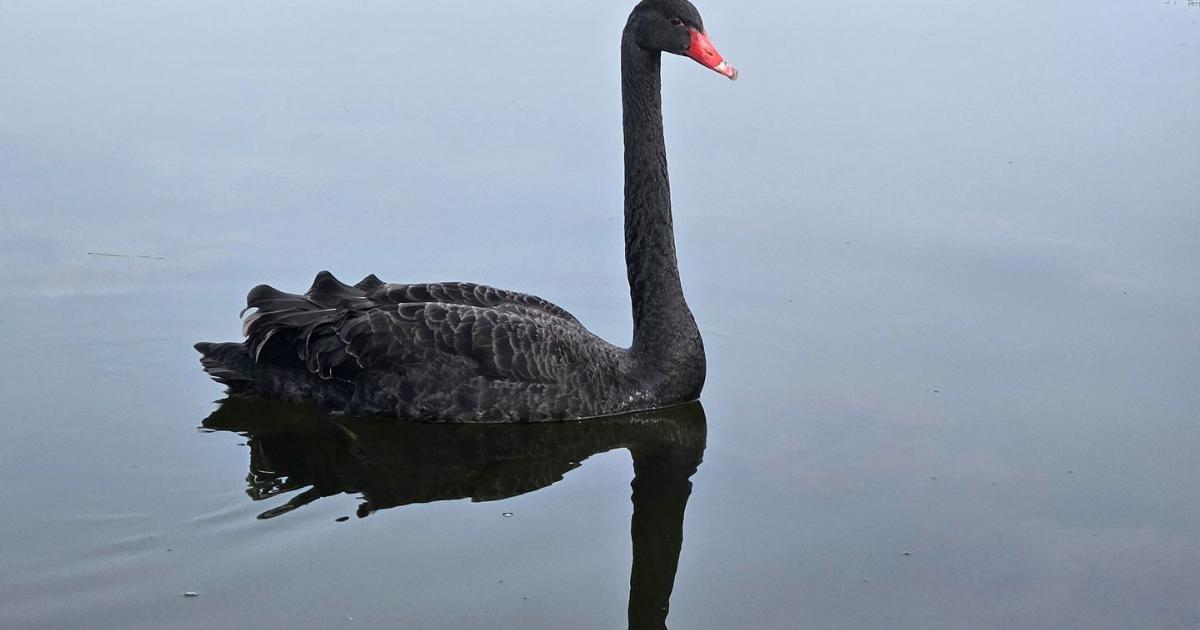
The bird, native to Australia and known for its striking black plumage, was seen at the meanders in Seven Sisters Country Park last week.
In a statement on Facebook, Seven Sisters Country Park said: “We spotted a black swan on the meanders this week – not something we often see.
“Native to Australia, they originate in the UK from ornamental collections of the late 18th century that escaped captivity and went on to establish in the wild.
“We think it’s a lone swan passing through, but how exciting would it be if they nested here.
“It’s a timely reminder to keep dogs on leads around the meanders to protect our birds and nests during nesting season.”
The black swan spotted at Seven Sisters Country Park (Image: Sylvia King/Seven Sisters Country Park)
Black swans are large waterbirds commonly found throughout Australia. They are the only swan species in the world with entirely black feathers.
Compared to the UK’s native mute swan, black swans are more vocal and sociable, gathering in large flocks rather than remaining solitary.
The species was first described by English naturalist John Latham in 1790.
Before European exploration of Australia, black swans held an almost mythical status in European culture.
The Roman satirist Juvenal used the phrase “a rare bird in the lands, and very like a black swan” as a metaphor for something that could not exist.
The discovery of black swans in Australia overturned this belief. Today, a “black swan event” refers to something extremely rare and unexpected.
Black swans are native only to Australia (Image: Bernard Spragg)
Sightings of black swans in the UK remain unusual, as they are not native and do not appear on the official British List of wild birds.
The black swans seen in Britain today are mostly descendants of birds that escaped from ornamental collections.
The first recorded black swan arrived in the UK in 1791, and the species quickly became popular in private collections, zoos, and ornamental parks.
Some birds escaped and began breeding in the wild, but the population has remained low. A 2012 study recorded just 37 confirmed nesting pairs across the country.
The mute swan is common in the UK (Image: Yerpo)
With no established wild populations in East Sussex, it is likely the black swan at Seven Sisters came from a nearby ornamental pond or private collection.
Lone black swans occasionally appear at scattered sites across the UK.
In 2025, one was spotted in Stratford-upon-Avon in January, and another in Orkney in June.