
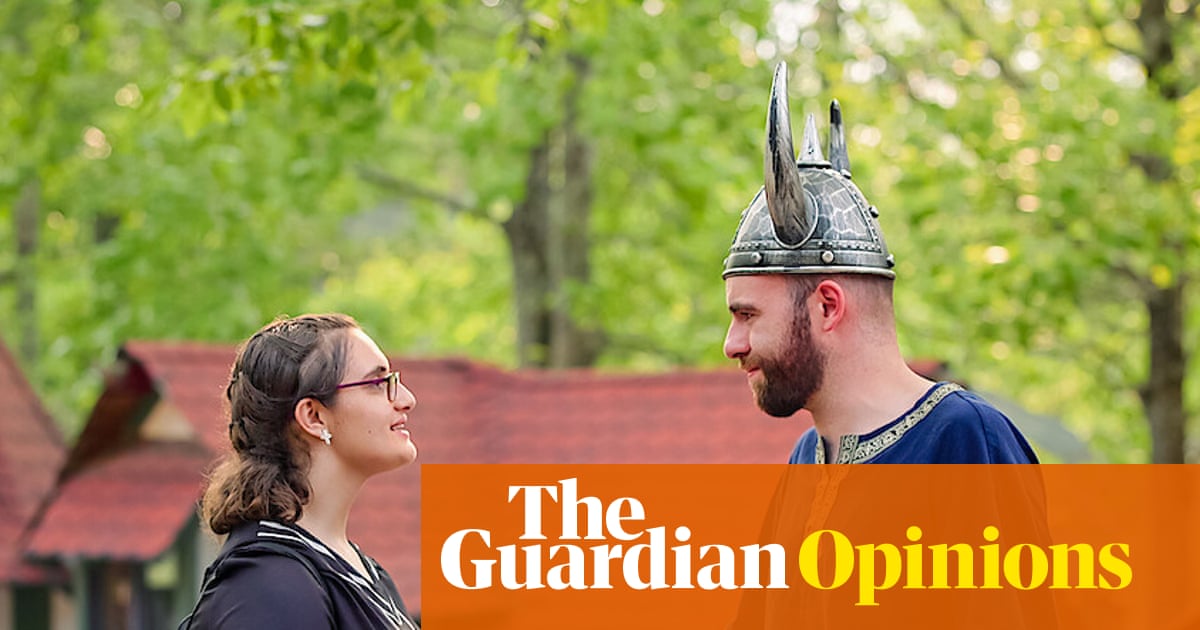
Logan is a big fan of Hannah Montana and Spongebob Squarepants. He loves model trains and watches videos of them crashing, because that way he knows that no one was hurt. His favourite desert is cheesecake. These are touchingly pure interests from a 25-year-old man who lives in the hedonistic capital of Las Vegas. “I describe myself as trying to be well-groomed, very patient, not lazy and always punctual,” he says. “Classy, fancy, romantic – wait, romantic? Is that the word?”
Logan is one of the new participants on Netflix’s Love on the Spectrum: a series that follows a group of neurodivergent young people as they search for a romantic connection, which returns this week for its fourth season. Unlike other dating shows, such as Love is Blind and Love Island, the stars of this show don’t seem to be motivated by fame and the promise of a Boohoo discount code in their name. In fact, Love on the Spectrum is the antidote to the reality TV of today, which often revolves around controversy and conflict. Watching these young people and their families navigate their search for love isn’t merely wholesome, it makes for life-affirming TV.
The new season is a mixture of familiar and new characters. We catch up with 27-year-old Madison, who found love on season three with Tyler and is now moving to Florida to be closer to him. When she arrives in her new apartment, she unpacks her extensive collection of Disney princess dolls. As she arranges them with precision, she says she wishes there was an autistic Disney princess. In episode two, Tyler takes her on a romantic date for their first Valentine’s Day. Afterwards, he serenades her with the country song Livin’ on Love. The lyrics tell the story of an old couple whose children have flown the nest, who spend their remaining days sitting together on a porch and reminiscing. You’d have to have a heart of stone not to be moved by it.
Next we catch up with Connor, 26, a returning participant from Atlanta. He isn’t sure whether his girlfriend Georgie likes him, because she keeps acting hot and cold. His mother, Lise, coaches him on how to approach it as they prepare a picnic of finger sandwiches for their upcoming date.
While the show focuses on its young people stepping out on their own to find love, it’s also about the support system around them. Emma, a 22-year-old college student (and fan-fiction writer) from Salt Lake City, is part of a close-knit Mormon family. Her mother still remembers the day she decided to stop “shh-ing” her daughter in church. For her, this was a profound realisation that she should “stop worrying about all the things Emma isn’t, and just enjoy what she is”. And really, isn’t that a lesson that so many of us could take into our own lives?
Looking at the wider reality TV landscape, there is something nostalgic about Love on the Spectrum. It might be hard to imagine, but the earliest reality TV wasn’t totally geared around conflict. At the turn of the millennium, the reality genre was more about shows that claimed to be “social experiments.” The Simple Life sent a Juicy Couture-clad Paris Hilton and Nicole Richie to “work” on farms. The original Queer Eye for the Straight Guy followed a squad of five gay men as they gave straight men makeovers, while Faking It offered participants the chance to dive into a different life – and learn a new skill – for a month. The central message of these shows was that, even when people are different from one another, they’ve still got things in common.
Towards the mid-aughts, reality TV became notably more extreme, dramatic and angry. In the last year, Netflix has released a pair of docuseries – about the making of The Biggest Loser and America’s Next Top Model – that are a case study in how the medium’s Overton window kept shifting, with producers crossing ethical lines to ensure a steady stream of drama. A show like 2004’s Wife Swap represented a tipping point, because it was about putting people together from different class backgrounds and waiting for them to have huge fallouts. That same year, in the UK, Big Brother went “evil”, with contestants who were specifically selected to get into arguments. And sure enough, during the now-infamous “fight night”, the housemates got into a physical brawl and the police were called. This was a far cry from the second series, in 2002, which centred a summer romance between Welsh hairdresser Helen Adams and Paul Clarke, and was won by the hilarious Irish air steward Brian Dowling.
Tyra Banks and cast members of America’s Next Top Model in 2007. Photograph: Evan Agostini/Getty Images
We look back at the 2000s in consternation, but today’s reality TV seems to be teetering towards similar extremes. In March, season 22 of ABC dating show The Bachelorette was pulled amid allegations of violence against its star, Taylor Frankie Paul, who rose to fame when she was arrested in the very first episode of Hulu’s The Secret Lives of Mormon Wives. On a backdrop of TV that is once again flirting with controversy, Love on the Spectrum is a welcome reprieve. It’s a reminder that people – and reality TV – can actually be good.
At the heart of the Love on the Spectrum is a fascinating dichotomy. In one respect, the participants seem unencumbered by many of the conventions that can make dating so awkward for people who aren’t neurodivergent. For example, on Emma’s first date, she didn’t feel the need to embellish her interests, or tell him what he wanted to hear. (She even let him hear her very good Donald Duck impression.) And at the end, she didn’t pretend that she’d like to see him again, only to ghost him later on. Instead, she told him straight-up that she didn’t see it going any further. (He reminded her too much of her dad – relatable.)
In fact, what’s so radical is that the show demonstrates that, when it comes to romance, neurodivergent people deal with similar anxieties as non-neurodivergent people – and they’re refreshingly open about it. When autism expert Jennifer Cook visits Logan ahead of his first date with Hailey, we’re reminded that people on the spectrum ask themselves the same questions before a date: will they like me? What will we talk about? What should I wear? And on the date, when Hailey tells him her favorite desert, we see that the first step towards love can be as simple as splitting a slice of cheesecake.