
This was the environment in which AI experts were being asked to project the future job-altering capabilities of LLM-powered software.
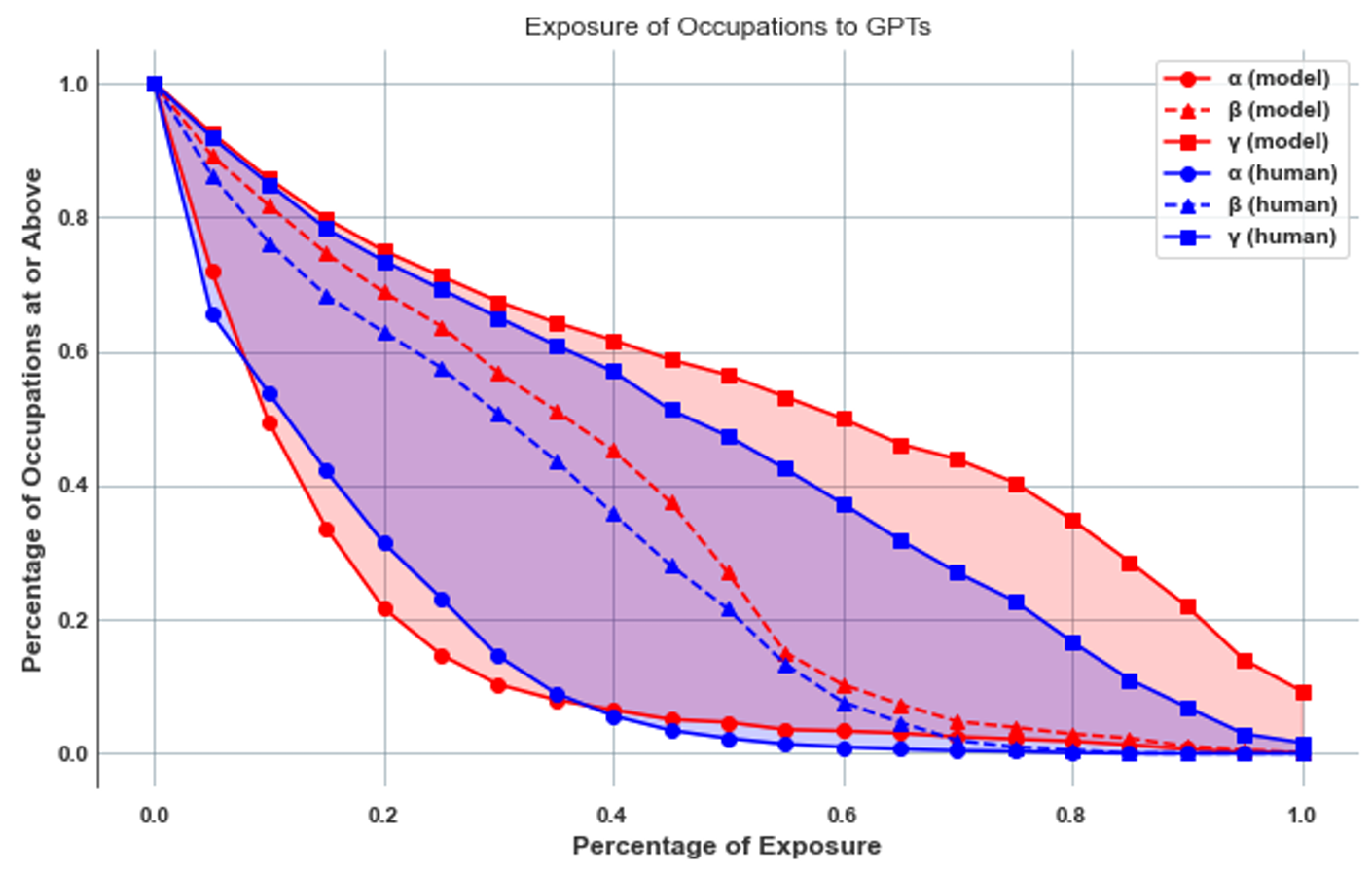
The 𝛽 and 𝜁 lines here assume much larger potential LLM impacts on jobs by incorporating forward-looking projections for “anticipated LLM-powered software.”
The 𝛽 and 𝜁 lines here assume much larger potential LLM impacts on jobs by incorporating forward-looking projections for “anticipated LLM-powered software.”
Credit:
Eloundou et al
Importantly, the researchers didn’t even set a self-imposed deadline for when these effects would be seen in future software. “We do not make predictions about the development or adoption timeline of such LLMs,” the researchers write, creating an essentially unbounded horizon that limits the predictive power of this kind of projection.
Digging into some of the examples shows how much the labelers are assuming about LLM capabilities going forward, too. For instance, the researchers predict that negotiating purchases or contracts could be impacted by LLMs because “you could have each party transcribe their point of view and then feed this to an LLM to resolve any disputes.” While some people might use LLMs in this way at some point, even the researchers blithely admit that “many people would need to buy into using new technological tools to accomplish this.”
It’s these forward-looking assumptions about LLM-powered software that generate the more eye-popping “theoretical capability” numbers, such as those cited by Anthropic. By the most generous read of this measure, the researchers predict that “between 47 and 56 percent of all tasks” will eventually be made at least 50 percent faster by LLMs and that 19 percent of all workers “are in an occupation where over half of its tasks are labeled as exposed.” That expands to 100 percent of all job-related tasks for some “fully exposed” occupations, including “mathematicians,” “writers and authors,” and “web and digital interface designers,” according to the researchers.
I guess we’ll find out
Even here, though, it’s important to note that the researchers are not suggesting LLMs will be able to replace humans or work unassisted at these tasks. Using LLM-powered software to speed up a human job task is not the same as wholly replacing human labor with that same software.