
Why you can trust What Hi-Fi?
Our expert team reviews products in dedicated test rooms, to help you make the best choice for your budget. Find out more about how we test.
This review appeared in AUSTRALIAN HI-FI magazine in sunny Australia
(Image credit: Future)
This review appeared in Australian Hi-Fi magazine, one of What Hi-Fi?’s sister titles from Down Under, and originally appeared within Addicted to Audio’s Audio 101 reviews. Click here for more information about Australian Hi-Fi, including links to buy individual digital editions and details on how best to subscribe.
As I sit here, I can lift my gaze and see three large boxes of electronics on my high-fidelity bench. They are a chunky preamplifier, a slightly less chunky power amplifier, and a similarly-sized network streamer/DAC. I’m about to take them away and replace them with one box.
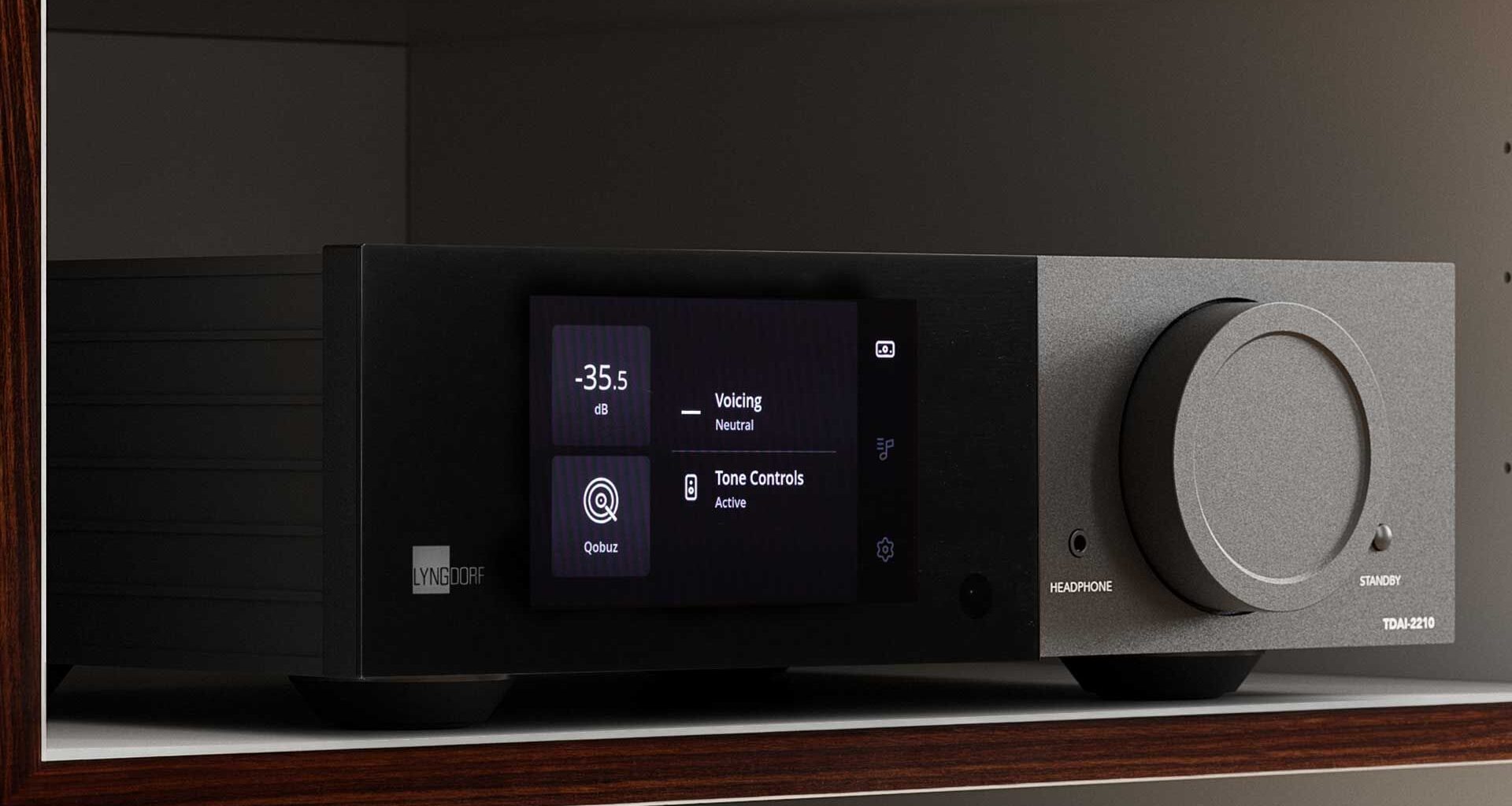
That replacement is, of course, the Lyngdorf TDAI-2210 digital streaming amplifier, launched in 2025 by the Danish company. The Lyngdorf TDAI-2210 combines pretty much all the features of those three boxes. It’s an integrated amplifier, so a pre-and power amp combined. And it has a streamer built in.
Where it also manages to effectively replace my previous three-box solution is power. The TDAI-2210 has a per-channel rating of 105 watts into 8 ohms, and 210 watts into 4. My regular system is 125/250 watts into 8/4 ohms, so on paper at least, the Lyngdorf could be the only box I need to maintain my current listening experience.
What’s also impressive about the Lyngdorf’s spec sheet is that it manages to package it into a relatively compact, full-width enclosure. A huge contributor to the compactness is that Lyndorf embraces “digital amplifier” fully.
Some others hide behind “Class D” in order to eschew the bogey word “digital”, but in reality, this class of amplifier is simply a slightly different form of digital. Instead of the PCM (Pulse Code Modulation) type of digital on a CD or most streaming platforms, it uses PWM (Pulse Width Modulation).
To simplify matters, perhaps excessively, this represents the signal by how wide the single-bit sample is. Filter that output appropriately and you have an analogue signal. But the thing is, at the amplifier, before the filter, the signal is all one thing or all another thing. Not a gradual slope between the two. So the output transistors are either entirely on, or entirely off. And that makes them immensely efficient.
Which is why you can get a lot of power out of a small box, with only modest heat dissipation. You can see that embrace in the expansion of TDAI – Lyngdorf says it stands for True Digital Amplifier Integrated.
(Image credit: Lyngdorf)
Once you fully embrace something, you can focus on making it as good as it can be. So Lyngdorf, for example, here uses a volume control at the output stage, instead of between what would normally be a preamplifier and a power amplifier.
Now, I do note that there are actually analogue pre-amp outputs: both RCAs and balanced XLRs. And I’m sure Lyngdorf wouldn’t mind in the slightest if, in the future, you wanted to upgrade the amplification to some of its higher-level standalone power amps. Or you might choose to go for some other brand. Whatever. In that case the TDAI-2210 can become a preamplifier, or even merely a source, should you wish.
But this kind of usage then goes against the ethos of the unit’s fully digital design. Because those two analogue pre-outputs must have a separate DAC, turning everything analogue. Stick with the built-in amps, on the other hand, and it’s fully digital all the way until it gets to the speaker binding posts.
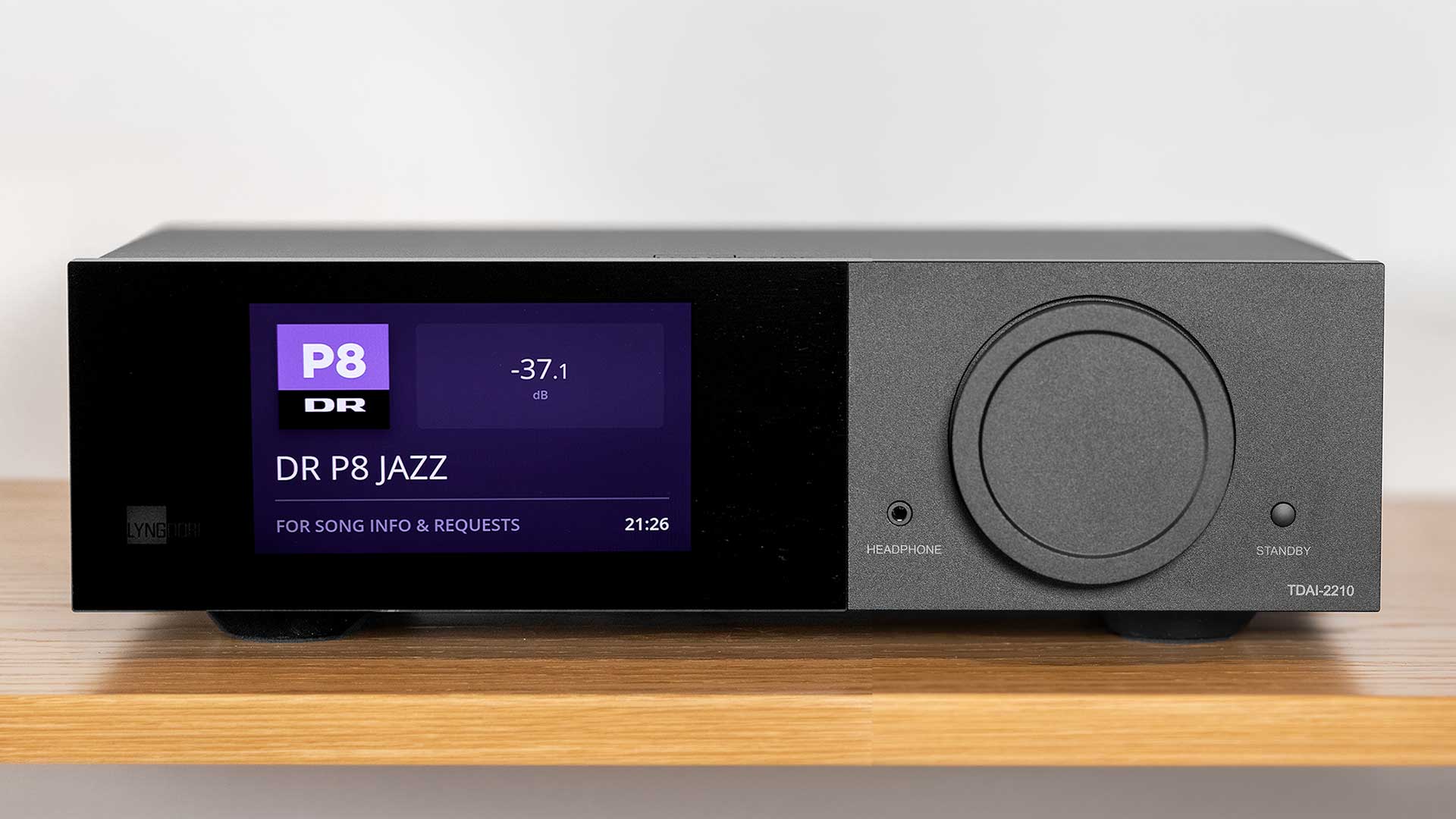
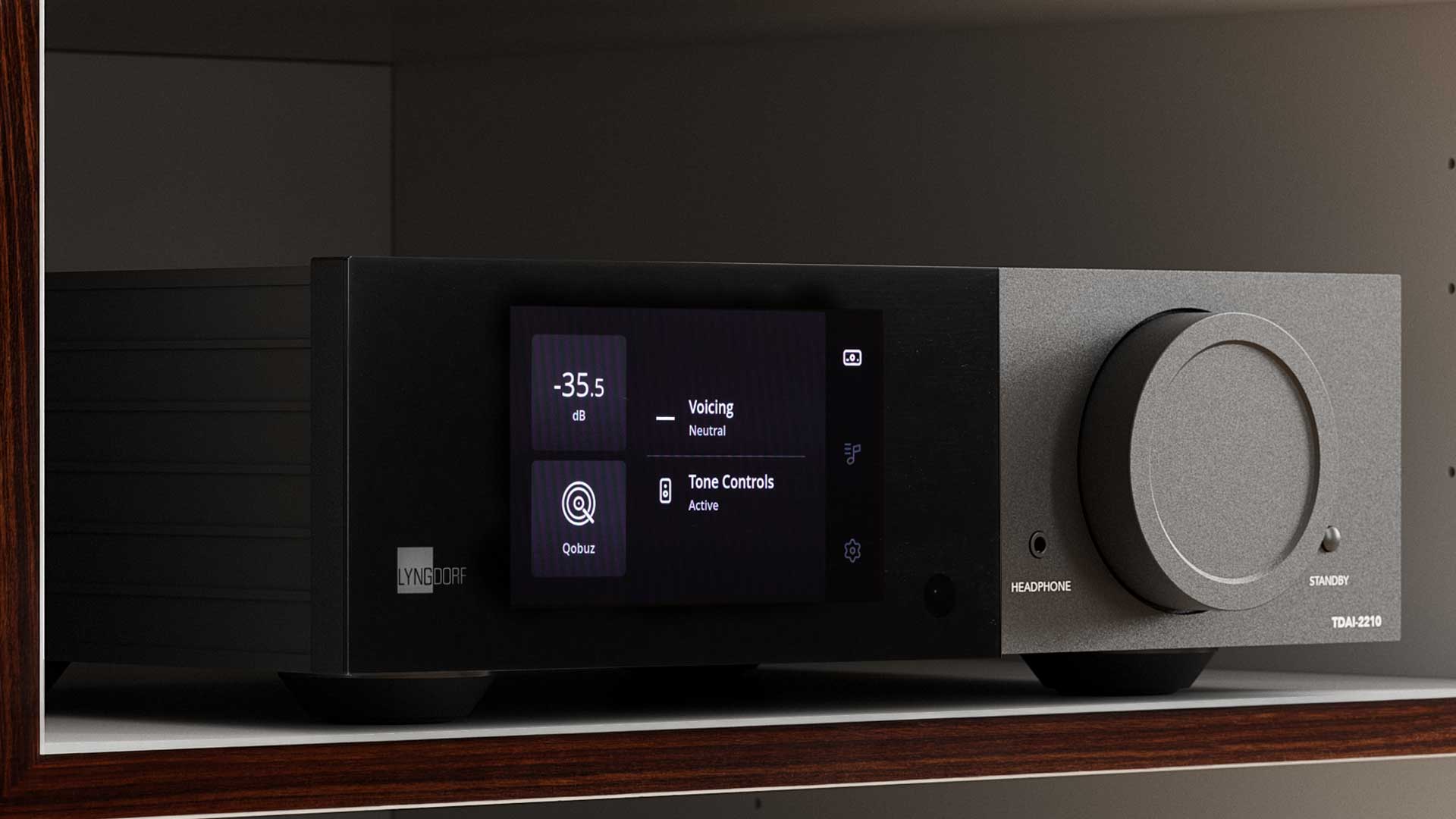
You will notice that there aren’t many controls on the front of the unit. That’s in part because you can do a lot of control using the front-panel touch screen, or even more using an Android or iOS app.
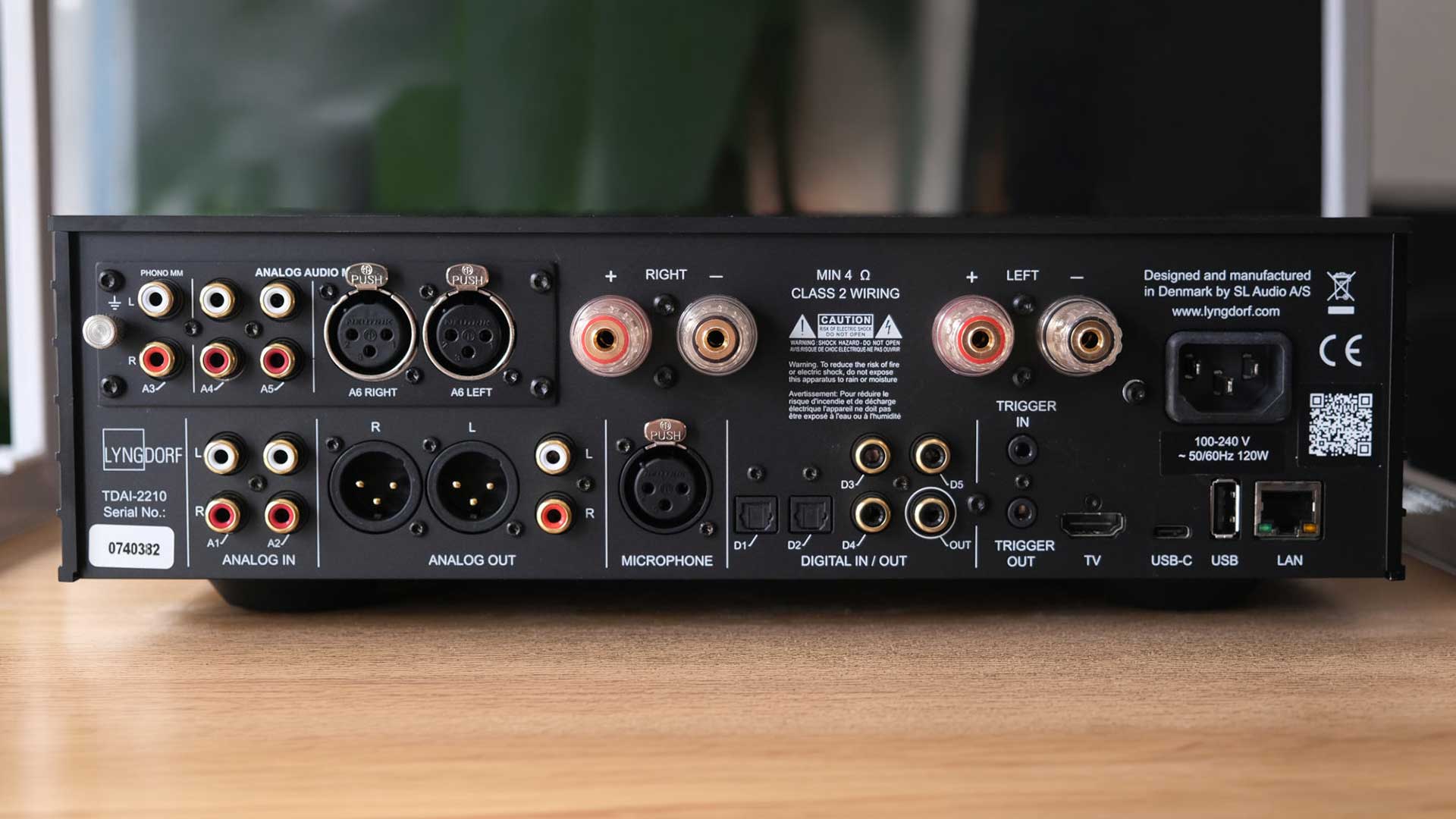
There is a “standard model” of the Lyngdorf-2210 which omits the balanced analogue inputs, two pairs of unbalanced RCAs and the moving-magnet phono input. In other markets, these can be added via a modular upgrade, but here in Australia those extra inputs come as standard (see the back panel above). You’ll need to ask your dealer about the other model if you’d prefer to go down that route.
Likewise, there’s a version with a more complete HDMI module: a couple of inputs and an output which supports 4K/8K. The HDMI socket on the standard model is only for the Audio Return Channel from your TV.
(Image credit: Lyngdorf)Set-up and use
I used the unit… twice. First I had a pre-production model that allowed me to get a good sense of how it worked. Then I was provided with a production model with the first production firmware, to give it the full review treatment. The former was difficult. The latter was a dream.
Happily, if you buy it you’ll be getting the latter!
I used it with Wi-Fi and with Ethernet, and it worked beautifully either way. I mostly used the app on an iPad – an old 6th gen one – but performance was fine regardless. It is very attractively designed, albeit with a few minor flaws. e.g. arrows for going back to previous screens are sometimes at top left, sometimes at centre bottom. A touch more consistency, please. But, of course, with every control app a little learning is involved, and I soon learned this one.
A couple of features were still being finalised as I reviewed. Apple AirPlay was still to come, as was Roon, as was app-controlled DLNA/UPnP. I should note that DLNA/UPnP actually work perfectly when using another app. I used Bubble UPnP on Android, and mConnectHD on iOS to reliably send music from the enormous library on my Synology NAS to the unit. Finalising this facility within the Lyngdorf app will simply be a nice bonus.
Oh, did I mention that there’s a remote control? It’s RF-connected, so no line of sight required. This is sufficiently comprehensive to allow you to pretty much skip using the app.
But you’ll still want your phone or tablet for Tidal, Spotify or your favourite streaming service. I used both of those, and particularly enjoyed Spotify as it became lossless. (And, yes, I have confirmed that it truly is bit-perfect with a comparison of nearly 150 million samples from seven CD tracks.) Both worked perfectly via their Connect features.
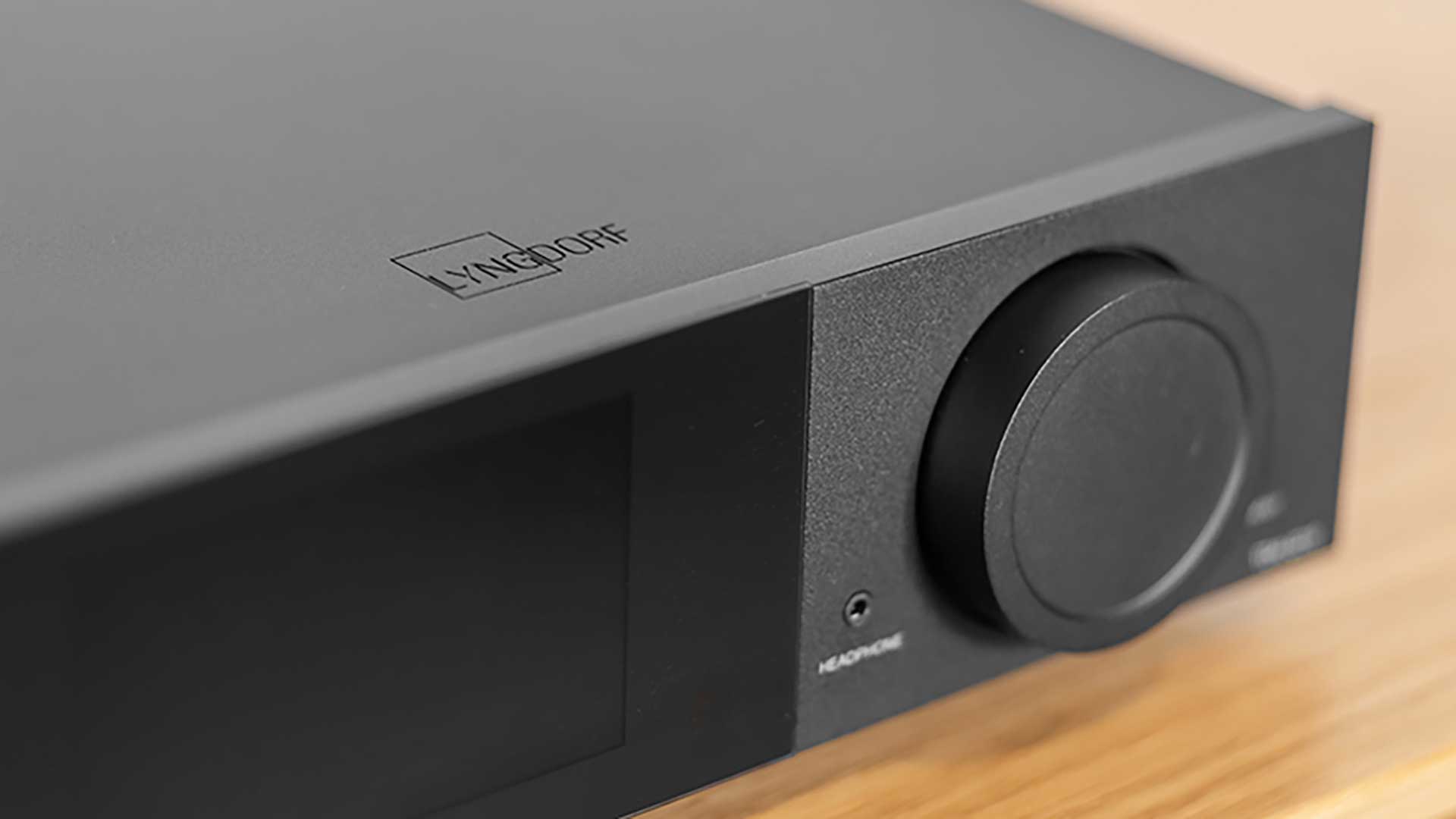
The large volume control on the front panel deserves a special mention. Since everything is digital, and indeed the volume controls the sound at the speaker outputs, rather than at the input level to the power amplifier section, there’s no potentiometer through which the signal runs. The volume knob is a controller.
It feels like all volume knobs should, but almost never are. It isn’t particularly heavy, but it does seem to be of machined aluminium, with most of its mass at its circumference. That gives it a nice momentum which, combined with the almost friction-free control device to which it is attached, allows it to spin rapidly, and keep spinning until you stop it. You can control the volume rapidly and surely.
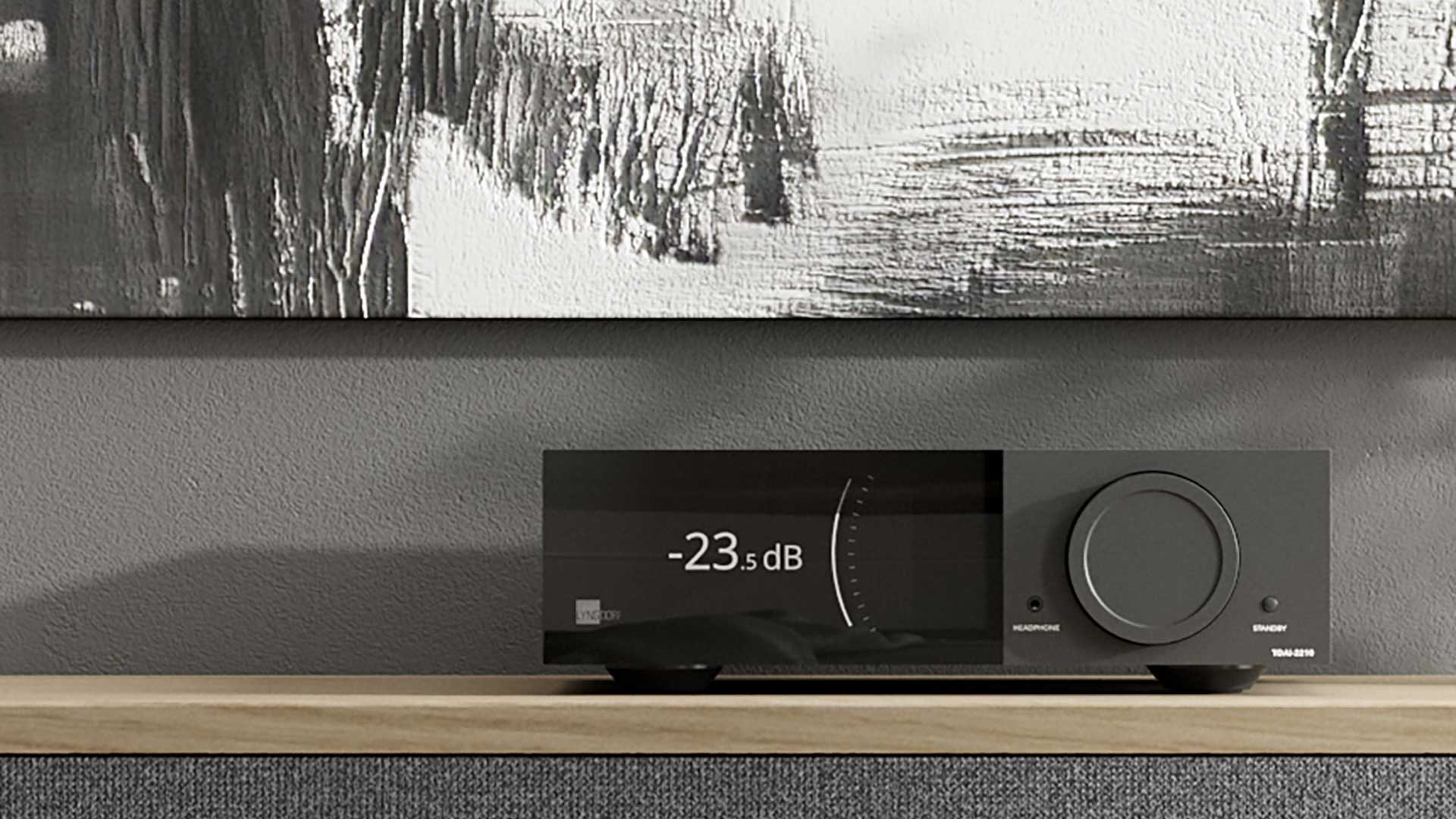
While on the subject of volume control, this is calibrated in one tenths of a decibel and is shown on the screen in home-theatre-like negative decibels, although it could (in theory) be advanced to +20dB. Spinning the knob allows you to fly through those 0.1dBs, but what about the remote? This also works well, once you learn how to use it. You don’t stab the volume control buttons unless you want the tiniest of change. You hold the button down for a second or more. A second makes a noticeable difference in the level, and thereafter it accelerates, so you can knock off ten decibels in about three seconds. This conveys a sense of being really well thought-out for practical use.
(Image credit: Lyngdorf)Listening sessions
Lyngdorf TDAI-2200 specifications
(Image credit: Lyngdorf)
Rated power: 2 x 10⁵ watts into 8 ohms, 2 x 210 watts into 4 ohms
Frequency response: ±0,5dB from 20–20,000Hz
Total harmonic distortion: 0.05% max from 20–20,000Hz, THD-N 1w/8ohm 0,04%, THD-N 1w/4ohm 0,04%
Analogue inputs: 4 x line level (RCA); 1 x moving magnet phono input (RCA); 1 x balanced XLR
Digital inputs: 2 x optical; 3 x coaxial; 1 x HDMI eARC; 1 x Ethernet; 1 x USB Type-A, 1 x USB Type-C, Wi-Fi
Outputs: 1 x stereo analogue (RCA), 1 x balanced stereo analogue (XLR), headphone (3.5mm), 1 x coaxial digital (RCA)
Digital signal support: PCM up to 32-bit, 192kHz
Dimensions (HWD): 10.2 x 32.5 x 30cm
Weight: 4.8kg
There isn’t much real estate on the back panel of this unit, but that doesn’t restrict the wealth of inputs, particularly because, as mentioned earlier, the Australian version of the TDAI-2210 comes as standard with extra analogue inputs. As a result, it meant I could use the unit’s own MM preamplifier with a Technica SL-1500C and ATVM95SH MM cart, as opposed to my regular setup of a Thorens TD1600 turntable with a Goldring Ethos MC cartridge and Moon 310LP phono preamp. I did use this on a few occasions, but ultimately the Lyngdorf’s MM input was more convenient.
Now vinyl is, obviously, about as analogue as things get. Yet this unit is very much digital. Which means that all the analogue inputs are converted to digital. What form of digital?
Happily, the front panel shows the answer when you have the spectrum display showing. This also shows the digital format, which for all the analogue inputs is PCM24, 96kHz. That is, the analogue to digital converter creates a high-definition digital version of the input to feed to the system. By using 24 bits of resolution, the system can provide quite a bit of headroom to the vinyl inputs – obviously, it wants to avoid hard digital clipping when fed with a hot input.
This provision means that unpredictable analogue inputs such as vinyl need to be turned up higher for the same playback level as any of the digital inputs. I found for the fairly high music levels I prefer, I usually set the volume to around -20dB for digital sources, and -10dB to -7dB for vinyl playback. A lower output cartridge would require an even higher level. The AT cart is pretty average on that front.
You can tweak the sound output of the Lyngdorf using its RoomPerfect EQ correction system, but for a fair comparison with my regular system, I initially chose to listen without this being applied.
Let’s start with a rare item: Capella Corelli’s ‘For ye Lovers and Masters of Musique’, on the Larrikin label. This collection of small ensemble baroque works was recorded magnificently in Canberra in 1979, and it contains the incredible Chaconne in g minor by John Blow, and as far as I’ve been able to determine this is the only recording, ever, of this piece. Want to enjoy it? You’ll need a piece of vinyl pressed in 1981.
The Blow piece is solo harpsichord. The other pieces include recorder, violin, basso continuo and such. The bite on the harpsichord was excellent, despite the A-D conversion, and the sound was delivered with a lovely sweetness and absolutely no sense of limitation in the plentiful transients. Indeed, the violin on the following Leclair sonata was also gorgeous. Even more so, with no tendency toward stridency in the violin. It was smooth as, well, silk.
The room acoustics were properly delivered, with perhaps a slightly reduced sense of the bass ambience that I’m used to.
But the bass was strong indeed, and powerful, and tight, on an album I picked up recently in the US. A live recording of Dave Grusin and the NY-LA Dream Band. This was released in 1982 before the CD appeared, and with naive enthusiasm for new tech, proclaims on the cover the use of a “Digital Master” – although the recording itself would have been analogue. It is a truly great sounding album, and through the Lyngdorf TDAI-2210 it retains that greatness. The timing is spot on, and the engaging bite of the bass guitar was as good as it gets.
What I particularly loved was the way the Lyngdorf unit supported my Dynaudio Contour 20i speakers in their immaculate presentation of Steve Gadd’s superb drumming. Every element of each tiny explosion of sound was delivered with proper intensity and control that spoke of a wonderful cooperation between amplifier and speaker. Danish amplifier and Danish speaker? Maybe there’s something in that.
What about digital? I played stacks of music from Tidal and Spotify. All worked perfectly well. I mostly use Tidal because, as I’ve found from testing, it really does provide a perfect copy of the original digital music. And now, so does Spotify (albeit without any proper high-resolution content). But I also spent a lot of time sending music from my network attached storage to the unit with the DLNA protocol (which also ensures perfect delivery).
As I write, I’m listening to Jethro Tull’s Thick as a Brick in two different stereo 96/24 versions: the original mix, and the 2012 Steve Wilson remix. I confess that I haven’t really compared them in the past, but using this system I did a bit of switching. And it was clear that the transparency of the Lyngdorf TDAI-2210 was first-class. There was a huge level difference between the two versions (the original was quieter), but even after adjusting for this there was a clear instability in EQ across the original and occasional confusion in some of the denser passages that was absent in the Wilson version. But in both the dynamics of the drumming provided a basal component that tied the entire works together.
Before exploring RoomPerfect, I wanted to pay close attention to some music with a modern recording sensibility, in which bass wasn’t limited in deference to the limitations of vinyl. So, back to Tidal and Billie Eilish’s ‘When We All Fall Asleep, Where Do We Go’ album, which is delivered on that platform at 44.1kHz, but a deeper 24 bits. That’s what the Tidal app says, and what the Lyndorf reports on its display.
The plentiful bass was delivered magnificently, with power and control. The Lyngdorf TDAI-2210 exercised masterful control over the Contour 20i speakers, making them do precisely what the music demanded. Those speakers aren’t the hardest in the world to drive, but neither are they the easiest – nominal four-ohm impedance and lowish (86dB, 2.83V, 1m) sensitivity. So I fired up the track Nature Boy from Primus’ album ‘Pork Soda’ on Tidal (192kHz, 24 bits!) and pushed it to an indicated -2dB. A normal loud listening level with my setup for streamed music is typically between -20dB and -15dB. At -2dB the music was thunderous but remained perfectly controlled, with a strong delivery of the kick drum, and other bits of the kit tightly delivered, Claypool’s bass strong and his nasal vocal delivery relatively smooth.
We don’t talk enough about high-fidelity systems going loud; I’m a strong believer that they ought to for maximum flexibility, and for occasional maximum enjoyment.
(Image credit: Lyngdorf)RoomPerfect
Now, how about the way Lyngdorf wants the unit to be used?
I had not accepted the RoomPerfect set-up option at first, but it was easy to find in the settings menu within the app. It talked me through the process, both in the app itself and on the front panel display.
Briefly, you assemble the microphone stand and place the microphone in its clip, then connect it to the dedicated XLR socket on the rear of the unit. The unit responds, telling you where to place the microphone (where your head would normally be while listening), and then it issues test signals, one speaker at a time. These are moderately loud but not unpleasant. Each cycle takes about a minute.
It insists on at least four: the head position and three more at random room positions, acquiring “Room Knowledge”. After this it gives you the option to test some more spots. I did just one more.
After that you can use a “Bypass” switch in the app to switch RoomPerfect on and off to assess whether you like it.
How much difference it makes will depend on your speakers, their placement, your sitting position and things like room treatments. For me it made little difference in mid and high frequency delivery, but it brought forward the mid to deep bass – say the 40 to 80 hertz frequency range. This was particularly clear on the Simple Minds album ‘New Gold Dream (81/82/83/84)’ (on vinyl). I can’t say I was missing these frequencies before applying RoomPerfect, but they added a nice body which may more accurately reflect what the record producers wanted. I assume that the calibration system was compensating for bands of destructive room reflections.
(Image credit: Lyngdorf)Verdict
The Lyngdorf TDAI-2210 is powerful, sounds great and is extremely versatile. If your budget might stretch into this area, you really should give it an audition; I’d be surprised if you were disappointed.