
The countdown is under way at Kennedy Space Center for the liftoff of Artemis II, which will send four astronauts around the moon and back in the first crewed lunar mission since 1972.
After a mission management team meeting on Monday, NASA Associate Administrator Amit Kshatriya said Artemis II is ready for launch on Wednesday.
Recommended Stories list of 4 itemsend of list
The weather is now the only potential constraint. The forecast indicates an 80 percent chance of favourable conditions with the primary concerns being cloud coverage and the potential for high winds, NASA noted.
When will Artemis II launch?
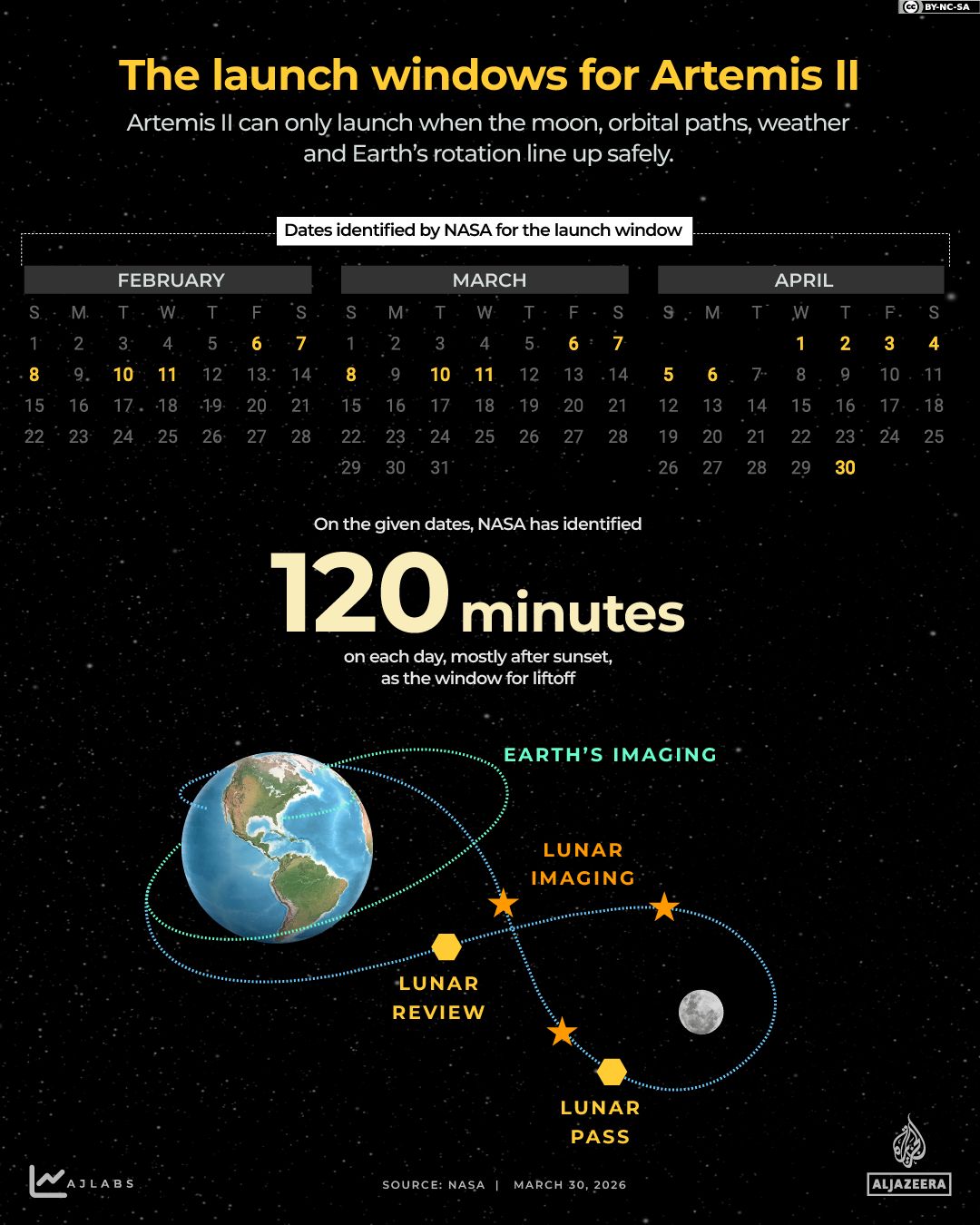
At 6:24pm (22:24 GMT) on Wednesday, a two-hour window will open for the Artemis II mission to lift off from the Kennedy Space Center in Florida.
The launch window will remain open until April 6 for two hours each day after sunset. The mission can launch only when the moon, orbital paths, weather and Earth’s rotation line up safely.
Artemis II has faced two major delays that pushed it from its original early 2026 launch window.
In early February, the first attempt was scrubbed after a liquid hydrogen leak was detected during a practice countdown.
A second launch attempt in early March was cancelled when engineers discovered a helium flow issue in the rocket’s upper stage.
How to watch the launch
NASA will livestream the launch on YouTube , which has shown Artemis II from its rollout at the vehicle assembly building to Launch Pad 39.
What is NASA’s Artemis programme?
The Artemis programme is NASA’s multidecade mission to return humans to the moon for the first time since 1972, establish a long-term base there and eventually enable future human missions to Mars.
The programme is currently divided into five missions: Artemis I, II, III, IV and V.
Artemis I was the inaugural uncrewed test flight, which launched on November 16, 2022, and lasted 25 days. It successfully placed the Orion spacecraft into Earth’s orbit and provided crucial data for Artemis II.
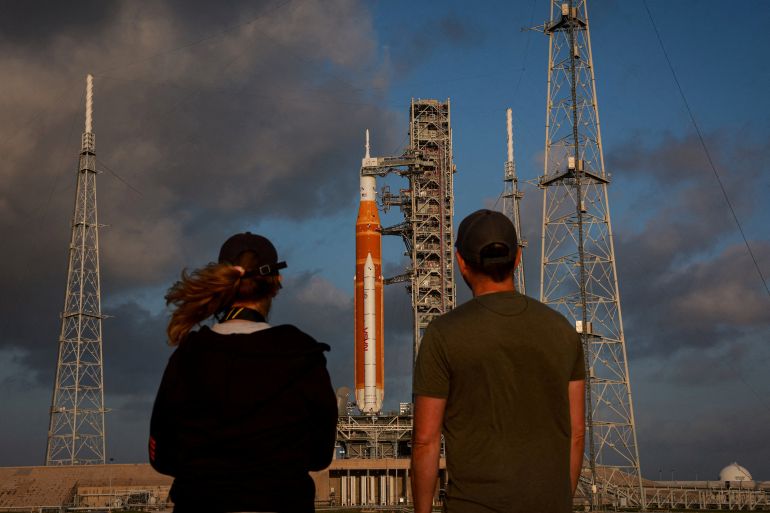 NASA’s next-generation moon rocket, the Space Launch System (SLS) rocket with the Orion crew capsule, on Pad 39B before the Artemis II mission launch at the Kennedy Space Center in Cape Canaveral, Florida, on March 29, 2026 [Brendan McDermid/Reuters]What is Artemis II?
Artemis II is the first human mission of the Artemis programme. While Artemis I was an uncrewed test mission that carried only mannequins and sensors, Artemis II will mark the first time since 1972 that astronauts will travel beyond low Earth orbit.
Will Artemis II land on the moon?
No. The four-person crew will not land on the moon but rather perform a lunar flyby, looping around the moon’s far side before returning to Earth.
What is the goal of the Artemis programme?
At its core, Artemis II is a systems validation mission. NASA will use the flight to test the Orion spacecraft’s life support systems, navigation, communication links and overall performance in deep space with a crew on board – conditions that cannot be fully replicated on Earth.
If successful, Artemis II will pave the way for Artemis III, a crewed low Earth orbit mission; then Artemis IV, which aims to land astronauts on the moon; and future missions that could establish a sustained human presence beyond Earth.
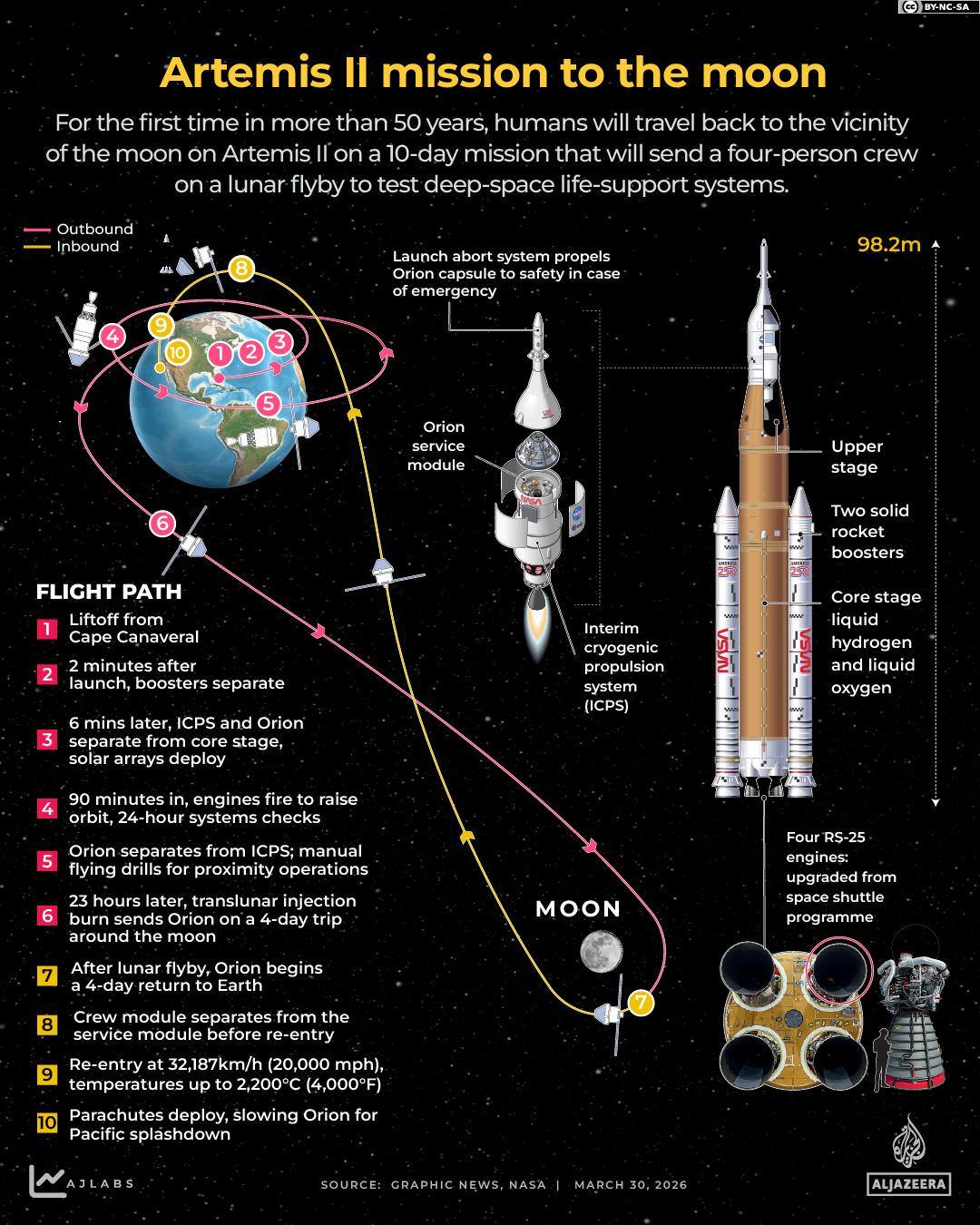
Here’s how the 10-day Artemis II journey is planned:
 (Al Jazeera)How is Artemis different from Apollo?
In Greek mythology, Artemis is the twin sister of Apollo and the goddess of the moon. The name symbolises the programme’s connection to the original Apollo lunar missions, which took place from 1961 to 1972.
The most notable of the Apollo missions was Apollo 11 when on July 20, 1969, Neil Armstrong and Buzz Aldrin became the first humans to walk on the lunar surface.
The last mission was Apollo 17 when Eugene Cernan and Harrison Schmitt left the lunar surface on December 14, 1972, becoming the last people to walk on the moon.
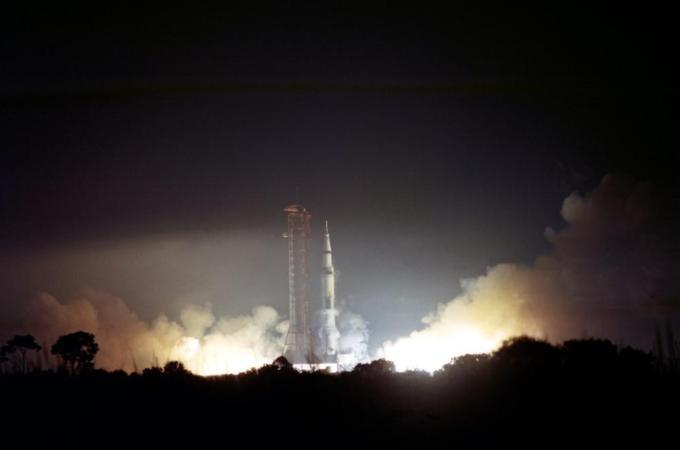 The Apollo 17 mission is launched from the Kennedy Space Center in Cape Canaveral, Florida, on December 7, 1972 [Handout/NASA]Who are the Artemis II astronauts?
The mission will carry four astronauts:
Reid Wiseman, 50, commander: The NASA veteran and former International Space Station commander is leading the Artemis II mission. A test pilot-turned-astronaut, he has leadership and deep spaceflight experience.
Victor Glover, 49, pilot: The US Navy aviator is the first Black astronaut assigned to a lunar mission and flew on SpaceX Crew-1.
Christina Koch, 47, mission specialist: The record holder for the longest single spaceflight by a woman at 328 days is a veteran of multiple spacewalks and has scientific and deep-space mission expertise.
Jeremy Hansen, 50, mission specialist: The first Canadian set to travel to the moon is a former fighter pilot and represents international collaboration in deep space exploration.
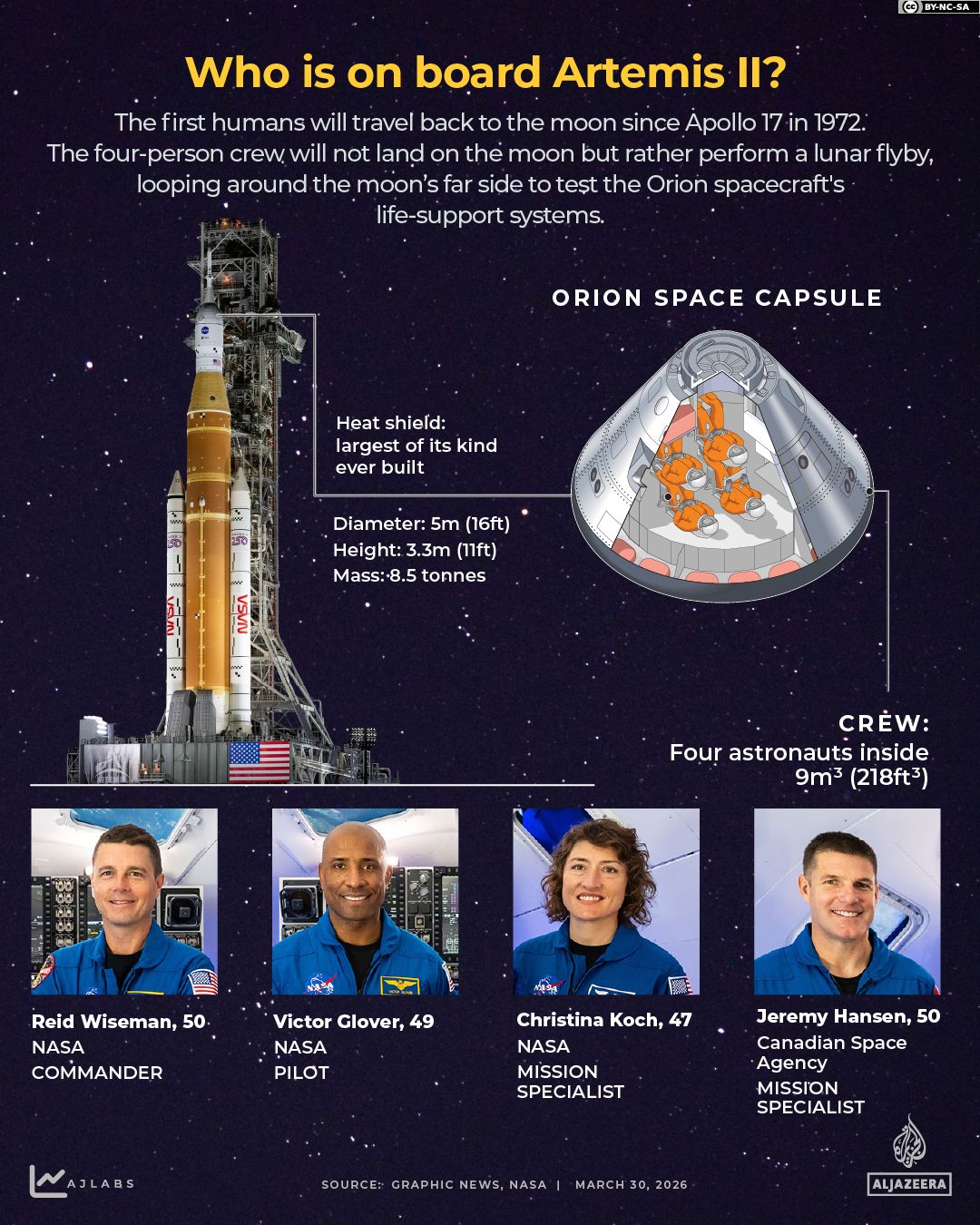 (Al Jazeera)What will the Artemis crew do during the mission?
During the flight, the four astronauts will evaluate the spacecraft, test their own responses to radiation and onboard fires, and perform a suit pressurisation test.
They will also carry out medical and scientific experiments and make detailed observations of the lunar surface during the flyby.
Why is NASA going back to the moon?
The mission reflects broader long-term goals. NASA plans to establish a sustained human presence on and around the moon, particularly near the lunar south pole, where water in the form of ice is believed to exist.
This is seen as a stepping stone towards future human missions to Mars. At the same time, Artemis is unfolding within a wider geopolitical context as the United States seeks to maintain leadership in space exploration amid growing competition, particularly from China.
When are the next Artemis missions?Artemis III – 2027
NASA recently overhauled the mission profile of Artemis III. The mission, scheduled for next year, will no longer land on the moon but rather send a crew into low Earth orbit, where it will test integrated operations between the Orion spacecraft and one or both commercial landers from SpaceX and Blue Origin.
Artemis IV – early 2028
The mission is to be the first crewed lunar landing since Apollo 17. NASA plans to send its crew into lunar orbit and two of its astronauts to the lunar south pole.
Artemis V – late 2028
With this mission, NASA plans a second crewed lunar landing and the start of a lunar base.