
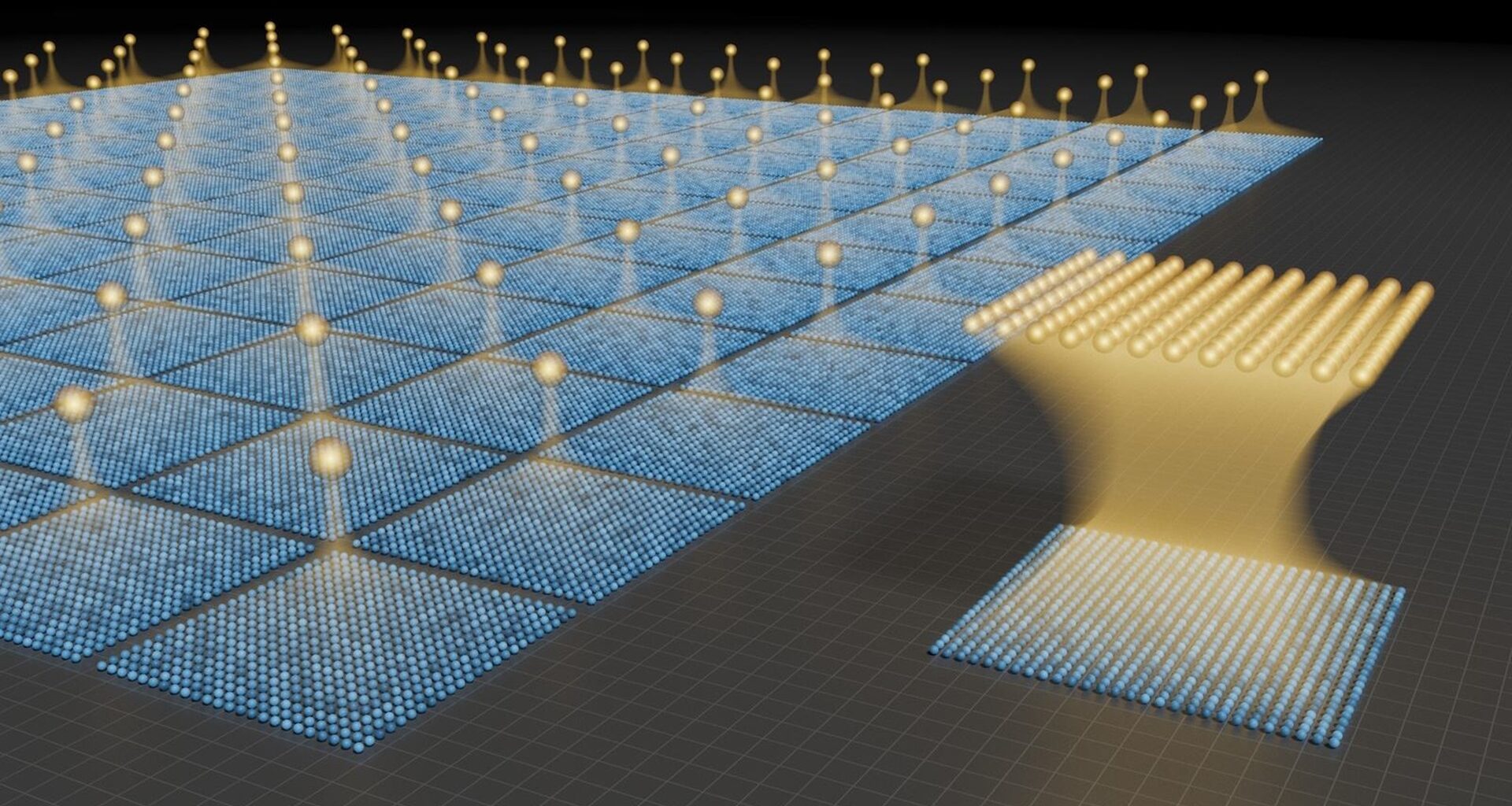
Scientists at California Institute of Technology and startup Oratomic have developed a method to drastically cut the number of qubits needed for fault-tolerant quantum computing, potentially accelerating the arrival of practical machines.
The team says a fully functional quantum computer could operate with as few as 10,000 to 20,000 qubits, far below the millions previously believed necessary.
The advance comes from a new quantum error-correction architecture that reduces the number of redundant qubits required to fix errors, one of the biggest challenges in building reliable quantum systems.
Quantum computers rely on qubits, which are highly sensitive and prone to errors. Existing methods often require about 1,000 physical qubits to create a single logical qubit, making large-scale systems difficult to build.
Fewer qubits, faster future
The researchers tackled this problem using neutral atom systems, where atoms act as qubits and are arranged using laser beams known as optical tweezers. Unlike other platforms, these atoms can be moved and connected across long distances.
“Unlike other quantum computing platforms, neutral atom qubits can be directly connected over large distances,” said Manuel Endres.
“Optical tweezers can shuttle one atom to the other end of the array and directly entangle it with another atom.”
This flexibility allows for high-rate error-correction codes, where each physical qubit can support multiple logical qubits. As a result, a single logical qubit could be built using as few as five physical qubits.
“It’s actually very surprising how well this works. It’s what we call ultra-efficient error correction,” Endres said.
The approach builds on rapid advances in neutral atom systems, including arrays with more than 6,000 qubits already demonstrated in laboratories.
The architecture also takes advantage of how neutral atom systems differ from other quantum platforms.
In conventional approaches such as surface codes, qubits are typically limited to interacting with their nearest neighbors, restricting how efficiently information can be processed.
In contrast, neutral atom arrays allow long-range connections between qubits, enabling what researchers call high-rate codes.
This means a single physical qubit can contribute to multiple logical qubits, significantly improving overall efficiency and reducing hardware demands.
Encryption risks move closer
The findings could have major implications for digital security. More efficient quantum computers would be capable of breaking widely used encryption methods such as RSA and elliptic curve cryptography much sooner than expected.
These systems could run Shor’s algorithm, developed by Peter Shor, which can factor large numbers exponentially faster than classical computers.
“For decades, qubit count has been viewed as the main obstacle to fault-tolerant quantum computing. I hope our work helps shift that perspective,” said people.
“I’ve been working on fault-tolerant quantum computing longer than some of my coauthors have been alive,” said John Preskill. “Now at last we’re getting close.”
While the results are theoretical, the researchers say the progress in neutral atom systems suggests practical quantum computers may arrive sooner than expected.
“Now it’s time to build the machines,” said Dolev Bluvstein.
The study was published in Nature.