
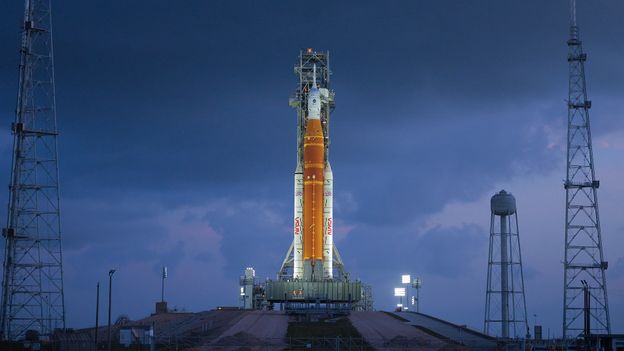
After several delays caused by technical glitches, a hydrogen leak and problems with helium flow in the rocket during prelaunch tests, Artemis II is set to launch in the evening of 1 April 2026 at the earliest. But the launch window could run from 1-6 April and then again on 30 April.
“Depending on which day we launch, it really changes what we’re going to see on the far side of the Moon,” explains Jeremy Hansen, a Canadian astronaut and one of two mission specialists on board Artemis II, making him the first Canadian to fly to the Moon. “In the early parts of this window, we are going to see an eclipse. So, we’ll see the Sun go behind the Moon.”
This will give the astronauts the opportunity to study and potentially discover new information about the dust lofting from the lunar surface and how it moves around the Moon. But they also hope to study parts of the Moon that have never been observed with human eyes.
“Orientale is this huge crater on the far side of the Moon,” says Hansen. “With telescopes you can see the edge of this crater, but no one has ever seen this full crater on the far side of the Moon.”
“It turns out there is 60% of the far side I think that has never been seen by human eyes,” adds Wiseman, the Artemis II commander. “When we see Orientale – human eyes have never seen that.”