
UK foreign secretary condemned “Iranian recklessness” for “hitting global economic security”
Travel cancellations begin in the UK after Ryanair boss warned of future fuel shortages
Iran will be hit ‘very hard’ in the coming weeks and sent ‘back to the Stone Ages’, says Trump
The price of oil rose more than 6% while stocks fell after Trump aimed his threat at Iran during an address on Wednesday
Iran denies Trump’s claims that new regime leader had asked for a ceasefire – as Iranian president says Iran will outlast US aggression
Estimated 15% of Lebanon’s population displaced by Israeli attacks and evacuation orders, humanitarian agencies say
French President Emmanuel Macron says opening Strait of Hormuz by military force is “unrealistic”
US embassy warns of imminent attacks in Baghdad
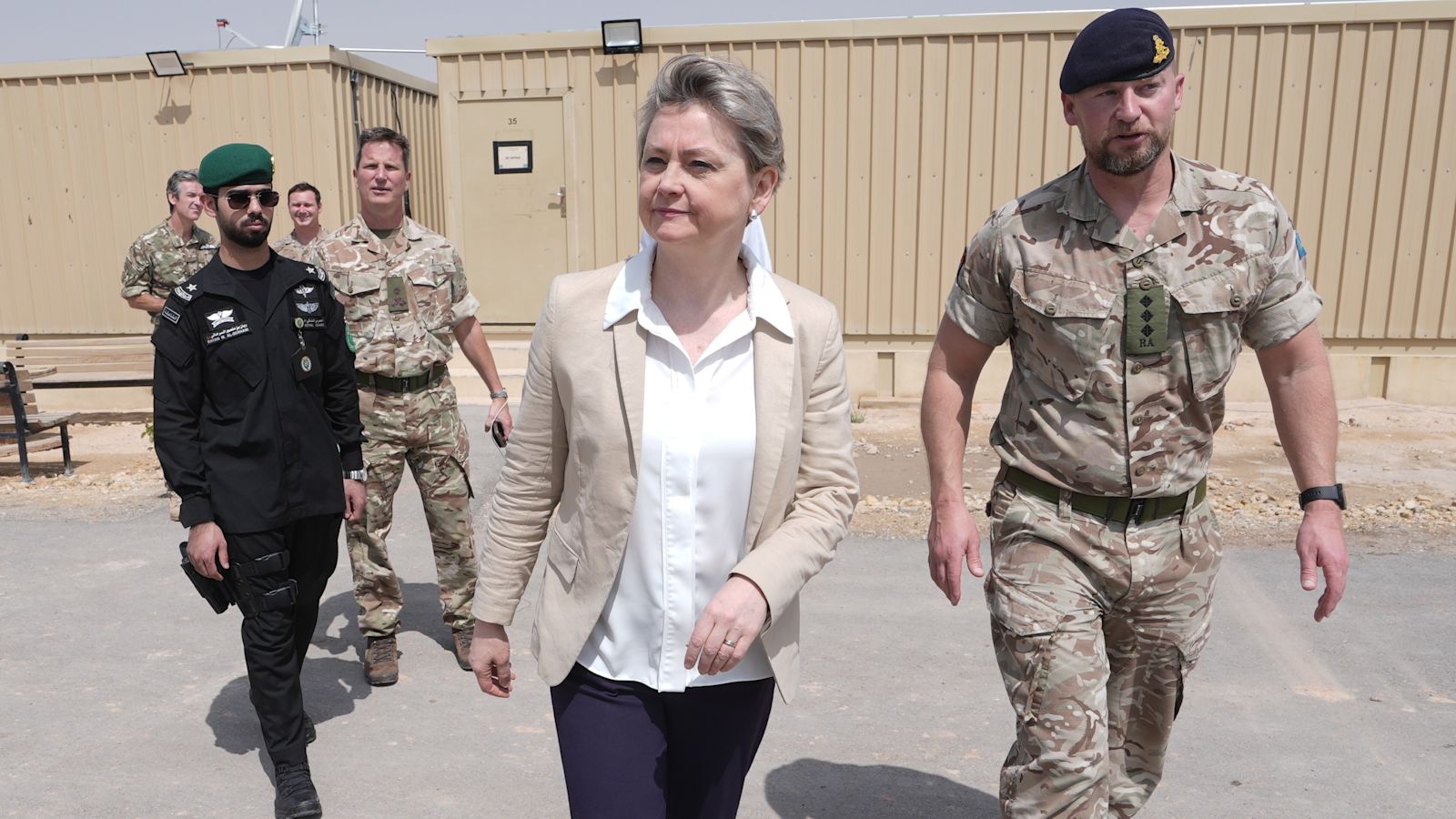
Foreign Secretary Yvette Cooper has condemned “Iranian recklessness” for “hitting global economic security” in talks with a coalition of countries aimed at reopening the vital Strait of Hormuz shipping lane for oil.
Britain is seeking to lead a diplomatic initiative, including countries such as France, Germany and some Gulf nations, to restore access to the maritime route being throttled by Iran in retaliation for the US-Israeli campaign against it.
It comes after Donald Trump said countries that rely on the strait should “build up some delayed courage” and “just grab it”, and suggested that after the Iran conflict was over, the critical waterway would “just open up naturally”.
During his first primetime address since the war began, the US president said his military would hit Iran “extremely hard over the next two to three weeks”.
“We’re going to bring them back to the Stone Ages, where they belong,” he added.
Trump is facing pressure at home as oil prices rise rose more than 6% as stocks fell after Trump’s address, with Brent crude oil – the international standard – jumping to $106.22 (£80.44) per barrel at one point.
Subscribe for free to our weekly newsletter for exclusive and original coverage from ITV News. Direct to your inbox every Friday morning.
Regional airlines cancelling flights in UK
Regional airline Skybus announced its flights between Cornwall Airport Newquay and London Gatwick would be abruptly cancelled starting from April 2, due to “circumstances beyond our control”.
Managing director Jonathan Hinkles blamed the “huge rise in the cost of fuel following the war in the Gulf” as well as a drop in passenger bookings.
“At a time of great economic uncertainty and steps being taken to conserve energy worldwide, it is neither environmentally nor economically sound for us to continue flying with vastly reduced passenger numbers,” Hinkles said.
The airline is the second to make this announcement after Guernsey airline Aurigny said last week it would be reducing flights between the island and London City airport between mid-April and early June.
The airline is also adding a temporary fuel adjustment surcharge of £2 on all bookings made from March 20 onwards.
“With no immediate end to the regional conflict in the Middle East in sight, aviation fuel prices have also increased considerably and show continued extreme daily fluctuations,” a spokesperson for Aurigny said.
Cooper chairing global Strait of Hormuz discussion
In a video call with counterparts and representatives from more than 40 countries on Thursday, the Foreign Secretary said: “In today’s meeting, we are focusing on the diplomatic and international planning measures, including collective mobilisation of our full range of diplomatic and economic tools and pressures, reassurance work with industry, insurers and energy markets, and also action to guarantee the safety of trapped ships and seafarers, and effective coordination that we need across the world to enable a safe and sustained opening of the strait.”
She hit out at Tehran after “over 25 attacks on vessels in the strait, and there are some 20,000 trapped seafarers on some 2,000 trapped ships”.
She said: “Iranian recklessness towards countries who were never involved in this conflict… is not just hitting mortgage rates and petrol prices and the cost of living here in the UK and in many different countries across the world, it is hitting our global economic security.”
Countries like the UK, Italy, France, Germany, Canada, Japan and the United Arab Emirates have all signed a statement demanding Iran stop its attempts to block the strait.
Meanwhile, during a visit to South Korea, French President Emmanuel Macron said France considers it “unrealistic” to reopen the Strait of Hormuz through a military operation – “a position that has at times been expressed by the United States”.
Macron told reporters a military operation “would take an infinite amount of time and would expose anyone passing through the strait to coastal threats from (Iran’s) Revolutionary Guard”.
The reopening of the Strait “can only be done in coordination with Iran,” through negotiations that would follow a potential ceasefire, Macron said.
Ongoing attacks
Meanwhile Iran’s armed forces said on Thursday the war would continue until the enemy’s “surrender and permanent regret”, according to regime’s semi-official Tasnim news agency.
Israel said it had intercepted Iranian missiles early on Thursday morning, while Iraq warned US citizens not to travel to the country and to leave if already there.
An estimated 15% of Lebanon’s population have been displaced by Israeli attacks and evacuation orders, humanitarian agencies have said, describing it as “unprecedented”.
Iran’s foreign ministry denied Trump’s claims that a ceasefire was requested Credit: AP
Trump’s primetime address sees oil prices spike
The US president made his first primetime address since the war began on Wednesday evening – and notably did not repeat his claims that negotiations with Iran are underway.
“America, as it has been for five years under my presidency, is winning, and now winning bigger than ever before,” the Trump said, adding that the military would “finish the job” and finish it “very fast”.
The president didn’t mention the possibility of sending US ground troops into Iran, and also did not reference Nato, the trans-Atlantic alliance he has railed against for not joining in efforts to reopen the Strait of Hormuz.
He threatened Iran’s electric generating plants if a deal between the countries is not made.
“We are going to hit (Iran) extremely hard over the next two to three weeks. We’re going to bring them back to the Stone Ages, where they belong,” Trump said.
The comments were later repeated by US Defence Secretary Pete Hegseth, who wrote on X: “Back to the Stone Age.”
Oil prices were sharply higher after Trump’s remarks, with Brent crude oil soaring above $106 (£80.28) a barrel.
Since the speech, Trump’s Stone Age comments have been heavily criticised, with the Council on American–Islamic Relations (CAIR) describing them as “anti-Muslim, racist, and dehumanising”.
Displaced boys who fled southern Lebanon make a bonfire next to their tent in Beirut Credit: AP
Iran denies talks of a ceasefire
A spokesperson for Iran’s armed forces said on Thursday the war will continue until the “enemy’s surrender and permanent regret” following Trump’s speech.
They also warned of further “destructive actions” against the US in a statement published via state news.
Before Trump’s address, Iran’s President Masoud Pezeshkian said Iran would endure US aggression, noting that the countries had a choice between “confrontation and engagement”.
“Today, the world stands at crossroads. Continuing along the path of confrontation is more costly and futile than ever before,” Pezeshkian wrote in an open letter on X.
“The choice between confrontation and engagement is both real and consequential; its outcome will shape the future for generations to come. Throughout its millennia of proud history, Iran has outlasted many aggressors.
“All that remains of them are tarnished names in history, while Iran endures – resilient, dignified, and proud.”
On Wednesday, Trump said in a post on Truth Social that “Iran’s new regime president” had asked the US for a ceasefire.
An Iranian foreign ministry spokesman denied the claim, calling Trump’s comments “false and baseless”.
Meanwhile Pakistan’s Ministry of Foreign Affairs said on Thursday that Islamabad is ready to host talks between the United States and Iran to help end the regional conflict, although no dates have been finalised.
In a news conference, ministry spokesperson Tahir Andrabi said it is up to Washington and Tehran to determine when they are ready to come to the negotiating table.
“Both Iran and the U.S. have expressed their confidence in Pakistan to facilitate these talks,” Andrabi said, adding that Pakistan remains optimistic about a peaceful settlement of the conflict.
US embassy warns of imminent attacks in Baghdad
The US Embassy in Baghdad warned citizens Thursday that Iran-linked militias in Iraq “may intend to conduct attacks in central Baghdad in the next 24-48 hours”.
The embassy says the attacks could target “US citizens, businesses, universities, diplomatic facilities, energy infrastructure, hotels, airports, and other locations perceived to be associated with the United States, as well as Iraqi institutions and civilian targets”.
It was not the first statement issued by the embassy urging U.S. citizens to leave Iraq, but the warning about potential attacks was unusually specific.
An American freelance journalist, Shelly Kittleson, was kidnapped in Baghdad on Tuesday and remains missing. No group has claimed responsibility, but U.S. officials have blamed the Iran-backed Kataib Hezbollah militia for her abduction.
Reporting History sees journalists join News At Ten anchor Tom Bradby to revisit their remarkable on-the-day reports of the defining events of the modern age. Listen to the episodes below…