
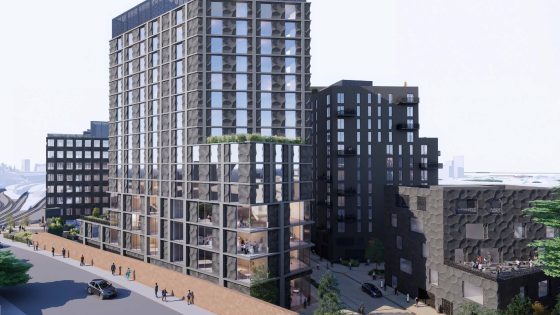
Bristol City Council planning committee voted unanimously in favour of the hybrid application yesterday (1 April) even though councillors were told by officers the scheme was ‘unviable to the tune of tens of millions of pounds’ as it currently stood.
The affordable housing element had already been cut entirely from the long-awaited scheme in an attempt to make the numbers stack up.
The practice’s Temple Island development has been seven years in the making. Site owner Legal & General (L&G) first unveiled initial concepts for site – a former rail depot near Bristol’s Temple Meads Station – in summer 2018. A deal was struck between the local authority and L&G to develop the plot three years later and a planning application was submitted in 2024.
The approved proposals include 520 homes across four residential buildings, two office buildings, retail space, flexible workspace and a new hotel. LDA Design is leading on landscaping, including a riverside walk.
The hybrid application seeks approval for an outline masterplan and detailed planning for the first phase: one office block plus ground-floor commercial uses, landscaping and associated infrastructure works.
The application was originally submitted with the plan to offer 20 per cent of the total housing for affordable rates. However, this commitment was removed over serious viability concerns noted by the planning committee as being in the ‘tens of millions of pounds’.
The council report said: ‘In the case of this application, the applicant submitted a viability report, which claimed that the scheme was unviable even when no affordable housing was included.’
Councillors ultimately backed the officer’s recommended plan to conduct subsequent viability reviews at later stages of the development, with a view to introducing affordable housing if and when it can be provided. The developer has said that it ‘remains committed to the delivery of affordable housing by other means’.
The committee noted that factors such as increased labour, power, and material costs, as well as the effect of post-Grenfell building safety regulation changes had put pressure on the viability of this scheme and ‘most sites in the city centre’.
Historic England had raised concerns over the impact of the proposed height and massing on St Mary Redcliffe church and the Grade I-listed Temple Meads station. However, no objection was made and the heritage organisation was ‘heavily involved’ in the pre-application process.
ZHA said in planning documents that the appearance of its Temple Island scheme takes its cues from Bristol’s industrial heritage, with ‘a very specific materiality and colour palette’ reflecting mud, pennant sandstone and galvanised corrugated steel.
Following the approval, an L&G spokesperson said: ‘This is a critical step towards unlocking a long vacant brownfield site and enabling the delivery of up to 520 homes, new offices, high-quality public spaces and a hotel beside Temple Meads station.
‘The scheme comes forward at a time when development viability across the city is under pressure and we welcome the local planning authority’s recognition of the substantial benefits Temple Island will deliver: supporting new jobs, enhancing the public realm, and contributing to the wider regeneration of Temple Quarter.’
Temple Island is part of the wider Temple Quarter regeneration masterplan, which includes 10,000 new homes and is led by Prior + Partners with a team including AHMM .
Weston Williamson + Partners (WW+P) previously won a contest to create the area’s development framework, focusing on required infrastructure, potential land uses and a set of guiding principles.
Work is currently ongoing to refurbish Temple Meads railway station under the wider masterplan, while construction is nearing completion on a new University of Bristol Enterprise Campus designed by Feilden Clegg Bradley Studios (FCBS).
Current site view