
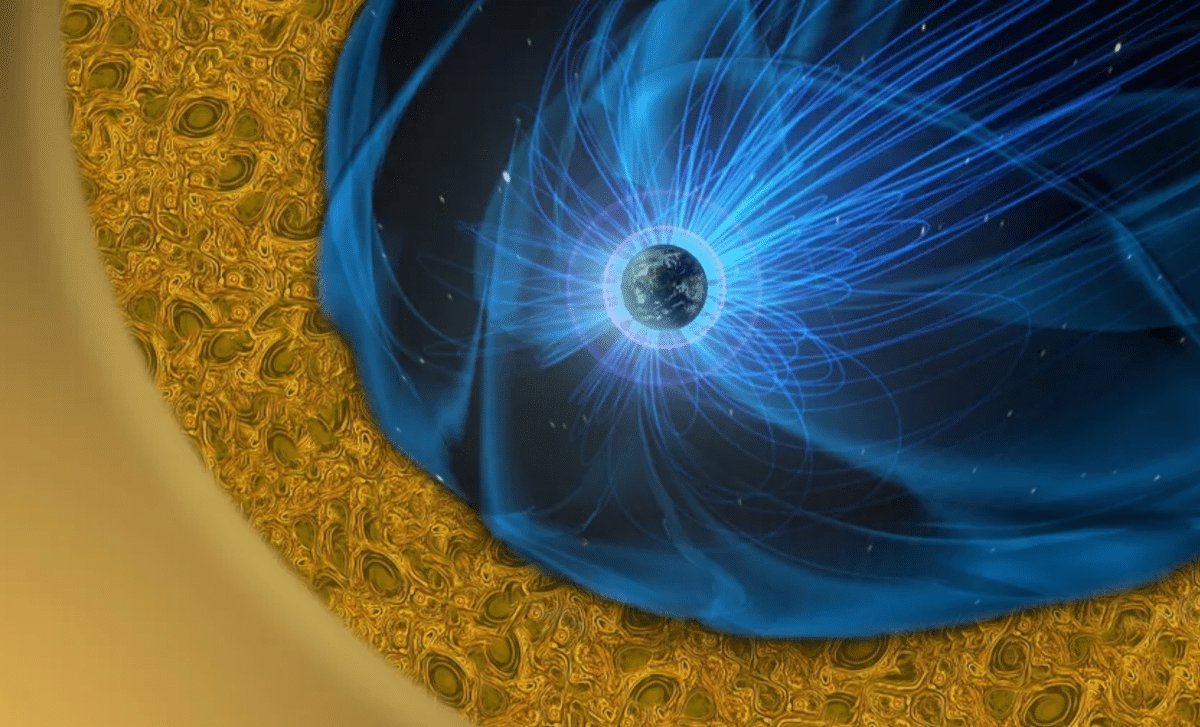
NASA’s Magnetospheric MultiScale (MMS) mission has uncovered a phenomenon previously unseen in space. Scientists have detected a turbulent plasma current in Earth’s magnetosheath, a region between the planet’s magnetosphere and the solar wind’s bow shock, that behaves like a dynamo, generating magnetic fields. This discovery, published in Nature Communications, promises to reshape our understanding of Earth’s space environment and its interactions with solar winds, with far-reaching implications for satellite systems, power grids, and global communications.
What Is the Magnetosheath and Why Does It Matter?
The magnetosheath is an often-overlooked yet crucial layer of space that sits between the Earth’s magnetosphere and the solar wind. While the magnetosphere serves as a protective shield against harmful solar and cosmic radiation, the magnetosheath is the turbulent region where solar winds interact with Earth’s magnetic field. Until now, much of the magnetosheath’s activity remained shrouded in mystery, but NASA’s MMS mission has changed that by providing high-resolution measurements of this dynamic space environment.
The findings of the MMS mission have revealed an unexpected process, turbulent plasma motion within the magnetosheath that leads to the creation of a dynamo, generating magnetic fields. This is significant because such activity was previously theoretical and never before observed with such clarity in space. The data collected from the mission sheds new light on the role that plasma plays in influencing Earth’s space weather and helps scientists better understand the underlying forces at play around the planet.
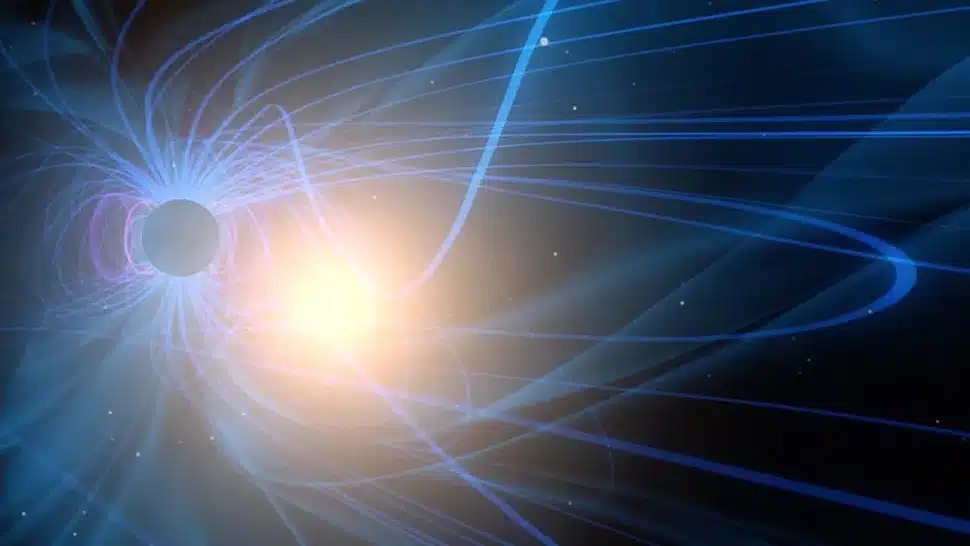 Credit: NASA/Goddard Space Flight Center
The Dynamo Effect: How Plasma Shapes Magnetic Fields
Plasma, the fourth state of matter, made up of charged particles, flows in complex patterns within the magnetosheath. These flows interact with the magnetic field, creating powerful forces that generate magnetic fields themselves. According to Dr. Zoltan Vörös, the lead author of the study from the Austrian Space Research Institute,
“We discovered regions where magnetic fields are amplified by plasma flows, and others where the fields weaken and fold back.”
This dynamo effect is significant because it confirms long-standing theoretical predictions. While these magnetic field behaviors were previously theorized by scientists, their direct observation in space is a first. The researchers note that this discovery could have profound implications for understanding the behavior of space weather, particularly during periods of heightened solar activity when the magnetosheath becomes especially dynamic.
Implications for Space Weather Forecasting and Technology
Space weather, the ever-changing conditions in space that influence technological systems on Earth, is a growing concern, especially as our dependence on satellites, communication systems, and power grids increases. Powerful solar winds and electromagnetic events can disrupt satellite operations, radio communications, and even electrical grids. The newfound understanding of the magnetosheath’s dynamics is therefore crucial for improving space weather forecasting.
“These features are consistent with long-standing theoretical predictions and numerical simulations, but have never before been observed so clearly in space,” said Dr. Vörös.
This insight could ultimately allow scientists to develop more accurate models of space weather, providing earlier warnings for potentially disruptive solar events and enhancing our ability to protect vulnerable infrastructure.
The study, published in Nature Communications, demonstrates the power of new technological advancements in space research. By using four spacecraft in a pyramid formation, the MMS mission has gathered the highest-resolution data ever recorded about this part of Earth’s space environment. With this new information, scientists can create 3D maps of the magnetosheath, enabling them to track the behavior of plasma flows and magnetic fields in unprecedented detail.