
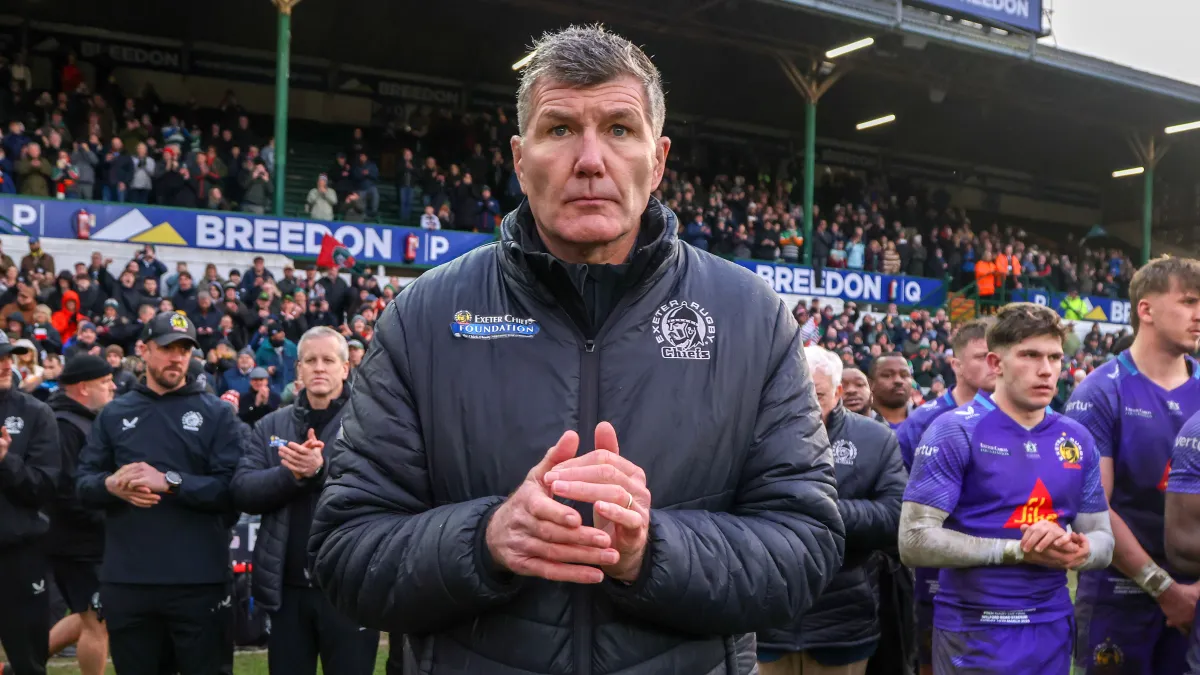
There were times last season when Rob Baxter feared his relationship with Exeter Chiefs, which has lasted more than half a lifetime as a player and coach, might be coming to an end. Exeter won just four league games in a campaign that Henry Slade described as “an embarrassment”. It was certainly a far cry from the glory days of the league and European double.
But Baxter, 55, found himself energised by the challenge of building something new at Sandy Park. Coaching changes were made. Impressive signings were brought into the club. And Baxter went old school in his methods, dismissing as “gobbledygook” the notion that modern-day players need to be mollycoddled and treated differently.
Exeter now sit fourth in the Gallagher Prem, well placed to make the play-offs, with a promising academy ready to reinforce the senior squad. Baxter’s reward is a new contract, which will extend his tenure as the longest-serving director of rugby in the league. Baxter has been in charge for 17 years, having spent 14 years as an Exeter player.
Second only to Baxter in coaching longevity, Mark McCall has also been trying to build a new team but the Saracens director of rugby has run out of energy for the job and will leave the club at the end of the season.
But Baxter has found the challenge revitalising because it made him reassess his approach to coaching — and the theory of how best to connect with Gen Z athletes.
“When people talk about coaching or management, they do sometimes underestimate the emotional toll,” Baxter said. “But in some ways last season recharged my batteries. I know that sounds odd. In a lot of ways it was the most emotionally taxing season. But it resets your clock in a lot of ways as well.
“Are we going to keep going down this spiral or are we going to stop? What are the things we really need to buy into. One thing that reaffirmed itself to me positively was that many of the things we had done previously would still work now.
 Exeter finished second from bottom in the Prem last seasonGetty
“Rob Hunter and Ali Hepher [the assistant coaches let go by Exeter] were very, very good coaches. Great coaches. They coached us to winning finals and being in multiple finals. We all probably over-adapted. Over a ten-year period, we probably all adapted away from some of the core fundamentals we put into the team every pre-season, every training session.
“You are trying to adapt. You are trying to move. You are trying to learn to work with new players. That thing we all get fed as coaches, that there is a new way you talk to younger players. Actually, a lot of what I did last season reaffirmed that some of that is gobbledygook.
“A professional rugby player is still a professional rugby player. You still have to be fit. You still have to be strong. You still have to be tough. You still have to be skilful.
“How do you get those? You don’t get them by not talking about them and not practising them, or moving away from them and dressing them up in teenage speak or whatever. You get on with it. You get it done.
 Exeter have responded to Baxter’s return to a firmer approach and are on track to secure a play-off placeGetty
“That is what has reignited my enthusiasm. You can change and adapt and mould and sometimes the game changes. But do humans change all that much really?
“Let’s talk honestly and openly about where we are and what we accept and what we don’t. Let’s get that set in stone right from the start. That can enthuse you as well if you look at them in the right way.”
Baxter has often been linked with England. Steve Borthwick, the head coach, is under pressure to improve during the summer tour after England’s worst Six Nations campaign. Other Test jobs will come available after the World Cup.
Was agreeing this new deal a sign of Baxter’s commitment to the club game, or Exeter insuring themselves should they receive an approach? Both, although Baxter is more confident about the England situation than many.
“I think England are more stable than many people think. When you know how many things can go wrong that will add up and hurt you and lead to a poor season, you realise that England probably had multiple things going on in the background,” he said. “I don’t think there was one major issue that England had because you saw by some of their performances, when things aligned, when a few things went well, the performances were still good. There is always a bigger picture.
“I think the England situation is a bit more stable than people probably give it credit for. I’m very aware of that. And I think our position here at the club is very similar, far more stable than people really give it credit for.
“If something turns around and England suddenly throw everything at me and say, ‘You’re the guy for the England job’, I’ve always been in a position where I could discuss that with Tony Rowe.
“I’ve never looked at it as shutting the door on England or opening the door for England. So, my position hasn’t changed. I’m a club coach now. I’m enjoying what I’m doing. I’ll do it to the best of my ability for however long the club want me to do it.”