
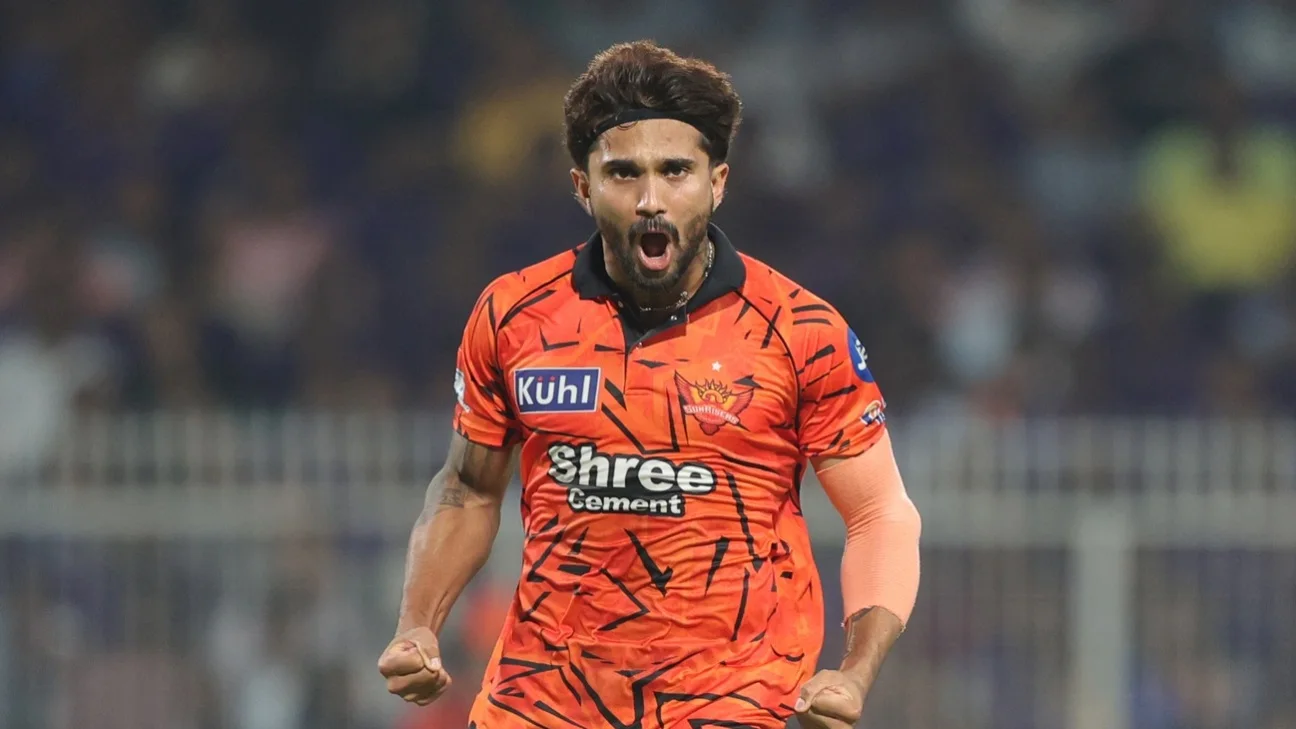
Bruce Lee lived by one philosophy: “be water.” You see, there’s nothing in the world as flexible as water. It adapts to the shape of its container. When it finds an obstacle, it quietly finds a path around it. And because water keeps moving, it is never stagnant.
Sunrisers Hyderabad (SRH) might have taken a leaf out of that on Friday from a bowling perspective, even if they moved from one batting-friendly venue – Bengaluru – on the opening night to another in Kolkata for their second game. That flexibility did wonders as Kolkata Knight Riders (KKR) were bowled out in just 16 overs and SRH secured their first win of the season.It all started when left-arm wristspinner Shivang Kumar, his art a rare commodity in the game in general and in the IPL in particular, was given a debut in the bat-first XI, leaving both Harshal Patel and Eshan Malinga on the impact bench. On paper, Shivang’s figures of none for 41 don’t stand out, but Shivang conceded just two more runs than Sunil Narine and fared significantly better than Varun Chakravarthy, who went for 31 in two overs. Daniel Vettori had said on the eve of the game that some days demand a different lens – that even 10 or 11 an over could be acceptable. Shivang might have done what was asked of him.It also allowed SRH to use more overs of spin, specifically left-arm orthodox spin, in the powerplay against a right-hand-heavy top order. Finn Allen, like fellow opener Ajinkya Rahane, prefers pace. So do middle-order batters Angkrish Raghuvanshi, Cameron Green and Rinku Singh. After Allen took 24 off David Payne in the first over, SRH pivoted immediately and Harsh Dubey came on for the second.
The adjustment paid off. To a length ball turning away, Allen toe-ended a return catch and fell for 28 at a strike rate of 400. Against RCB, Dubey had waited until the sixth over; here, he operated in the second and fourth, and was done. His job was simple: disrupt, not dominate. Rahane and Raghuvanshi managed just one boundary off him with the field up.
The intention was the same when Ishan Kishan turned to Abhishek Sharma in the third over for more left-arm orthodox spin. That he missed his lengths and was hit for two sixes by Raghuvanshi after bowling two slot balls is a conversation for another day, but the willingness to make such wholesale changes stood out, especially on a surface that hadn’t behaved very differently from the one in Bengaluru. Both were against explosive batting line-ups, but unlike the RCB game where they looked helpless after a point, SRH had more ideas and were more proactive.
Harsh Dubey got rid of the dangerous Finn Allen•BCCI
Eventually, Malinga was the impact player SRH chose, leaving Harshal consigned to the bench. While Harshal has a deadly slower ball and a variety of variations, Malinga can crank up the pace while also possessing a useful slower one. The gap between his fastest and slowest deliveries gives him a distinct edge, and he showed that in the sixth over, conceding no boundaries off his first five balls.
Off the last delivery of the powerplay, Malinga also effected a run-out by stopping the ball with his foot in his follow through before whipping the bails off to dismiss Cameron Green. Back again in the 15th over, he used pace-off deliveries to send both Narine and Ramandeep Singh packing to all but end KKR’s game.
Jaydev Unadkat played his part too, using slower balls early to deny Rahane fluency. Rahane, usually dangerous in that phase, mistimed a pull to fall cheaply. Unadkat later cleaned up the tail to finish with three wickets. Payne adjusted in his second over too, turning to changes of pace to tie down Raghuvanshi and Rinku Singh in the tenth.Nitish Kumar Reddy, who had opened the bowling against RCB, bowled the 12th and 14th overs this time and largely relied on cutters. In his first ten balls, he conceded just five runs and dismissed Anukul Roy, edging to the keeper, and Rinku off a slower ball.
Speaking after the game, Reddy explained SRH’s approach. “Because of the wicket, we wanted to try [a different plan compared to the previous game] because the KKR seamers leaked a little bit of runs in the opening six overs [SRH were 84 for 1]. So why not spinners [early on],” Reddy said. “The wicket was two-paced, and we thought if it gripped for the spinners early on, it will go well. And Harsh got the wicket of Finn Allen.
“You have to respect the conditions and you have to change the plans according to the conditions. That’s what Ishan has done. You know Ishan has been brilliant with captaincy, so it’s not like you can take him easy. He’s got good thoughts in his head.
“When I batted, I honestly thought the wicket is a bit two-paced because when bowlers try to bowl slow bouncers, sometimes it’s sticking and sometimes it’s rushing to the batters. So when I got the ball, I thought ‘why not give it a try’ and that’s what I actually did. I got Rinku’s wicket when it rushed onto his bat and that’s when I got the edge. The slower one is one of my strengths and I utilised that one.”
It ended up being the first total successfully defended in IPL 2026, and that too on a surface expected to favour batting. The difference on the night was how SRH read what was in front of them, adjusted in real time, and stayed one step ahead. They kept changing shape.