
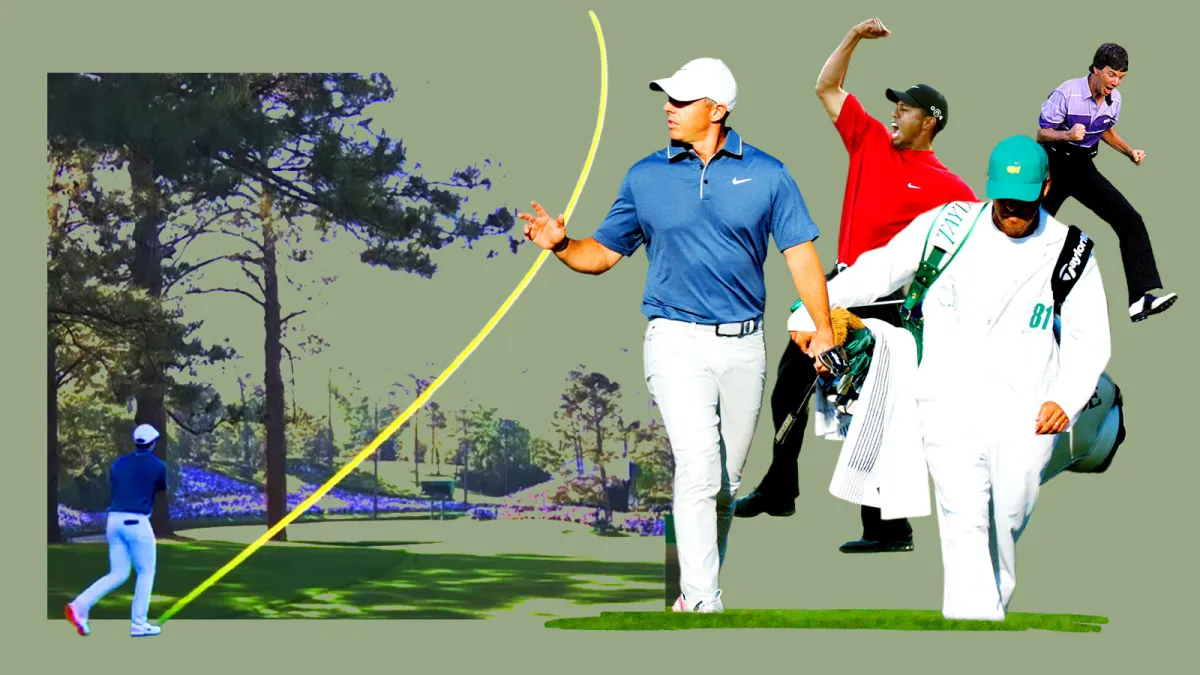
In the new Amazon Prime documentary Rory McIlroy: The Masters Wait, the tension builds steadily for an hour up to the bit you are kind of waiting for. That’s in the final round of last year’s Masters when McIlroy has just lost the lead and he steps on to the 15th. That’s when he plays that shot.
That shot is McIlroy’s second to the green. When he strikes it, in the documentary, the immediate reaction is from Jim Nantz, the CBS doyen, who purrs: “Shot of a lifetime.” The documentary then moves to an interview with Jack Nicklaus, who describes it as “one of the most fantastic shots I’ve ever seen”, and we then go to a reflective interview with McIlroy himself, who says: “I don’t know if I’ll ever hit a better golf shot under that amount of pressure in my career.”
Which makes you wonder: was that the greatest shot ever played at Augusta?
A key gauge for an answer here is another comment from Nicklaus: “I don’t think many people would have tried it.”
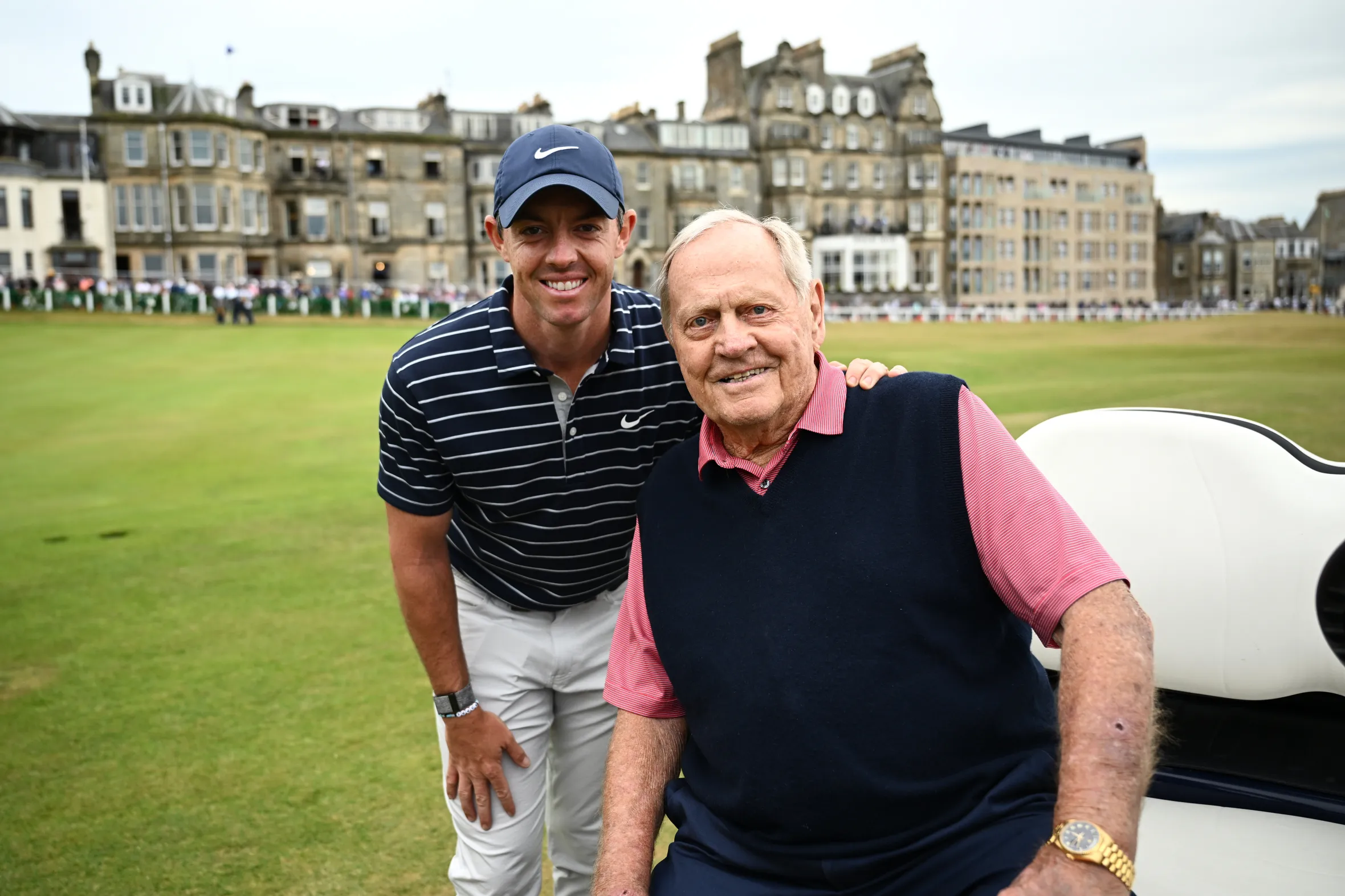 Such was the daring of McIlroy’s shot that Nicklaus believes few others would even have attempted itStuart Franklin/R&A/R&A via Getty Images
Indeed, the sheer audacity of the shot is as astonishing as its technical execution. Rewind back into the excruciating tension in the late afternoon of that final Masters round and you find, at that point, McIlroy’s life seemingly unravelling. In the space of two holes, he had just sabotaged the four-shot lead that he had taken up the 13th fairway and he was now a shot behind Justin Rose.
That sense of “wheels coming off” was exacerbated by his drive on 15, which drew slightly left, meaning there were three pines blocking a shot into the green. Yet no assessment of his position on that fairway can be made in isolation of where he was in his career: this was his 17th attempt at the Masters, it was the only major that still eluded him, he had spent a decade returning here trying to become the sixth player to complete the grand slam.
McIlroy took out an eight-iron and switched to a seven. There were 208 yards to the pin. When he stood over the ball, the general expectation was that he would punch it out and lay up short of the water that defends the green. On commentary, the best option suggested was that he draw it round the trees into the right-side bunker.
Loud gasps then followed his swing, which announced that he was doing none of the above — instead he had opted for what no one had even considered: he was going for the green. That meant setting it out 30 yards right and playing a controlled draw back in. “I knew it as soon as I’d hit it,” McIlroy said. The ball pitched on the edge of the green and rolled on to six feet.
Shot of a lifetime.
Best shot ever at Augusta? Not literally, at least not literally even McIlroy’s best. A month ago he was asked about it and said that he’d just returned from Augusta where he’d played a practice round with his father. When he got to the 15th, for fun, he recreated the same shot and hit it even better.
Just for background, he hit that with a different seven-iron. The actual club now hangs on display in the Champions Locker Room.
Also, in his post-victory press conference at Augusta last year, he was asked which was his best shot of the round and his answer was his 24-yard pitch at the 3rd.
As an assessor of technique, it’s probably reasonable to allow McIlroy to be his own judge here. And that shot also came at a crucial time.
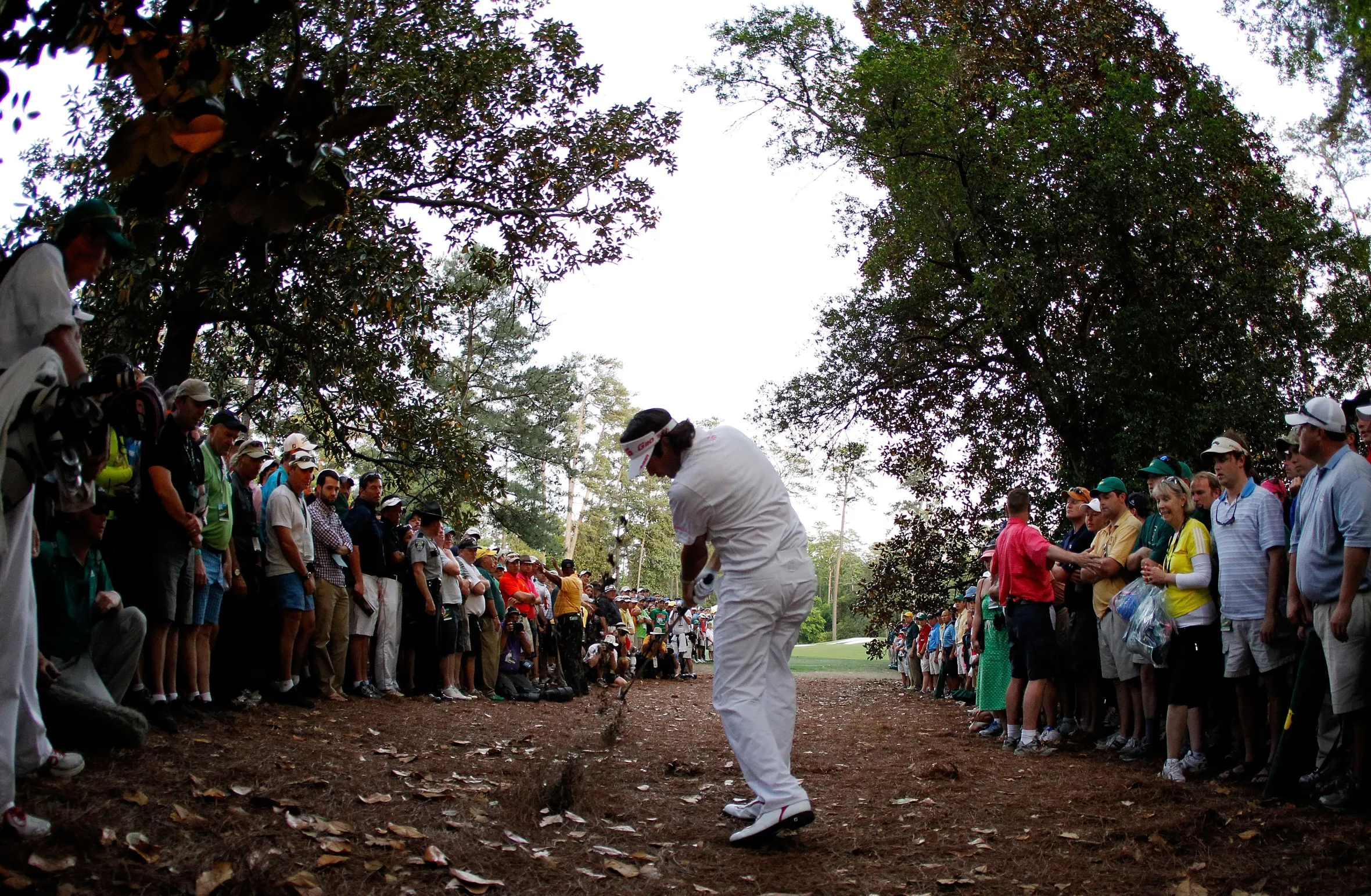 Watson’s remarkable shot on the 10th in the 2012 play-off helped to secure the American the first of two Masters titlesStreeter Lecka/Getty Images
Yet I’d say that any contender for “best shot ever” has to be in the back nine of the final round and the later they come and the greater the pressure, the better they are. The last hole in one at Augusta was 2022, Stewart Cink at the 16th in the second round, but it was already inevitable that he was missing the cut, so that’s just a fun shot, it’s not do or die.
I asked some experts: technically, how hard was McIlroy’s second at 15?
“There’s probably half a dozen players in the world that have got that shot,” said Pete Cowen, who has coached many of the greats in the game, including McIlroy himself.
Ken Brown, one of the great TV analysts, put it a different way. He said that if you gave other top pros 200 balls to hit that shot, only some would get it on the green. McIlroy was one from one.
What separates him, they explained, is his ball speed and thus the height he can give the ball, thus limiting the roll. A draw shot is normally lower and one that has to move 30 yards would be spinning hard, so they would run on. On the 15th, that’s a disaster.
Mike Walker, another coach, best known for his work with Matt Fitzpatrick, had another view of this. He recalled the driveable par-four 5th at the 2023 Ryder Cup and the Friday fourballs when he watched Fitzpatrick, Collin Morikawa and Xander Schauffele all go through the green before McIlroy landed one in, seemingly from orbit, and stopped it three feet from the pin.
He says: “I remember thinking at the time, ‘There’s probably a handful of players on the planet, if that, that could have hit that shot.’ That’s the first thing that cropped into my head when I saw it [his second on 15].”
The danger in the shot contributes to its greatness too. The 15th is a narrow green with water front and water back, so this was high tariff, the margin for error minuscule.
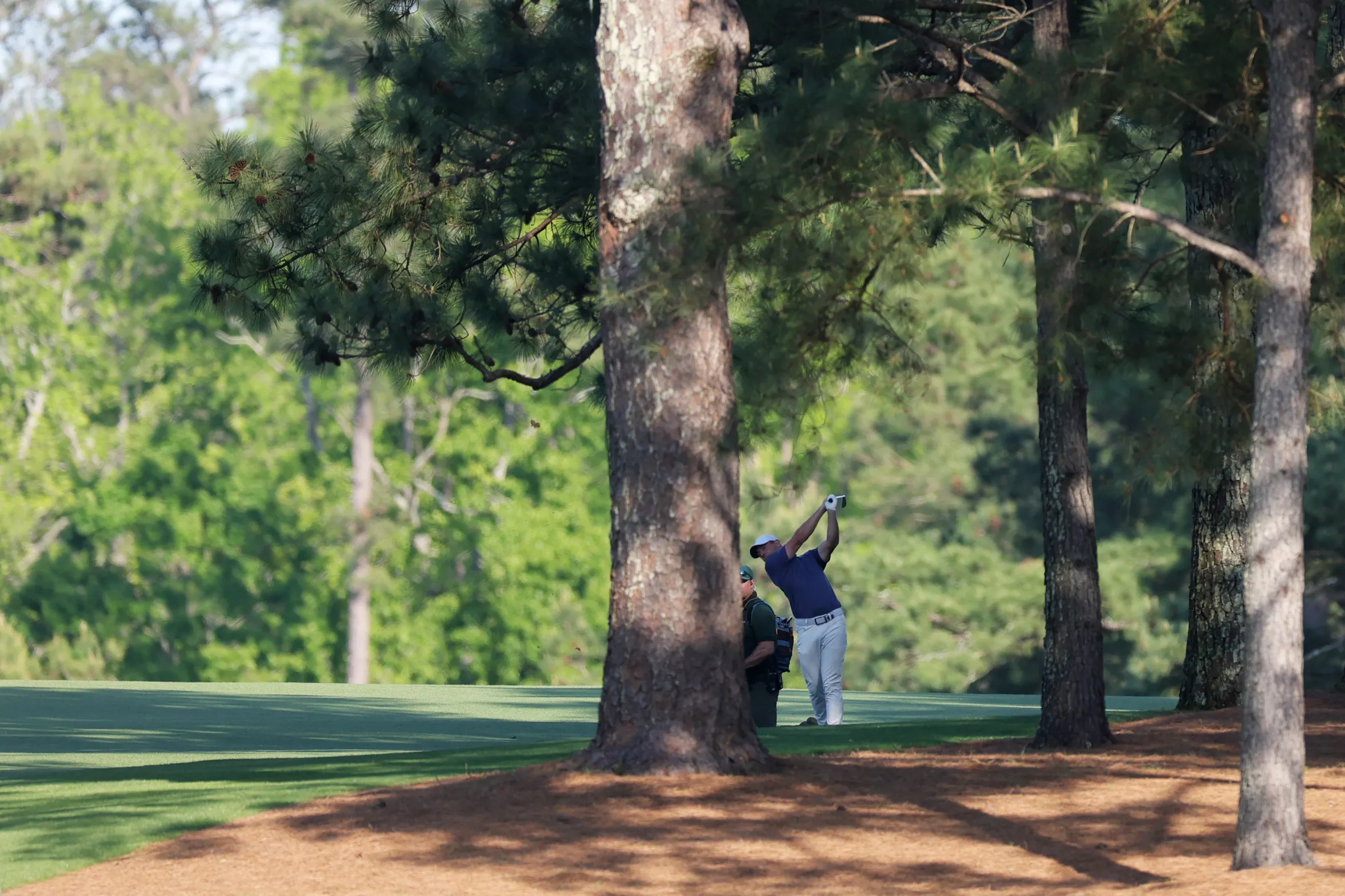 McIlroy says he recreated the shot at the 15th earlier this year — and hit it even betterAndrew Redington/Getty Images
“You get it wrong,” Brown says, “you ain’t going to win the Masters.”
“He’d already screwed up on the previous par-five,” says Paul McGinley, former Ryder Cup captain and now a leading broadcaster. “You make a mistake like that, your head is reeling. You’ve got the grand slam in your hand. It was the bravery of it that makes it so great.”
Greatest shot ever at Augusta? Well, there’s quite a pantheon, isn’t there?
Most comparable is Bubba Watson’s decisive shot on the 10th in the 2012 play-off: also behind trees, hooking it further (40 yards) but from closer (155 yards) so with a more lofted club.
A year after it Links Magazine asked the same question — best shot ever at Augusta? — and scored the contenders by three categories: difficulty, derring-do and decisiveness. In that respect, McIlroy beats Watson on derring-do: McIlroy didn’t have to take on the shot, Watson was forced into it. On decisiveness Watson wins, because that single shot killed off the play-off. On difficulty McIlroy’s was longer, with a less lofted club, but Watson’s moved a lot further, so maybe that’s a draw.
On decisiveness nothing beats Larry Mize in 1987, whose bump-and-run from 140 feet finished the play-off stone dead.
The other contenders are numerous: Sandy Lyle’s seven-iron from the fairway bunker which set up his victory in 1988; Jack Nicklaus in 1975, a one-iron on 15, 246 yards to ten feet; Nick Faldo in 1996, his foot on Greg Norman’s throat, killed him off with his second to the green on 13. Somehow that didn’t make the Links top ten for derring-do. “The ball was six inches above his feet,” Brown says. “Anybody who’s tried to play that shot knows there’s no margin of error.”
None of these, however, quite replicate the emotion and the drama of McIlroy last year: the long, elusive grand slam, the spectre of another opportunity being self-detonated. If there was a category for “career on the line”, no one beats McIlroy.
Similar here is Gene Sarazen, also on the 15th, in 1935, holing a four-wood from 230 yards for an albatross. Like McIlroy, that was the Masters that completed his grand slam, yet that was only the second year of the Masters so it wasn’t as if the grand slam had been his holy grail. Was the grand slam even a thing back then?
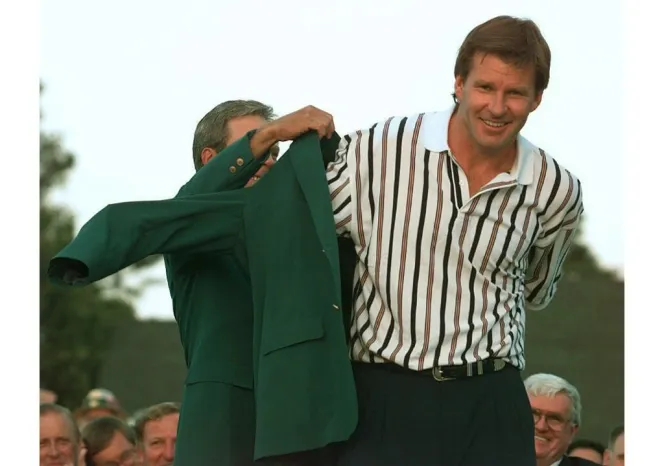 Faldo’s second shot on 13 was key to his path to the Green Jacket in 1996Jeff HAYNES/AFP
Links Magazine’s formula made Sarazen’s the greatest shot in Masters history. It ranked top for both derring-do and difficulty.
But back to the experts. Cowen goes for Tiger Woods’s chip in on 16 in 2005. “Probably half a dozen players could hit the one that Rory hit,” he says, “but not under that sort of pressure, so maybe two or three. But with Woods, I would say probably only Woods could hit that shot.”
Brown goes back to his 200-ball assessment. “From where Tiger was,” he says, “even a top pro, you could give them 200 balls and they might not chip one in.”
Indeed, this is clearly a subjective thing, but for greatest shots, it probably needs to go in. After the glory of his second shot on 15, McIlroy didn’t even sink the following eagle putt.
Here, then, are the top five shots in Augusta history:
Tiger Woods chip on 16, 2005
Gene Sarazen’s second on 15, 1935
Larry Mize to win in 1987
Rory McIlroy’s “shot of a lifetime”, 2025
Bubba Watson’s “hook from the woods”, 2012