
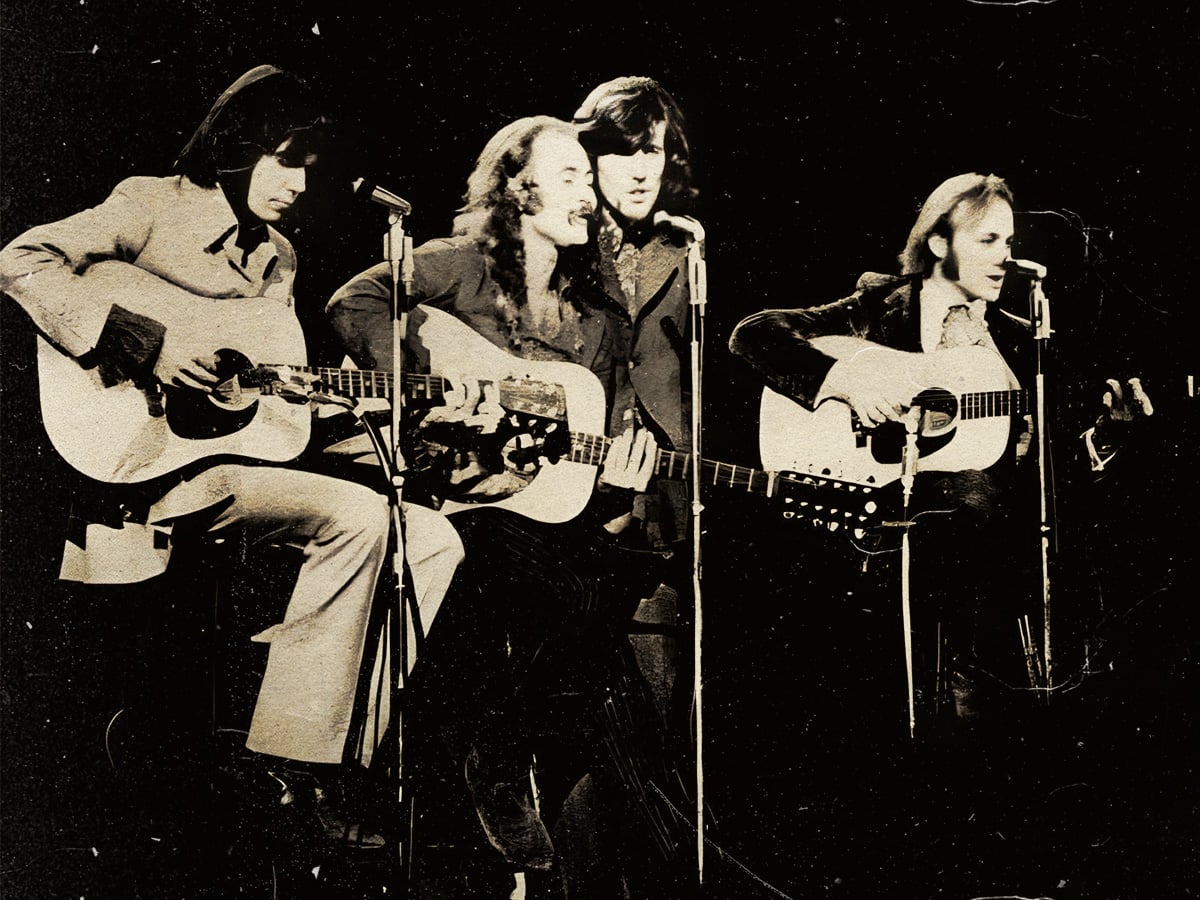
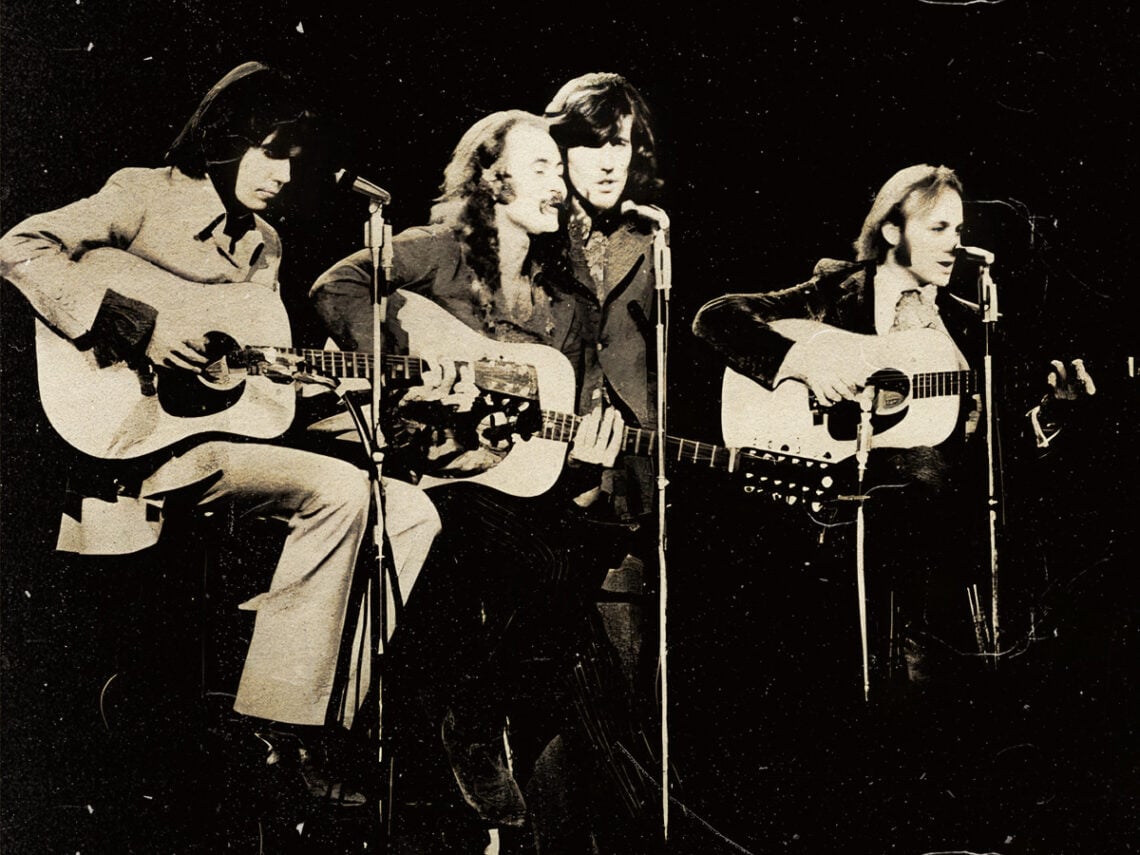
(Credits: Far Out / CMA-Creative Management Associates / Atlantic Records)
Fri 3 April 2026 20:15, UK
Musical chemistry doesn’t mean anything. Singing or performing together might look like fun and can make performers seem naturally connected, but time and time again, musical history has proved the opposite.
Sometimes even the fiercest of enemies can create the prettiest of songs, and Crosby, Stills, Nash and Young are a great example of that.
This idea is especially true when it comes to supergroups. You might expect new bands to form from existing friendship groups, and that is mostly what happened with The Traveling Wilburys, as the powerful unit came together largely through hanging out. But for the 1960s and ‘70s band of top-class cast-offs, Crosby, Stills, Nash and Young were mostly defined by fallouts.
It was doomed from the start, really. Considering the bands the members came from, the founding father, David Crosby, had the upper hand. His old group, The Byrds, had been huge, so there was clearly an element of Crosby assuming he would be the leader. That meant that when other members spoke up, especially when Neil Young got involved and tried to shape their sound, Crosby didn’t like it much.
There were other issues in the mix, too. There was the classic problem of drugs and alcohol, as the members’ taste for illicit substances only intensified the infighting and made Crosby a particularly difficult creative partner as he plunged deeper into getting high. Romance also caused problems. Crosby met Joni Mitchell first, but by the end of the band, she had either been close with or involved with several of them, naturally creating tension.
But overwhelmingly, there were musical teething problems. It gets tricky here as the band’s musical brawls were both what made them great and what tore them apart. Uniquely, though, part of how they protected that greatness was by keeping their distance a fair amount. Despite being a band, a good amount of their songs weren’t recorded with everyone in the room. Instead, on Déjà Vu, especially, they only came together a handful of times.
“The band sessions on that record were ‘Helpless,’ ‘Woodstock’ and ‘Almost Cut My Hair’,” Young explained to Rolling Stone. Out of the album’s ten tracks, only those three were made with all four of them in the studio together. “That was Crosby, Stills, Nash & Young. All the other ones were combinations, records that were more done by one person using the other people,” he explained.
Part of that does just come down to the nature of a supergroup. These sounds were generally written beforehand, stored in the back pocket of one of the members and then simply gifted to the collective, so it made sense that they would end up being recorded by the person who wrote them, and the musicians they chose. But the fact that they didn’t choose each other for a lot of the time shows just how disconnected the band were as friends.
However, when they did come together, that’s when that spark lit up and kept them as a unit, thanks to the music. For Young, ‘Almost Cut My Hair’ stood out in that way as he said, “It’s really Crosby at what I think is his best. It’s like all live, three guitars, bass, organ and drums, and it’s all live”. That’s how he liked to record, and so when the band did finally all get in the room together and do just that, it really worked.
