
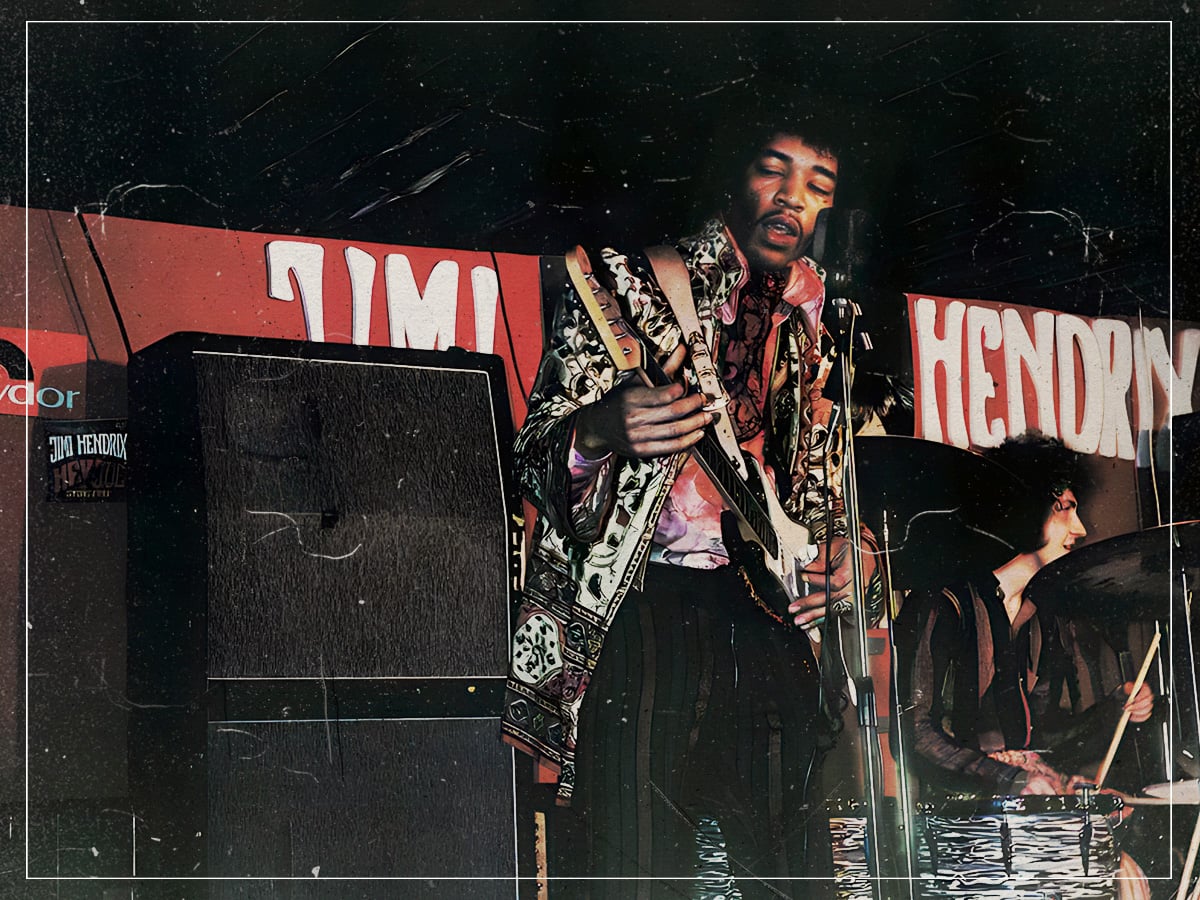
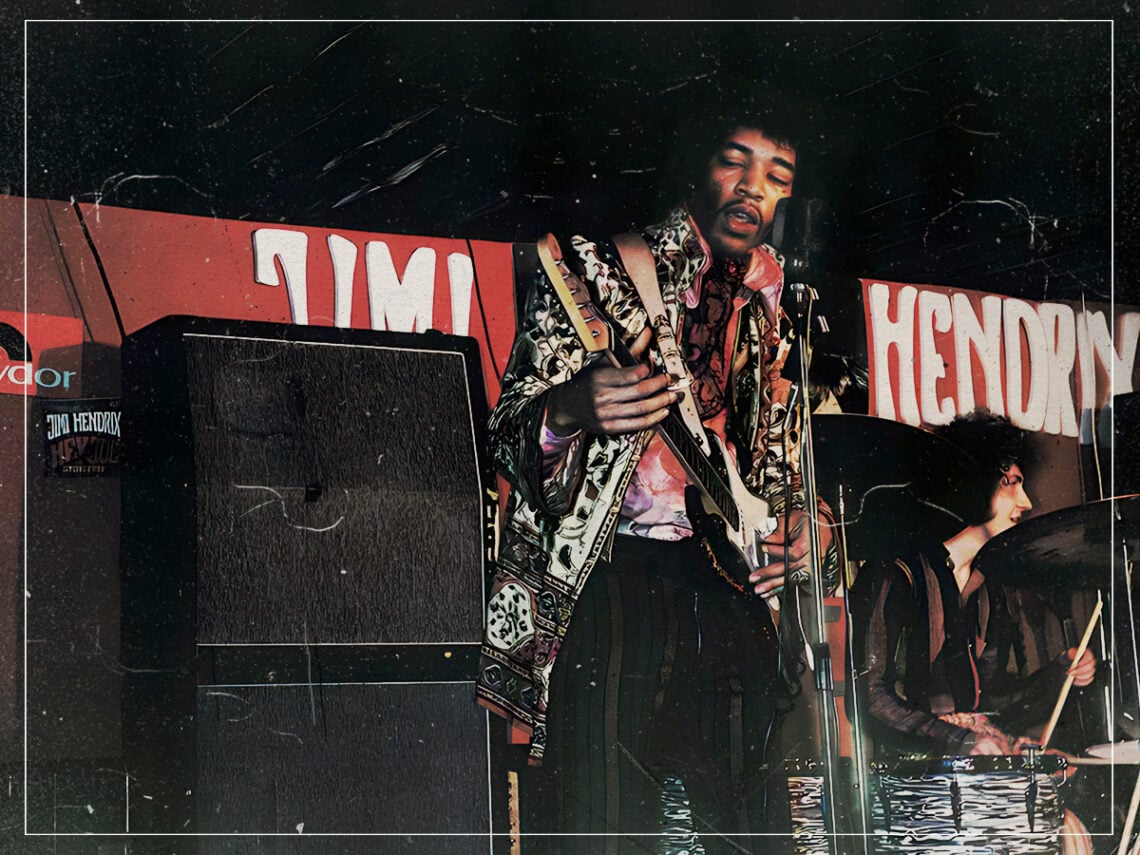
(Credits: Far Out / Alamy)
Fri 3 April 2026 19:00, UK
Information might travel faster in the internet age, but legacies seemed to crystallise a hell of a lot quicker in the 1960s.
Back then, the average pop star packed a lifetime’s worth of achievements and failures into the span of a few years, creating a moment-to-moment lifestyle denser than the nucleus of an atom. By comparison, current headlining rock acts like Wet Leg and Geese are still considered ‘up-and-coming’, despite already having longer recording careers than Jimi Hendrix.
It might be “better to burn out than fade away”, as Neil Young famously put it, but if you were Hendrix in 1970, well into your fourth or fifth lifetime, that burnout probably felt interminable.
It’s now been nearly 56 years, or a little over 20,000 days, since Hendrix died of a drug overdose and asphyxia on September 18th, 1970, while the entirety of his career as a performer, dating from the first Jimi Hendrix Experience concert in 1966 to his final gig at an ill-fated German rock festival in 1970, covered a mere 1,419 days. And yet, improbably, he remains a daily topic of conversation around the world, still the gold standard when it comes to discussing the history, craft, technique, and limitations of the electric guitar as a means of music making.
At the age of 27, Hendrix should have been entering a new, perhaps slower-paced stage of his career. His performance at the Woodstock Festival the previous summer, immortalised in a hugely successful 1970 documentary film, had elevated his international rock-star bankability to its highest tier yet, presumably giving him the opportunity to coast on that fame and ease his workload a bit, playing the hits to big audiences. That idea wasn’t the least bit inspiring to Jimi, however.
Instead, he felt like he had inadvertently become a living avatar of sorts for all the excesses, weakening idealism, and frustrating contradictions of the ‘60s.
 (Credits: Alamy)
“I don’t any longer dig the pop and politics crap,” Hendrix said in a chat with Melody Maker, published during his final tour in 1970, just weeks before his death. “That’s old-fashioned”.
Hendrix wanted a new beginning, explaining that he felt like he was “back right now to where I started,” he said. “I’ve given this era of music everything. I still sound the same, my music’s still the same, and I can’t think of anything new to add to it in its present state…I started thinking, thinking about the future. Thinking that this era of music, sparked off by The Beatles, had come to an end.”
Hendrix had grand visions of re-inventing himself and being part of whatever the new post-Beatles movement in popular music might sound like, noting that drugs no longer needed to be a part of it. He was imagining his own future compositions combining elements of classical giants like Strauss and Wagner, ”those cats are good”, with “Western sky music”, “sweet opium music”, and “plenty of blues”. He was eager to get started, but unfortunately, there were some loose ends to deal with first.
At this same point in 1970, work was being completed on Hendrix’s new Electric Lady recording studio in New York, and costs were mounting on the project. In order for him to be able to utilise the studio for his new sonic adventures going forward, he’d need to book some extra European tour dates in the late summer of 1970 to bring in some more dough; or at least that’s what his manager, Michael Jeffrey, strongly suggested. After wrapping up the North American leg of his Cry of Love tour in July of ‘70, Hendrix got a few weeks off, then headed off for the European leg with original Experience drummer Mitch Mitchell and Band of Gypsys bassist Billy Cox as his backing band.
What followed was less a triumphant victory lap than a bizarre, drawn-out unravelling, as from the outset, the tour was plagued by fatigue, poor organisation, and a sense that Hendrix himself was running on fumes, both physically and mentally. Billy Cox, one of Jimi’s closest friends and a stabilising, drug-free presence in his orbit, also began suffering from severe exhaustion and what would later be described as a nervous breakdown, supposedly brought on after his drink was spiked with LSD at a tour stop in Gothenburg, whose condition deteriorated over the next few days, and would eventually lead to the tour being cut short after the first week of September, just seven dates into the journey.
In the meantime, the gigs themselves were wildly inconsistent at best. At the Isle of Wight Festival, Hendrix performed in the early hours of the morning to a gigantic crowd of nearly half a million people, but technical issues, along with a lingering cold, hampered his playing, and while flashes of brilliance were still there, it was an overall disappointing kickoff to the tour.
Sniffles and snafus were nothing compared to the problems awaiting Hendrix and his mates at the continental festival stops, where security was minimal, and tensions often ran high. Hendrix told a Swedish newspaper that he felt “mentally hollowed” ahead of the Gothenburg show, and this seemed evident in his performance, as he seemed to lose his focus at times, coming out of a guitar solo only to forget which song he’d been playing.
 (Credits: Bent Rej)
On September 3rd, Mitch Mitchell got word that his wife was going into labour back home, so he chartered a plane to London, weirdly deciding to bring the increasingly unstable Cox along with him before the pair of them rejoined Hendrix that same night for a gig in Copenhagen. Somehow, that show wound up being the best of the lot, with Jimi seemingly absorbing the adrenaline of his bandmates and sounding more like himself.
The next night, ahead of a performance in West Berlin at a festival called “Super Concert ‘70,” Hendrix talked with American Forces radio about this new era of the big rock ‘n’ roll festival and his place as the post-Woodstock poster boy for such events. Jimi was less than enthused. “It’s pretty hard for this sound to get to all those people in such a big crowd,” he said. “Like, if we had smaller crowds, you can really get next to ’em more, you know?… It’s just too big. You know you’re not getting through to all of them.”
Another problem with the overnight mega-popularity of large-scale rock festivals was that a lot of fly-by-night organisers were trying to put together their own events in the same DIY manner as Woodstock, and very few had the money, know-how, or event-planning experience to pull it off without incident. Hendrix would experience this firsthand when he arrived on the island of Fenharm, West Germany, where he was slated to play the new Love & Peace Festival on the night of September 5th.
“We got there mid-afternoon,” Mitch Mitchell later recalled, “And were supposed to be on at eight. By about six, we heard this wind, and then it turned into a gale. We knew by then there were other problems, as well: the usual equipment trouble plus Hell’s Angels with guns.”
This was a year after the Hell’s Angels biker gang had already infamously wreaked havoc on the Altamont Speedway Free Festival in California, suggesting that the virtually self-policed, imaginary utopia of Woodstock was already an unreplicable dream. The German wing of the Angels was no less problematic than their American counterparts, and with Billy Cox already on a razor’s edge with his mental health, the gig felt like a powder keg ready to go off. Almost by the grace of god, extreme winds and rain forced the postponement of Hendrix’s show that night, pushing it back to the next day. Jimi spent the night chilling out at the Hotel Dania with various other musicians, but Cox’s condition worsened.
 (Credits: Far Out / Wikimedia)
“Billy had kind of a breakdown,” tour manager Gerry Stickles recalled in Tony Brown’s 1997 book, The Final Days Of Jimi Hendrix. “It was part of my job to nurse him through it, to get the date over with. But he was severely paranoid about what was going on, you know. This whole thing was going to collapse and everybody was going to be killed and God knows what else.
“I had to sit on the side of the stage and stuff like that, so he could see me all the time. Everybody was feeling bad at that time. When somebody’s like that, it permeates through the whole thing. But this was the last show, ‘let’s just do it, get it over with and get out of here’, and that’s what happened.”
Rather than being greeted like heroes the next afternoon for their rescheduled appearance, Hendrix, Cox, and Mitchell were loudly booed by much of the German crowd, many of whom had waited in the rain the night before, and apparently blamed the band for not powering through and facing potential electrocution. No one in attendance, of course, was aware that they were about to witness the final live performance of the greatest rock guitarist of all time.
“I don’t give a fuck if you boo,” Hendrix told the crowd, “As long as you boo in tune”.
The band then kicked off the show with ‘Killing Floor’, the same Howlin’ Wolf cover that had opened the first ever Jimi Hendrix Experience gig back in 1966. From there, despite more rain, more wind, and more disturbances from the audience, including fist fights and objects getting thrown around, the band put together a strong set, putting their last ounces of energy into bringing the experience to some sort of satisfying conclusion.
The closing number was ‘Voodoo Child (Slight Return)’, a song that concludes with the lines, “If I don’t see you no more in this world / I’ll meet you in the next one / And don’t be late, don’t be late”.
This was Jimi Hendrix’s unintentional farewell, the final words he’d ever sing on a stage, as returning to London the next day, he was still battling the cold he’d had throughout the tour, not to mention an overall exhaustion from the brutal and emotionally taxing week. These factors may have contributed to his decision to start overloading on sleeping pills in the days that followed, ultimately leading to his death on the morning of September 18th, 1970, the day before the first-ever Glastonbury Festival got underway.
