
The United Kingdom and France have signed a landmark agreement to develop a successor to the Meteor missile. This collaboration continues the long history of the two countries co-developing missile technology.
By Sam Cranny-Evans, Editor of Calibre Defence. Published April 3, 2026.
The United Kingdom and France have entered into a Memorandum of Understanding (MoU) to study a successor to the Meteor air-to-air missile. The Mou initiates a 12-month joint study to analyse future air combat threats and design new missile concepts.
The study will identify suitable technologies for a next-generation weapon system. Furthermore, it will establish a roadmap for development to ensure the Royal Air Force and French Air Force remain competitive.
This initiative is part of a revived “Entente Industrielle” designed to reduce duplication and improve industrial efficiency. As part of the move, both nations will establish a joint Complex Weapons Portfolio Office. This office will oversee the project and explore further opportunities for missile cooperation.
According to an April 1 press release from Defence Equipment & Support (DE&S), this agreement is a key deliverable under the Lancaster House 2.0 treaty.
However, it does not explain or hint at the role of MBDA, the missile house that is a joint venture between BAE Systems, Airbus, and Leonardo. As well as being the original developer of Meteor, MBDA is arguably the most capable missile developer in Europe. It stands to reason that the company would have to be involved in work on a successor to Meteor.
Tech profile: Meteor air-to-air missile
The current Meteor missile is a benchmark for beyond-visual-range air-to-air missiles (BVRAAM). However, the emergence of stealth aircraft and advanced electronic warfare necessitates a more capable successor. Consequently, the UK and France are looking to build on the success of the original six-nation partnership led by MBDA.
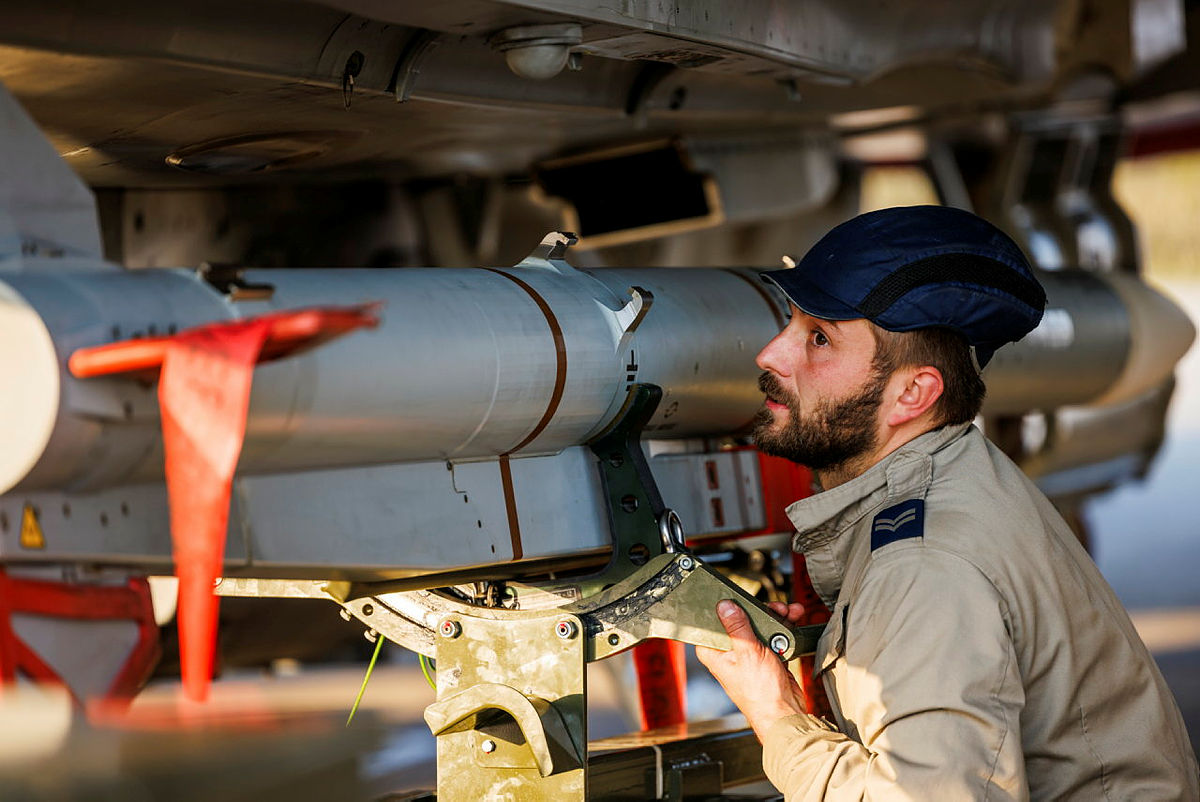
Meteor is an active radar-guided BVRAAM produced by MBDA. It is currently integrated onto the Eurofighter Typhoon, Dassault Rafale, and Saab Gripen. In the future, the UK also plans to integrate the missile onto the F-35B.
The weapon’s defining feature is its throttleable ducted rocket, or ramjet. Unlike traditional rocket motors that burn all their fuel quickly, a ramjet can adjust its thrust during flight. As a result, the missile maintains high speeds over long distances and retains energy for the terminal phase of an engagement. This provides Meteor with a significantly larger “no-escape zone” compared to conventional missiles.
Key specifications include:
Range: In excess of 100 km.
Speed: Over Mach 4.
Guidance: Active radar seeker with a two-way data link.
Propulsion: Solid fuel, variable flow ducted rocket (ramjet).
Calibre comment: The future of air warfare
4th generation aircraft like the Typhoon, F/A-18, and Gripen set new paradigms in air warfare. The fidelity of their sensors and range of their weapons theoretically extended engagement ranges var beyond visual sight. It was expected that a large-scale war would involve significant exchanges of missiles and loss of aircraft without ever seeing enemy planes. With the advent of 5th generation aircraft, however, some analysts are anticipating a significant change to this paradigm. If the low-observable properties of aircraft like the F-35, J-20, and Su-57 are what the manufacturers claim, it may be very difficult for aircraft and their missiles to detect them.
Various efforts are underway to improve detection, the ECRS Mk 2 radar for the UK’s Typhoons being one example. The APG-82(V)X from Raytheon, which is meant for the F-15 is another. At the same time, some developments are focused on increasing the range of existing missiles like the AMRAAM. And yet, there is the possibility that 5th generation aircraft will end up in dogfights with each other. It could be prudent for air forces to continue practicing those skills as a result.
The lead image shows an RAF armourer loading a Meteor onto the wing of a Typhoon. The aircraft was being prepared for a sortie in the Middle East. Credit: AS1 Ciaran McFalls RAF/UK MOD © Crown copyright 2025.