
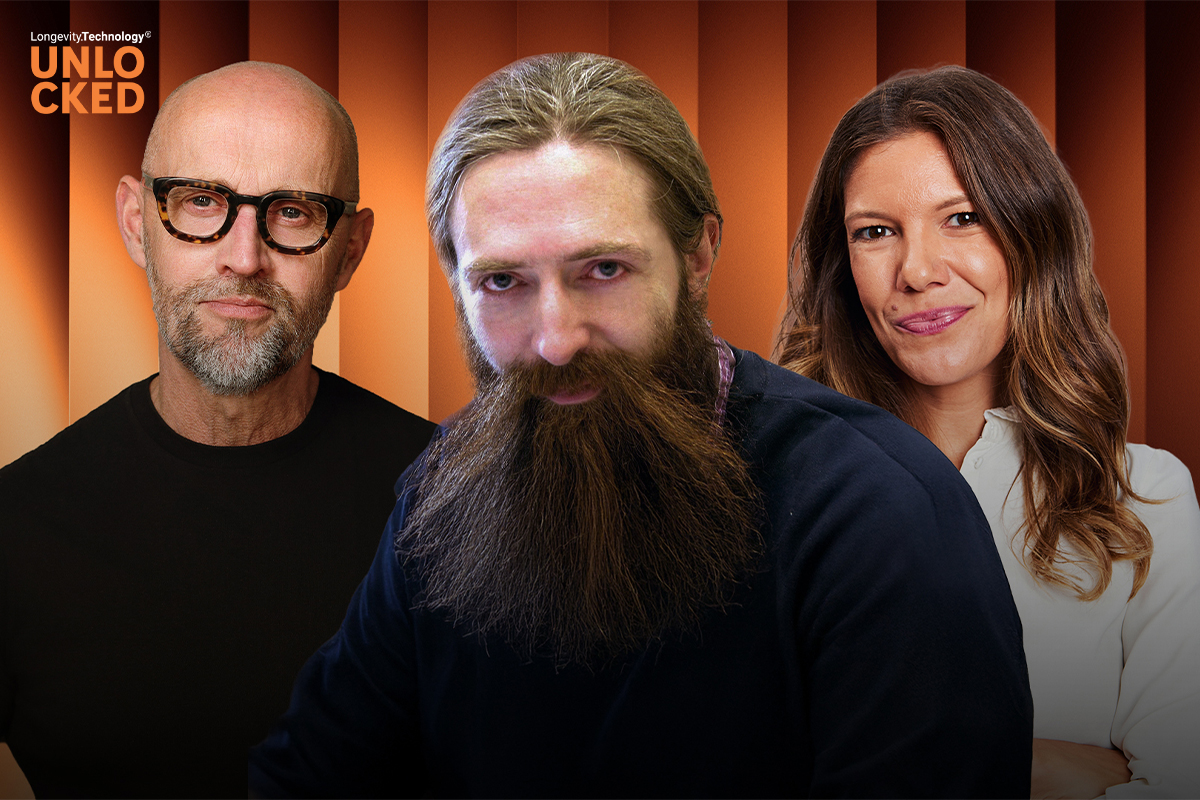
Aubrey De Grey breaks down longevity escape velocity (LEV), repairing aging and changing how we think about growing old.
The dream of significantly extending human life has long been the stuff of science fiction. Yet, for some scientists, it’s edging closer to reality. On the latest episode of Longevity Technology Unlocked, Phil Newman and Dr Nina Patrick explored one of the most ambitious ideas in aging research: longevity escape velocity (LEV) – the point at which medical progress extends life faster than the natural aging process can catch up.
Joining them was Aubrey de Grey, founder and chief science officer of the LEV Foundation (Longevity Escape Velocity Foundation), a biomedical charity dedicated to repairing the molecular and cellular damage of aging. Dr de Grey, known for his bold predictions, offered a personal perspective on a field often clouded by skepticism.
“Having a purpose in life…is actually one of the best things one can do for one’s longevity,” de Grey explained. “I feel very privileged that I’ve been able to get into a position where I can make a significant contribution to the thing that I regard as humanity’s biggest problem.”
His commitment is both personal and professional: by driving research and nurturing the scientific community, he says, he keeps himself energized and engaged, a form of living proof for the philosophy he advocates.
At its core, LEV is about repairing the damage that aging causes, rather than merely slowing it down. De Grey likens the human body to a vintage car: “It’s working every bit as well as it was the day it was built…because of preventative maintenance. That’s what we’re doing – helping the body help us.” This “repair, don’t just slow” framework forms the backbone of the interventions his team explores.
So, what would longevity escape velocity look like in practice? De Grey frames it in concrete terms: rejuvenating someone in their 60s or 70s back to a biological age of 40 buys time – roughly 20 years – for ongoing research to refine therapies. By the time they age again, newer technologies would be ready to extend healthspan even further.
As de Grey put it: “The progress in the research during those 20 years will outrun that so that we will be able to re-rejuvenate the same people.”
Of course, translating this concept into tangible results requires a mix of science, technology, and societal engagement. Dr de Grey highlights the critical role of mouse studies. While seemingly distant from humans, these experiments are pivotal in demonstrating that interventions can actually extend lifespan.
“Every single expert in the world will immediately know that we have entered a new era and they will say so to the influencers, and the influencers will say so to the public,” he said. Essentially, showing progress in mice helps shift societal beliefs, a key factor in advancing longevity science.
The Robust Mouse Rejuvenation Program is one such initiative that combines multiple interventions to extend life in middle-aged mice. These include telomerase gene therapy, heterochronic bone marrow transplants, senolytics (drugs that remove damaged “zombie” cells), and newer techniques like partial epigenetic reprogramming, exosomes and deuterated fatty acids. Each method targets a different aspect of aging, echoing de Grey’s “divide and conquer” approach.
“These are sophisticated interventions, and surprises can happen,” de Grey admitted, acknowledging the risks. “For example, partial reprogramming carries a high risk of stimulating cancer. It’s not a showstopper, but we need to be careful.” Yet he is confident that by leveraging existing cancer detection techniques and careful experimentation, such challenges can be managed safely.
While the science itself is ambitious, de Grey stresses that societal and regulatory action is just as crucial. Drawing a parallel to the COVID-19 pandemic, he argues that the global response to a single problem can happen fast when priorities align:
“I believe that the response…was a precedent that we can follow…once we start caring about aging, it will completely abolish all of the obstacles that exist in society,” he said.
Artificial intelligence also plays a role, particularly in accelerating drug discovery and optimizing experimental design. Tools like AlphaFold and AI-driven drug development platforms are helping researchers focus their limited resources on interventions with the highest likelihood of success. But de Grey emphasizes that healthspan and lifespan remain the ultimate tests: “If you extend the healthspan of a mouse but not its lifespan, critics will call it cherry-picking. Lifespan is the acid test.”
In sum, longevity science is no longer a fringe endeavor. With strategic experimentation, societal engagement and a focus on repair-based interventions, the odds of outrunning aging are improving. Slowly, cautiously but unmistakably.
As de Grey reminds us, the challenge is as much about changing human belief and regulatory inertia as it is about biology: proving that aging is not inevitable, but malleable.
For those who dream of a world where middle age is just another checkpoint rather than a countdown, these experiments in mice (and the visionaries guiding them) may be the first signals that humanity is entering a new era of longevity.
Join us on Mondays for expert insights on longevity and health science on Longevity Technology Unlocked. Stay updated with our Friday news roundup. Listen on Apple Podcasts, Spotify and YouTube.