
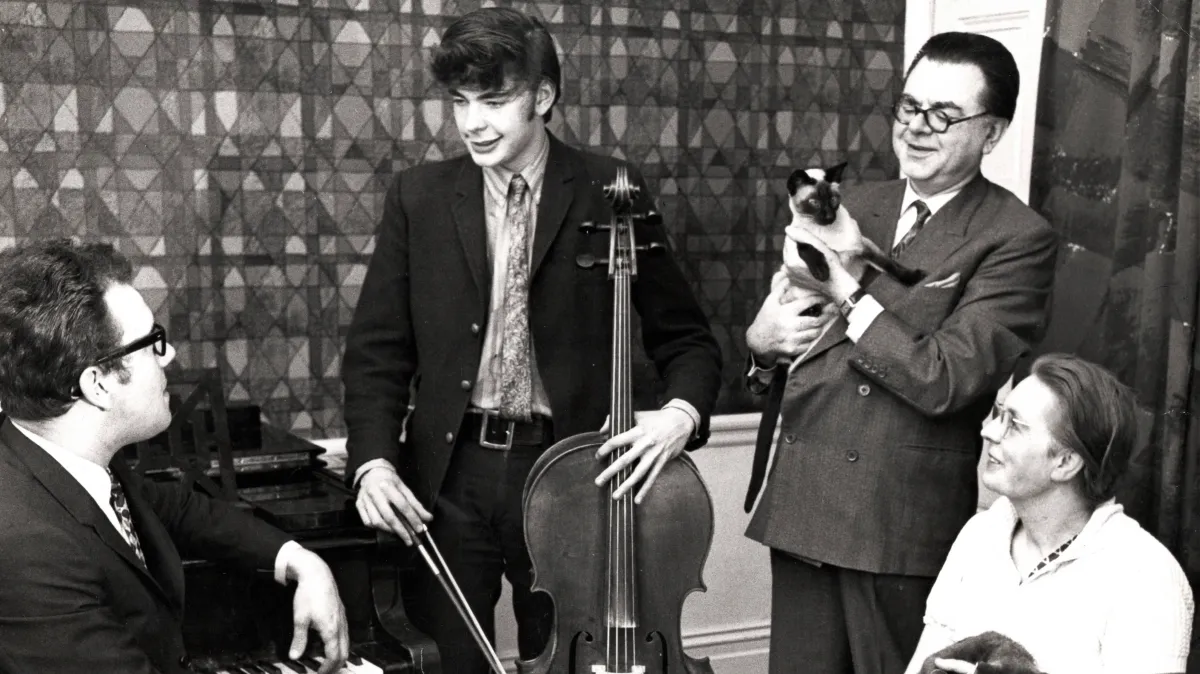
My first memory is of Andrew’s screams. I was only six weeks old. Biologists insist that such a memory is not possible. They didn’t hear my brother. Andrew was suffering acute appendicitis and was rushed to hospital, minutes from death. Appendix removed, he then returned to our flat, where he continued to scream off and on (but mostly on) until his departure from No 10 Harrington Court, in South Kensington, 15 years later.
As children we developed an entire make-believe world that centred around our toy theatre, the Harrington Pavilion. Made of bricks and wooden blocks, and papered with fabric samples, it featured a magnificent revolving stage, constructed from an old record turntable. Performances were staged with surprising frequency. Friends, family and unsuspecting guests would be dragged in to hear Andrew’s latest musical while we both chipped in to operate the lighting and “cast” of toy soldiers. There was even a plush crimson curtain.
But when I was ten my playmate suddenly left the roost. Andrew won a scholarship to Westminster School, where he became a weekly boarder, so I began to devise solitary hobbies. These mostly involved collecting things that were entirely useless but I also grew determined to “collect” the Underground, which to me meant travelling to every station on the network.
Sixty plus years ago, the layout of Tube trains was completely different. There were oblong seats with glass partitions rather than today’s carriages where everything is visible from one end to the other. And there was no CCTV. Thank God what happened to me would be impossible now.
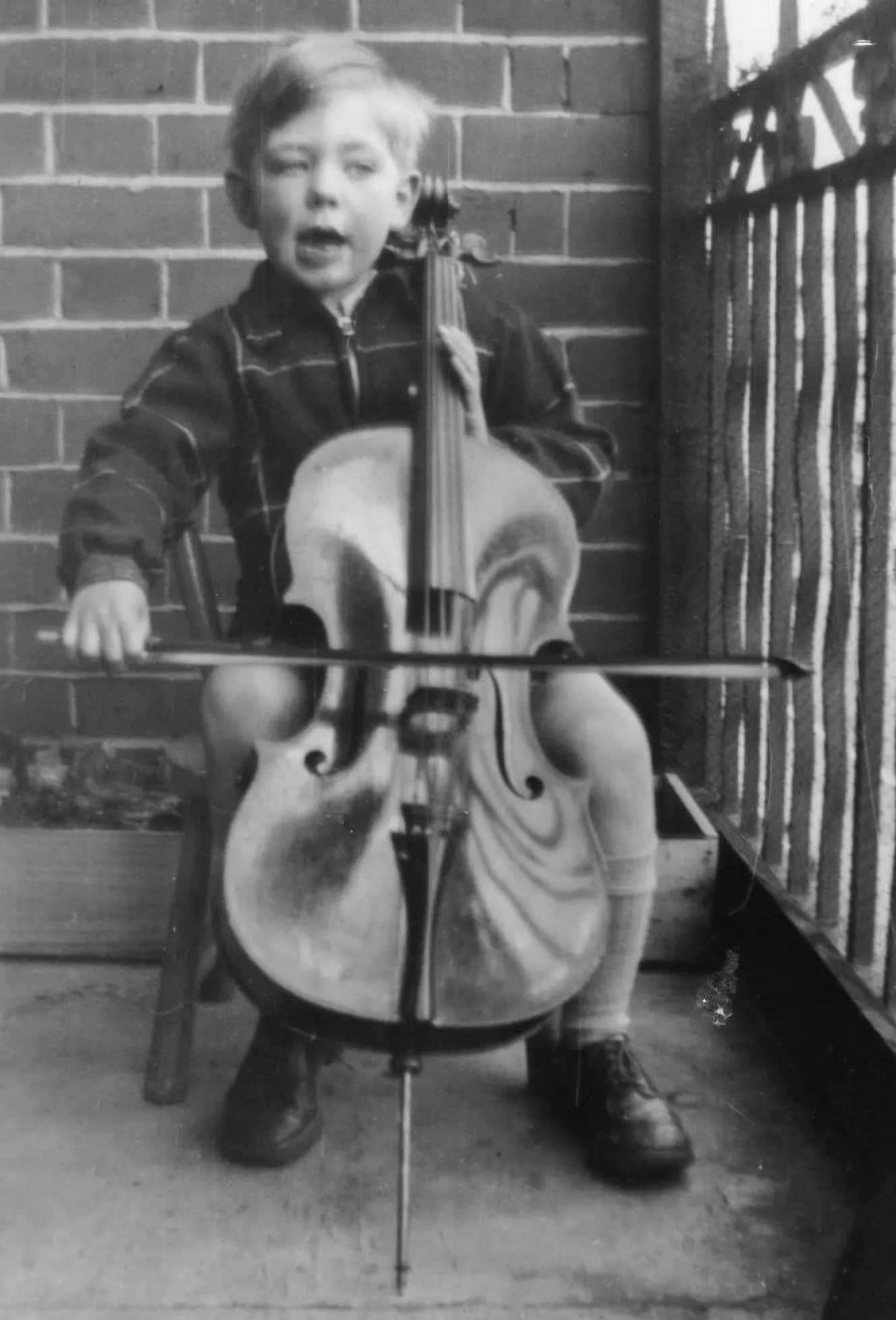 Aged five, practising the cello on the balcony of Harrington CourtCourtesy of Julian Lloyd Webber
One summer afternoon in 1960 I set out to conquer the Piccadilly Line from South Kensington to its easternmost terminus. I got on the almost deserted front carriage and sat down opposite a respectable-looking bloke reading a broadsheet. I’d been told not to talk to strangers, and especially not to strange men, but I had never been given any reason why. After a few stops I saw the guy opposite was preoccupied with something under his newspaper. I was so scared that I couldn’t move and I couldn’t see any other passengers. I tried as hard as I could to pretend that I hadn’t noticed, but he must have been watching me closely and, sure enough, he soon asked me to sit next to him. So I did. I didn’t know what else to do. He told me to play with him. When I refused, he pulled my head down and forced me to perform what the media loves to call “a sex act”. Then he tried to do the same thing to me, but the train was arriving at a platform and he suddenly panicked and ran. I will forever be grateful to Arnos Grove station.
I got off at the next stop and caught the first train home. I was still shaking when I arrived. For once, Mum and Dad were both in and I spilled the beans in graphic detail. I remember Dad, white as a sheet, saying, “Christ, that’s really bad.” I don’t remember Mum speaking at all. I do know they had a massive row about it. They knew they were directly responsible for letting their child roam around London on his own.
The next day a policeman arrived with an enormous photo album of known paedos. I was handed a well-thumbed book to look through filled with endless mugshots of dodgy-looking weirdos. I remember turning each page dreading the sight of a face I never wanted to see again, yet hoping against hope that he would be there. But my abuser was nowhere to be seen. I wanted him to be caught. I wanted him to be punished. I wanted him to die. Until then I had lived a happy, carefree life. In little more than half an hour he had destroyed my innocence. But he failed to destroy me.
For a long while I was in shock. Overnight I became shy and self-conscious. I would blush when introduced to adults and wouldn’t say a word. Although Mum and Dad were understanding and supportive, I found it much easier to talk to Gran. She had suffered her own traumas and learnt the hard way that nightmares do fade with time — especially when you have things to look forward to.
I was born on April 14, 1951. By the time I was brought home to the run-down Victorian block of flats where I would spend my childhood, Mimi (the monkey) had already departed. Perseus, Dimitry and Sergei (the cats) and Champagne Charlie (the “pedigree” mouse) had yet to arrive, but four other members of the Lloyd Webber menagerie were in residence at 10 Harrington Court: my dad, William; my mother, Jean; my brother, Andrew; and our maternal grandmother, Molly.
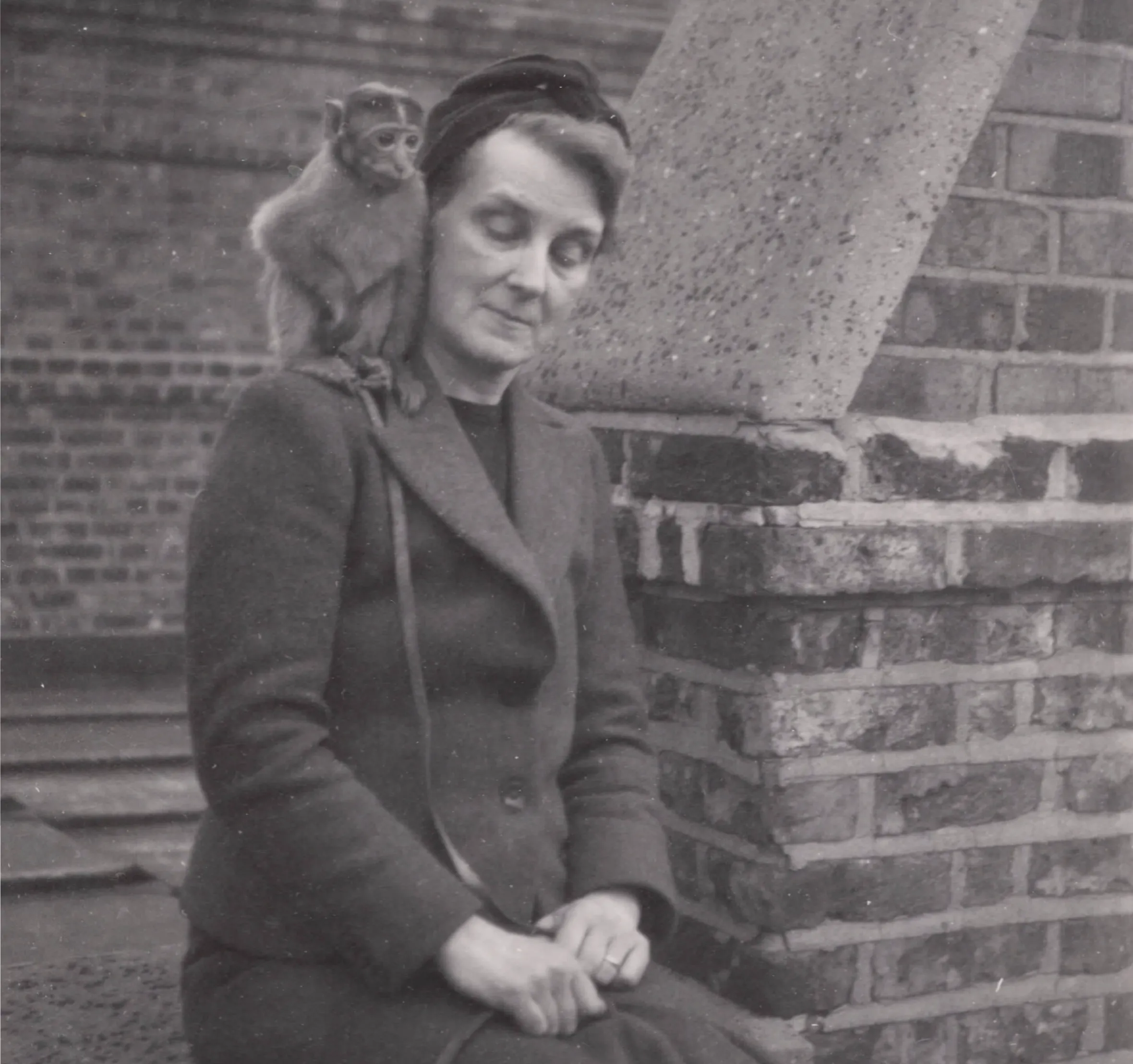 Molly, his maternal grandmother, with their pet monkey, MimiCourtesy of Julian Lloyd Webber
Dad, the son of a plumber, was a professor at the Royal College of Music and a composer of note to the very few who knew his works. Mum was a music teacher. Gran, her mother, had moved to London and rented the flat in 1935 just after the death of her son in a boating accident, and shortly before she lost the man she loved to her daughter, my Auntie Vi, who married him instead.
It was a bohemian home. People wandered in and out at random. And that was before Andrew’s lyricist Tim Rice, the future concert pianist John Lill and their array of scantily clad girlfriends moved in as well. Surprise was the norm. I have fond memories of the place. Andrew is on record as saying he “couldn’t wait to get out”.
Psychologists will tell you that the number of seconds it takes to make a first impression varies from one tenth of a second to seven seconds. Like the biologists before, they are wrong — my brother Andrew’s impression is instantaneous. He is someone who cannot be reasoned with, who will not take no for an answer and is used to getting his own way, who will sell his own house to back a musical he believes in, who will choose the unlikeliest subjects for his work and bludgeon them through to success, who will not suffer fools nor take bullshit, yet who can be as shy and awkward as our parents could be, incredibly loyal to his friends and family and the funniest, most irreverent, company. I have been fortunate — and occasionally unfortunate — to meet and work with some of the most revered composers, conductors, musicians, singers, politicians, academics, sportspeople and more, from many walks of life, but I have never met anyone as restless, as driven, as resilient and as seemingly indestructible as my brother. In short, I love him to bits.
Because our parents were invariably out, Gran has to take the lion’s share of blame for Andrew’s habit of getting his own way. His missing socks were forever the cause of crises akin to nuclear war. “You hid it on purpose” and “You’ve ruined my career” were among the less hysterical outbursts. Gran would search high and low, clucking around him like a besotted mother hen. Often I wished that once — just once — Gran would have told Andrew where he needed to go, but she never did. Had she done so, the future of musical theatre might never have been the same.
When I was five I persuaded my parents to buy me a cello and by the time I was nine I was at the Royal College’s junior department. I played percussion in an orchestra there with a boy called John Lill. At 16 he was known as a piano prodigy, so I was instructed to invite him for lunch. Mum and John got on like a house on fire with petrol-doused flames. Dad and Andrew seemed enamoured, and I felt chuffed that my introduction of someone seven years older than me had gone down so well.
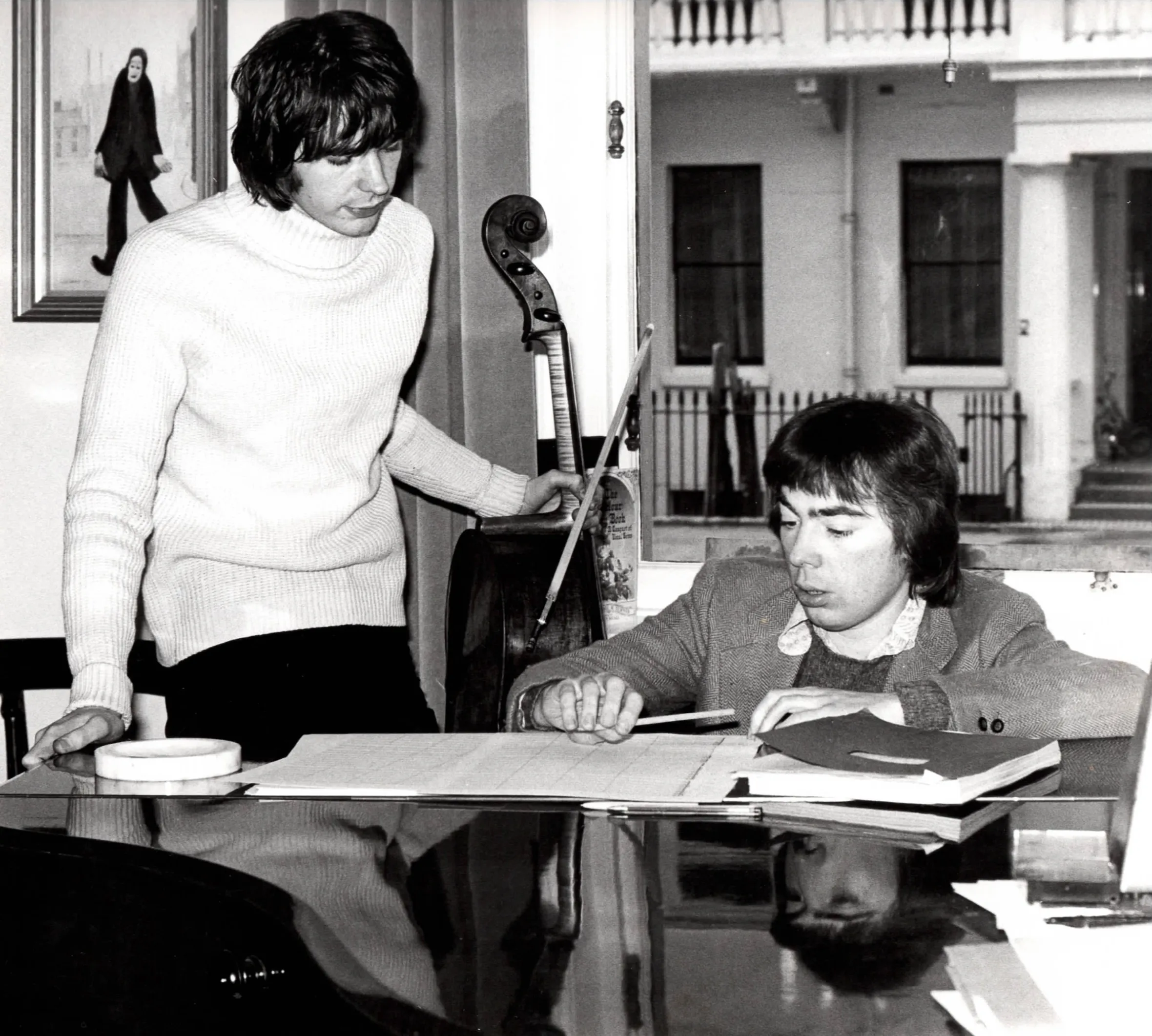 Working with Andrew on Variations, their 1978 classical rock fusion LPCourtesy of Julian Lloyd Webber
John was an extraordinary talent. His party trick was to look at any piece you put in front of him for a few seconds, then go straight to the piano and play it “by heart”. Mum was ecstatic. For the first time in many years she had found another young male talent to obsess over, who — just like Dad — came from a very poor background.
Mum’s previous musical beau, in 1944, was a tenor from Gibraltar with a limp called Luis Gomila. He was a lesser talent but was directly responsible for Mimi the monkey’s arrival at Harrington Court. Luis claimed that Polish sailors in his digs had brought her back from Bombay and needed to find her a home. My parents went to view Mimi and Dad was instantly besotted. The next morning Luis arrived with a large cage containing the monkey, a harness and a long lead. No one ever met the sailors.
She lasted until Andrew arrived. Before Mum even realised she was pregnant, Mimi sensed a rival and started attacking Mum. Soon the reason for her jealousy became clear, making Mimi, in my brother’s own words, “the first person to take a dislike to Andrew Lloyd Webber”.
Following a tearful goodbye at Brighton Zoo, Dad’s beloved simian became a distant, cherished memory.
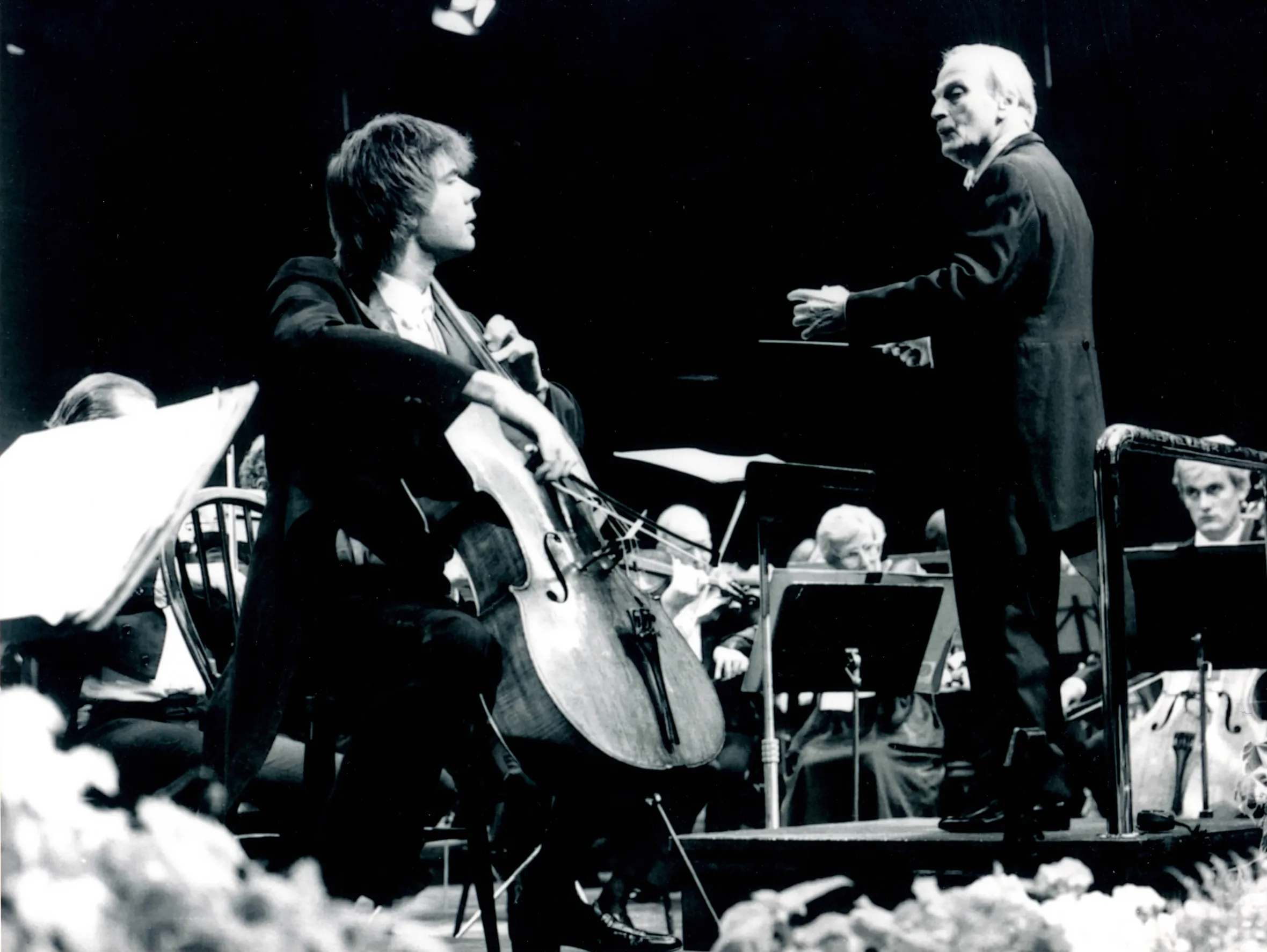 Playing Elgar with the Royal Philharmonic Orchestra conducted by Yehudi Menuhin, 1986Courtesy of Julian Lloyd Webber
By the mid-1960s the music was changing at Harrington Court. Andrew’s “jukebox” — Elvis, Buddy Holly, the Everly Brothers and Bobby Vee — was becoming sidelined; suddenly I was practising the cello for hours on end and John Lill was monopolising our grand piano with Beethoven and Brahms. Mum and Lill were firmly in the “classical” camp, Andrew wasn’t and Dad — who knows? But which side was I on? Mum was determined to find out and posed a question: “Who would you have most liked to meet? Elvis Presley or Beethoven?” “Well,” I answered in my best southern drawl, “I guess, it would need to be Elvis.” Mum wouldn’t speak to me for weeks.
In truth she did not have a lot to worry about. I was now at University College School in Hampstead — my third and final all-boys establishment — whose laissez-faire attitude to academic achievement suited me down to the ground.
Between homework and cello practice there was only ever one winner. One night as O-levels approached, my English homework was due. It consisted of writing a poem, which, come midnight, I hadn’t started. What to do? I couldn’t even remember what it was supposed to be about. Something to do with a young man’s struggles? As the sound of Andrew’s piano wafted down the passage, I realised that his new lyricist was with him. Surely he should be able to help? On cue, a tall, blond Adonis emerged from the room. “Hi, I’m Tim Rice,” he announced.
Five minutes later “my” homework was ready to hand in. I received a B+ with the comment, “Not what I asked for. But a good poem — well done!”
Meanwhile Mum had been busy negotiating a cheap deal to rent a smaller flat on the same level in the next block. Flat 2a’s balcony backed onto the side window of No 10. By replacing the window with a door we would be able to walk across the balcony from one flat to the other.
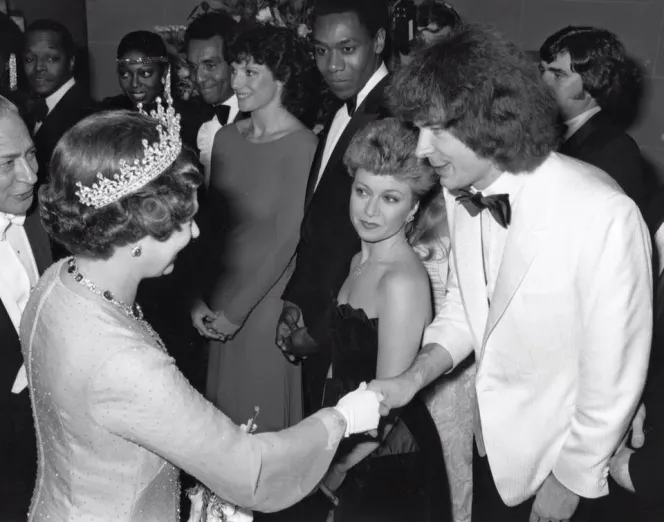 Shaking hands with Queen Elizabeth II alongside Elaine Paige after performing with Andrew at the Royal Variety Show, 1981Courtesy of Julian Lloyd Webber
I moved into Gran’s old bedroom and her new flatmates in 2a were John and Tim, who had agreed to pay £5 a week rent. Although Gran was no prude, both lodgers’ nocturnal visitors gave her good reason to be grateful that her hearing was not as razor-sharp as it used to be.
The centre of No 10 remained the drinks cupboard; its surrounding chests and benches were where visitors congregated to sip Dad’s celebrated, intoxicatingly strong cocktails. Winter conversations were frequently punctuated by enormous farts from one of the prehistoric gas fires.
For me, these were the best times at Harrington Court. It had a crazy, hothouse atmosphere populated with gifted, strong-willed characters drifting in and out whenever they pleased.
At 16 I left school to focus on my cello. Dad had always made it clear that once Andrew and I left school there would be no handouts. We could remain at Harrington Court but we had to pay our way. He also advised us against entering the music profession “unless there is absolutely nothing else you can do”. His reasoning was that only those prepared to ignore such advice will succeed.
I didn’t need the threat of not being able to go to music college unless I got a scholarship: it was assumed I would get one. In the end I got two: from the Royal Academy of Music and the Royal College of Music, both in London. I felt on top of the world when the second one, from the Royal College, was posted. That night Dad’s cocktails packed an even greater punch and I slept as well as I’d ever done. I was not yet 17.
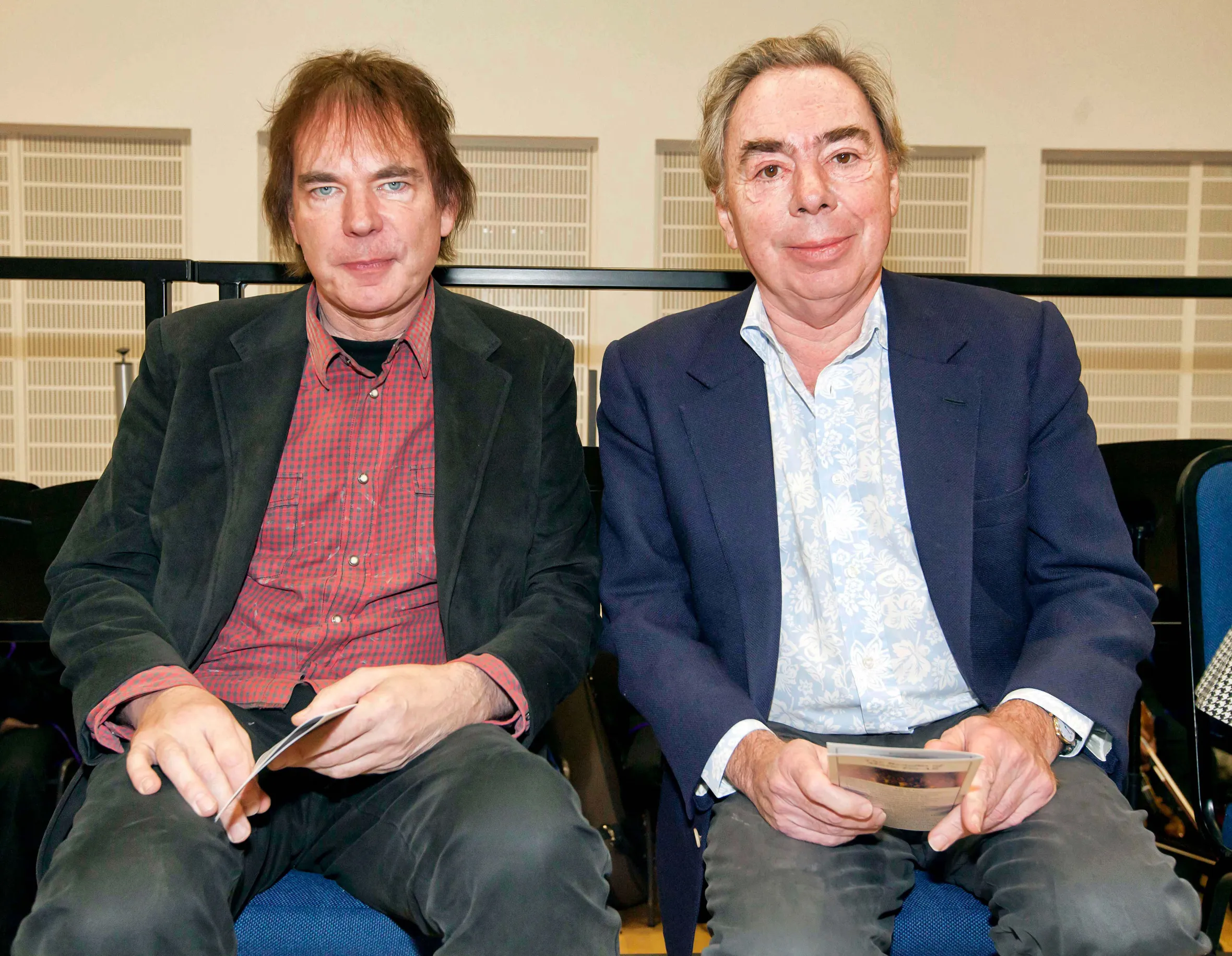 The brothers in 2012eyevine
Two months later, on the evening of May 12, 1968, I played in a concert at Central Hall, Westminster. It was a family affair centred around the first public performance of Andrew and Tim’s new “moderatorio”, a work commissioned the year before by my former history teacher at Westminster Under School.
John Lill began the evening with three piano solos, I continued with Saint-Saëns’ First Cello Concerto (accompanied by Dad on piano) and the first half ended with three organ solos from Dad. The second half belonged to the new work, Joseph and the Amazing Technicolor Dreamcoat, which launched the “Andrew Lloyd Webber-Tim Rice partnership”.
Andrew moved out the next year. In 1970 John won the International Tchaikovsky Competition in Moscow, the world’s most prestigious piano prize. In 1971 Andrew and Tim’s Jesus Christ Superstar became a Broadway hit. In 1972 I made my professional debut, performing the London premiere of a new cello concerto by Sir Arthur Bliss at the Queen Elizabeth Hall. Memories of halcyon days at Harrington Court were fading. Gran had died and the place had become grubbier. John Lill was hardly ever there but when he did appear, he would join Mum in lengthy sessions with a Ouija board, culminating in the news that they had received conclusive proof that John was the reincarnation of Beethoven. Like Andrew before me, I couldn’t wait to get out.
Deliverance came from an unexpected source. Landlords were piling into the area to make a quick buck, and Harrington Court was ripe for redevelopment. Mum and Dad played hard to get but eventually they received a pay-off even they couldn’t refuse.
An era was at an end.
© Julian Lloyd Webber 2026. Extracted from Bows and Arrows: The Autobiography (Biteback £22), published on Tuesday. To order a copy go to timesbookshop.co.uk. Free UK standard P&P on orders over £25. Special discount available for Times+ members