
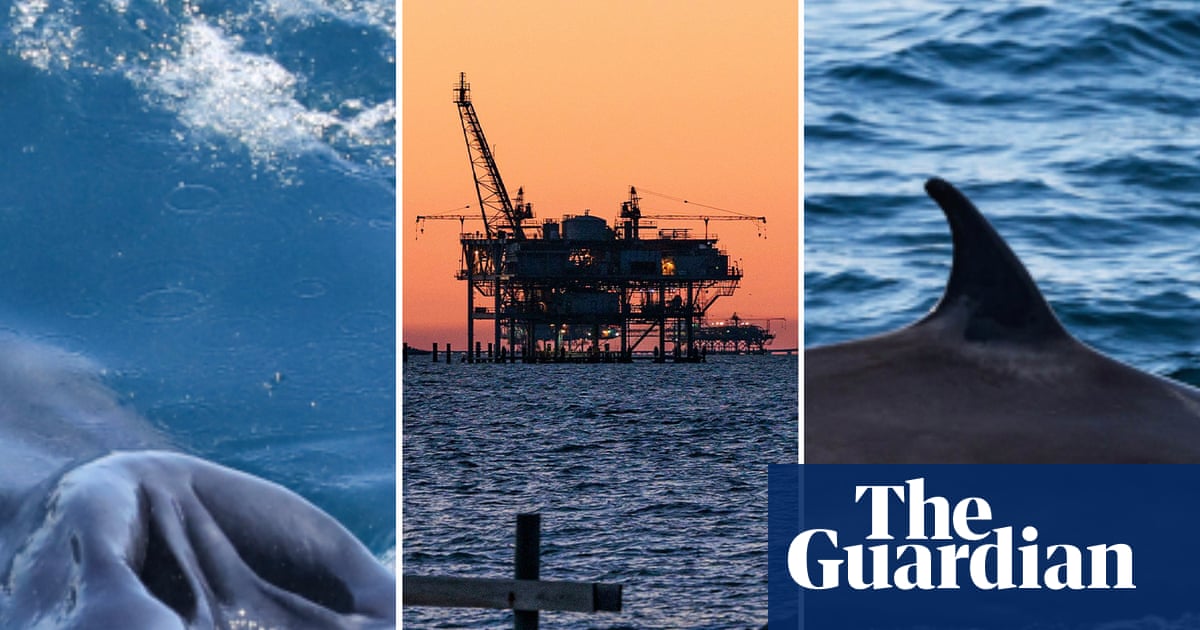
Since before modern humans existed Rice’s whales have been diving to the depths of the ocean to gorge on fat-rich fish while growing to leviathan proportions, their bodies spanning the length of a bus and weighing as much as as six elephants.
Unfortunately for these grand creatures, their only home became a patch of the Gulf of Mexico that the oil and gas industry, much later, became highly interested in for drilling. Only about 50 of these baleen whales still exist on Earth, surrounded by clanging aquatic highways of boats and shifting drilling infrastructure.
Last week, unbeknown to the cetaceans, an existential moment arrived when the Trump administration made the extraordinary decision to scrap all protections for the Rice’s whale, along with other endangered marine life in the gulf, in service of an industry that has facilitated the overheating of our oceans and our atmosphere. It may result in the first extinction of a whale species in North American waters in 300 years.
“Nothing surprises me with this administration but if I was still capable of shock, this would do it,” said Pat Parenteau, an environmental law expert at the Vermont Law School.
A Rice’s whale surfaces in the Gulf of Mexico. Photograph: NOAA Fisheries via AP
“‘Unprecedented’ is too mild a term for it – it’s beyond belief. Donald Trump likes being first and if this is upheld he will be the first president to make the conscious decision to make a whale extinct. It will happen before our very eyes. What a black mark on our legacy that would be.”
At a closed-door meeting at the Department of Interior that lasted barely 15 minutes, six Trump administration officials on Tuesday agreed to exempt the oil and gas industry from complying with endangered species laws in the Gulf of Mexico.
The panel formed under a rare gathering called the Endangered Species Committee, more informally named the “God Squad” because it essentially holds the power to decide whether a species lives or dies. It has only been convened three times, and not since 1992, when logging was allowed in the Oregon habitat of the northern spotted owl.
Usually, a complaint from a state or business triggers lengthy reviews before a God Squad hearing. But in this case, the fate of imperiled whales, sea turtles and other at-risk species was in the hands of Pete Hegseth, the secretary of defense, who invoked “national security” for the exemption, the first such rationale given since the 1973 passage of the Endangered Species Act.
“When development in the gulf is chilled, we are prevented from producing the energy we need as a country,” Hegseth said at the meeting. “Recent hostile action by the Iranian terror regime highlights yet again why robust domestic oil production is a national security imperative.”
The US is the world’s leading oil and gas producer and the Endangered Species Act, which prevents harassment and harm to threatened species, has never stopped a drilling project in the gulf. Regardless, “energy streams in the Gulf of America must not be disrupted or held hostage by ongoing litigation”, according to Doug Burgum, the interior secretary.
Pete Hegseth takes questions during a press briefing at the Pentagon in Arlington, Virginia, last month. Photograph: Win McNamee/Getty Images
In practice, this means that the Rice’s whale, listed as endangered in the US and critically endangered internationally, will be stripped of the modest safeguards oil and gas companies are required to observe, such as slowing boats in whale habitat and monitoring for the creatures when undertaking exploratory and drilling work.
All of the major threats to the Rice’s whale, the only whale that spends almost all its time in US waters, stem from the oil and gas industry. The busy ship traffic in the northern Gulf of Mexico results in deadly vessel strikes upon the whales, which rest at the surface of the sea at night. The noise of seismic surveys, pipelines, cables and drilling also interferes with the whale’s communicative vocalizations, which include long moaning noises.
The catastrophic 2010 Deepwater Horizon oil spill disaster, meanwhile, killed off about a fifth of all known Rice’s whales. “Our industry has a long track record of protecting wildlife while developing offshore energy responsibly,” claimed Andrea Woods, spokesperson for the American Petroleum Institute, which includes BP, responsible for the Deepwater disaster, in its membership.
Despite not asking for the endangered species exemption, the oil and gas industry has welcomed the move. “Over the long term, American energy leadership depends on getting that balance right through reasonable, science-based protections while meeting growing energy demand,” Woods added.
The Rice’s whale (Balaenoptera ricei), named after the late cetacean researcher Dale Rice, was only deemed a separate species in 2021 after federal scientists realized it was distinct from the similar Bryde’s whale (the two species differ genetically and in the shape of their enormous skulls).
It became immediately clear that the Rice’s whale was in a precarious position – it has a tiny population restricted to a small, busy slice of the gulf. It is also a “bougie eater” as Jeremy Kiszka, a biologist and marine mammal expert at Florida International University, puts it, preferring to feast only on fatty fish found at depths of several hundred meters.
“There’s a lot of elements that make this species really vulnerable,” Kiszka said. “It is a species living on the edge. The more we’re going to drill, the more we are going to industrialize the gulf, the more likely we are to lose a species that is solely or primarily found in US waters. We can still save these animals, but the situation is dire.”
A Bryde’s whale, a closely related species, in the Gulf of Thailand. Photograph: Department of Marine and Coastal Resources
The idea that a whale species could be completely snuffed out can appear anachronistic. Not since the North Atlantic population of gray whales were wiped out in the 1700s has a cetacean species been lost near the continent. Since the 1980s, when the end of whaling was declared, worldwide whale populations have rebounded strongly. “The cessation of commercial whaling is one of the biggest conservation successes on Earth,” said Kiszka.
Still, many cetaceans – a group that also includes dolphins and porpoises – are menaced by global heating, marine pollution and stray fishing gear, with just a handful of vaquita, a type of porpoise, left in the Gulf of California and 384 remaining North Atlantic right whales, which get tangled in fishing ropes and nets.
But Rice’s whales are perhaps the most at-risk species of all, Kiszka said. “They can’t go anywhere, they don’t have anywhere else,” he said. “You never know what you lose until they’re lost. I don’t want to think that these animals are going to be gone anytime soon, really. Because if you do that, you’re already grieving.”
Trump has previously spoken of his distress at whales washing up dead on beaches but has, erroneously, blamed this upon the offshore wind turbines that he has sought to halt. “The windmills are driving the whales crazy,” the president has said, despite scientists pointing to other factors as the primary threats to whales.
Whales have another ostensible ally in cabinet – Robert F Kennedy Jr, the US health secretary, previously advocated for whales as an environmental lawyer and two decades ago sawed the head off a dead beached whale and strapped it to the roof of his car. Kennedy has, like Trump, claimed offshore wind turbines harm whales.
The National Marine Fisheries Service, responsible for US stewardship of the oceans, did not answer questions on whether it now considers wind turbines a greater threat to whales than oil drilling, with a spokesperson stating that the committee “voted in favor of the national security exemption, acknowledging the critical risks involved in restricting oil and gas activities in the Gulf of America [Trump’s preferred name for the area of sea]”.
A host of environmental groups have sued to reverse the God Squad’s ruling, arguing it is illegal. “You can’t just wave a national security wand with no process and decide to make something extinct,” said Parenteau. “I don’t think the courts will buy it. If somehow they do buy it, we may see national security used to justify anything, from timber sales to new datacenters for AI to more drilling.
“This does all show how addicted they are to fossil fuels, even when it doesn’t make any sense,” he added of the administration. “They are fossil addicts.”
Should the decision survive legal challenge and the Rice’s whale dwindles and dies off after a long tenure on Earth, it will mean the government had “voted to knowingly eradicate every member of an entire whale species from our planet”, said Dan Snyder, director of the Environmental Enforcement Project.
“And for what benefit? our children will ask. So that large oil and gas tanker ships can travel just a little bit faster.”