
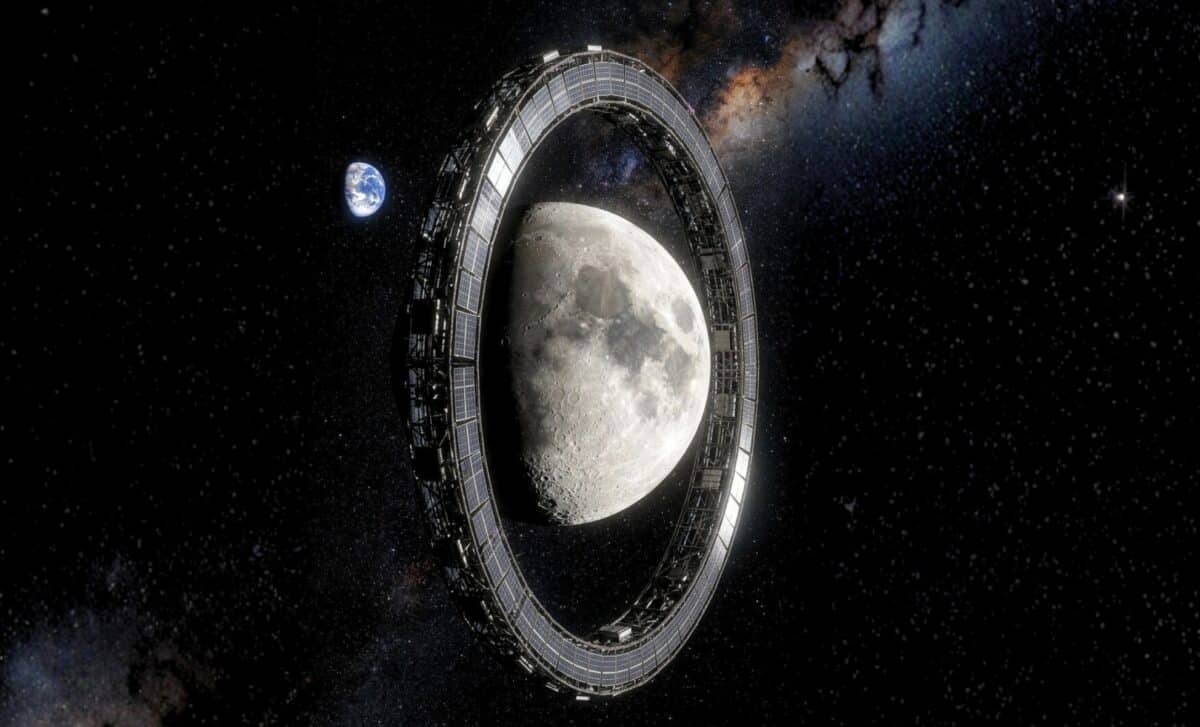
More than a decade ago, a Japanese construction company unveiled a plan to build a massive belt of solar panels around the Moon’s equator. The concept, called the Luna Ring, would stretch for 6,800 miles and generate uninterrupted solar power without any of the weather or darkness problems that plague Earth based arrays. The project received little attention at first, but after the Fukushima Daiichi nuclear disaster in March 2011, Japan suddenly had a much sharper interest in alternative energy sources.
The numbers are hard to ignore. Shimizu Corporation, the firm behind the proposal, claims that Earth based solar panels can only generate one twentieth of the energy produced by an equivalent array in space. On the lunar equator, there is no atmosphere to block sunlight, no clouds, and no night on the sunlit side, meaning the system could run continuously around the clock.
Tetsuji Yoshida, president of Shimizu’s space consulting group CSP Japan, told ABC News that if all the energy from the lunar panels reached Earth, there would be no need to burn coal, oil, or biomass ever again.
How Power Travels From the Moon to Your Home
The Luna Ring solves a basic problem with terrestrial solar power: intermittency. On Earth, solar farms stop producing at night and lose efficiency during cloudy weather, but the Moon has virtually no atmosphere, meaning nothing blocks the Sun’s rays. Along the lunar equator, one side or the other is always bathed in sunlight, enabling true 24 hour power generation.
Here is how the energy would travel. Solar cells on the lunar equator convert sunlight into electricity, and built in cables carry that power to the near side of the Moon, the face that always points toward Earth. There, transmission facilities convert the electricity into microwave beams and high energy lasers aimed at receiving stations on the ground.
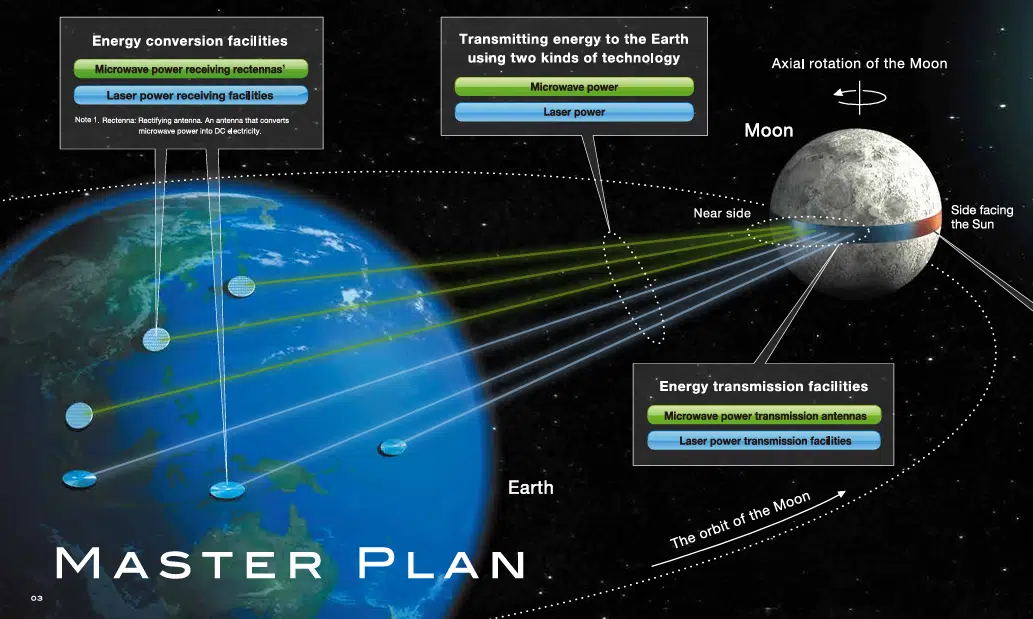 Solar cells on the lunar equator convert sunlight to electricity. Cables carry power to Earth facing side. Microwaves and lasers beam it to ground stations. Image Credit: Shimizu Corp
On Earth, specialized antennas called rectennas capture the microwaves and convert them back into electricity for the power grid. According to Shimizu’s proposal documents, the system could also use the energy to produce hydrogen fuel for storage and transportation. The goal is a complete shift away from fossil fuels and toward a hydrogen based society.
Robots and Moon Dirt: A Construction Plan Like No Other
Building anything on the Moon is extraordinarily difficult, so Shimizu plans to rely almost entirely on robots. These machines would be tele operated from Earth 24 hours a day, performing tasks like ground leveling, excavation of lunar crust, and assembly of equipment. A small team of astronauts would support the robots on site, but humans would play a secondary role.
The construction would also use lunar resources as much as possible, reducing the need to haul materials from Earth. Moon soil is an oxide compound, and by importing hydrogen from Earth, workers could produce water and oxygen from the lunar surface. The same soil could be turned into concrete, ceramics, glass fibers, and even the solar cells themselves.
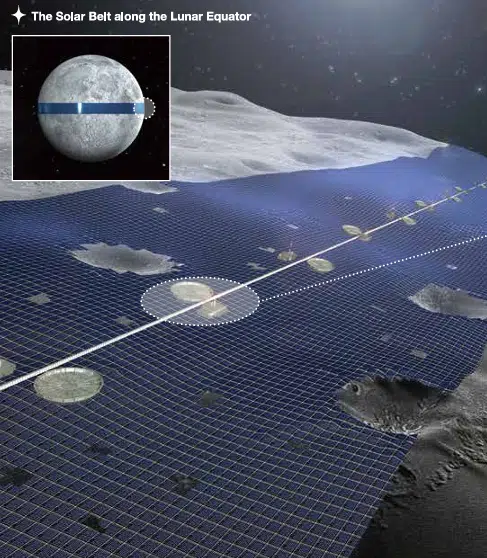 Tele operated robots will build the solar belt using lunar soil. Moon dirt can become concrete, glass, and solar cells. Self propelled plants will install panels automatically. Image Credit: Shimizu Corp
Shimizu’s proposal includes self propelled production plants that would move along the lunar equator, manufacturing solar cells from local materials and installing them as they go. The solar belt would range in width from a few kilometers to 400 kilometers at its widest point, wrapping the entire circumference of the Moon. A transportation route along the equator would carry construction materials, with power cables buried underneath.
The Cost Problem That Nobody Has Solved
For all its ambition, the Luna Ring faces one overwhelming obstacle: money. Masanori Komori, an economist with the Institute of Energy Economics in Japan, told ABC News that lunar solar power sounds good in theory but costs too much. He argued that Japan should focus on more realistic alternatives like geothermal power, which is already available and far cheaper to develop.
Yoshida himself admitted that he has no concrete estimate of the project’s cost. The technology required is still in the research phase, including the ability to beam gigawatts of power across 238,855 miles of space with pinpoint accuracy. The microwave and laser transmission would require guide beacons on Earth to ensure the beams hit their receiving stations, a feat never attempted on this scale.
Despite these hurdles, Shimizu’s proposal argues that all the basic ingredients already exist. Sunlight is free, solar panels are mature technology, and both microwaves and lasers are well understood. The challenge is scaling everything to an unprecedented degree and doing it on the surface of another world.
Where the Luna Ring Stands Today
As of the source documents from 2011, the Luna Ring remained a conceptual dream project on Shimizu’s official website. The company had not secured any funding, received no official endorsement from space agencies like JAXA or NASA, and had no active development timeline. The proposal was featured on NASA’s Lunar Science Institute website but generated little interest beyond that.
The Fukushima disaster changed the conversation temporarily. With 54 nuclear reactors generating 30 percent of Japan’s energy supply and more than half of them idled after the meltdown, the Japanese public and government became more open to unusual alternatives. Yoshida noted that his plan had been quiet for a year before suddenly receiving attention after the March 2011 earthquake and tsunami.
No public updates from Shimizu have moved the project beyond the proposal stage. Yoshida remains confident, telling ABC News that all the team is doing is using existing resources: sunlight, solar panels, microwaves, and lasers. “If we can continue to do the research,” he said, “we think there’s a huge chance this could become reality.”