
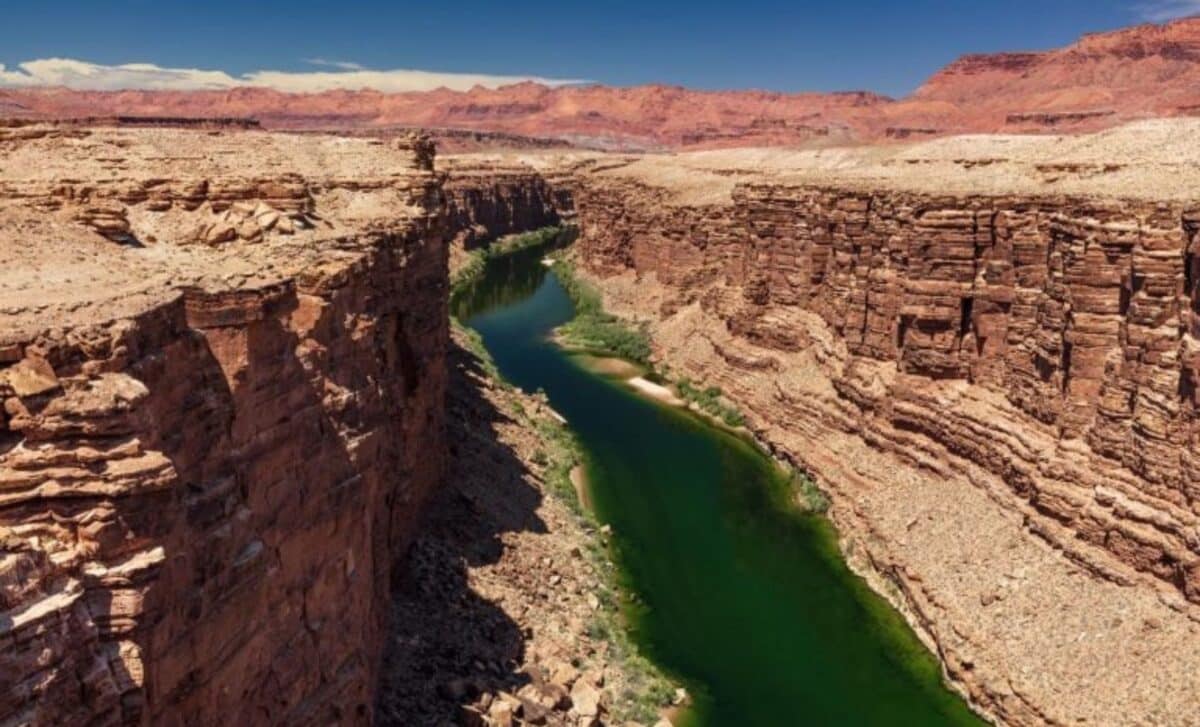
For over 150 years, geologists have wondered how the Green River, the largest tributary of the Colorado River, managed to carve a path through the Uinta Mountains in Utah. A new study, published in Journal of Geophysical Research: Earth Surface, may finally provide the answer, which could hold the key to this long-standing mystery.
It follows a surprisingly direct path through the Uinta Mountains, which are much older than the river itself. The Uinta Mountains formed around 50 million years ago, while the Green River has only followed its current course for about eight million years. Still, the river managed to cut through this mountain range instead of avoiding it, a phenomenon that has long puzzled geologists.
What is Lithospheric Dripping?
Therecent study suggests that “lithospheric dripping” could explain the river’s path. This process happens whenheavy, mineral-rich material accumulates at the bottom of the Earth’s crust and eventually sinks into the mantle. As this material descends, it pulls the crust down, temporarily lowering the land surface.
This would have allowed the Green River to cut through the mountains during a time when the land was lower. The researchers pointed out that this subsidence created an opportunity for the river to erode the exposed rock and form the canyon system it follows today. According to Dr. Adam Smith from the University of Glasgow, lead author of the study:
“We think that we’ve gathered enough evidence to show that lithospheric drip, which is still a relatively new concept in geology, is responsible for pulling the land down enough to enable the rivers to link and merge.”
The study suggested that this process allowed the flow to carve its path, eventually connecting with the Colorado River system.
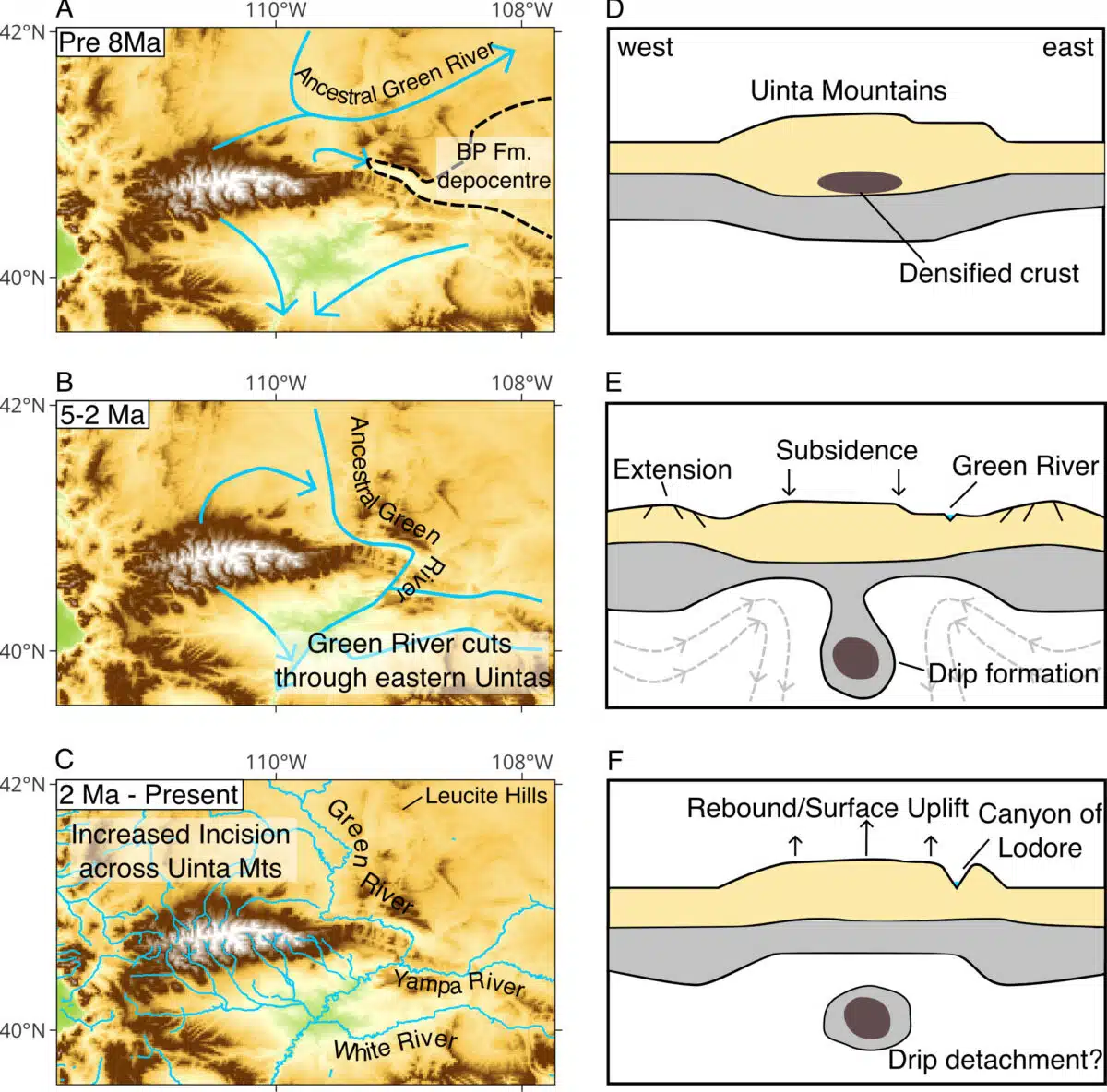 This diagram illustrates the geological history of the Green River’s path through the Uinta Mountains. Credit: Journal of Geophysical Research: Earth Surface
Seismic Imaging Supports the Theory
To support this hypothesis, the study used seismic imaging and computational models. Seismic imaging works similarly to a CT scan, analyzing how seismic waves from earthquakes travel through the Earth’s surface. The researchers identified a cold, circular anomaly about 200 kilometers beneath the Uinta Mountains, which they interpret as the detached part of a lithospheric drip. This anomaly measures between 50 and 100 kilometers across.
Using data from previous seismic studies, the team calculated how far this mass had descended and estimated its rate of movement. The findings suggest that the lithospheric drip likely separated between two and five million years ago, which coincides with the time the greenwater stream carved its path through the mountains. The study’s modeling further supports this, as it showed that the surrounding networks displayed the characteristic “bullseye” uplift pattern associated with lithospheric dripping.
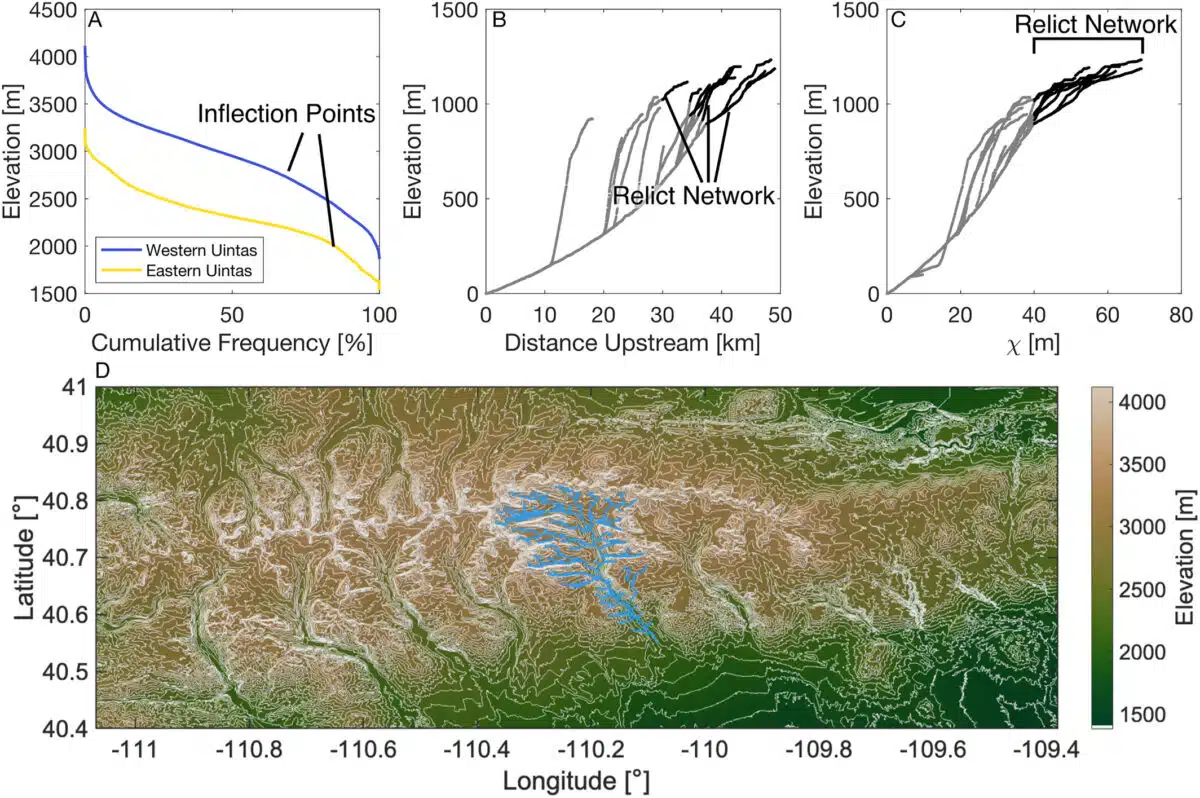 This figure shows elevation data and topography of the Uinta Mountains. Credit: Journal of Geophysical Research: Earth Surface
How Did the Green River Carve Its Way Through the Uinta Mountains?
Some geologists had suggested that the river existed before the mountains were formed, or that erosion from the south had captured the channel. The findings from this study provide strong evidence against these ideas, confirming that lithospheric dripping is likely responsible for the water course’s path. Smith added:
“The evidence we’ve collected strongly contradicts the idea that the river predated the mountains, or that sediment deposits might have built up enough for the river to overtop the range, or that erosion from the south of the mountains captured the Green River.”
The findings support the idea that the river’s path was shaped by deep, slow-moving geological processes over a long period, gradually carving out the landscape we see today.
“We hope that this paper will help resolve a longstanding debate about one of North America’s most significant river systems, and help build the growing body of evidence that lithospheric drips may be the hidden answer to more tectonic mysteries than we’ve previously realized,” Dr. Smith concluded.