
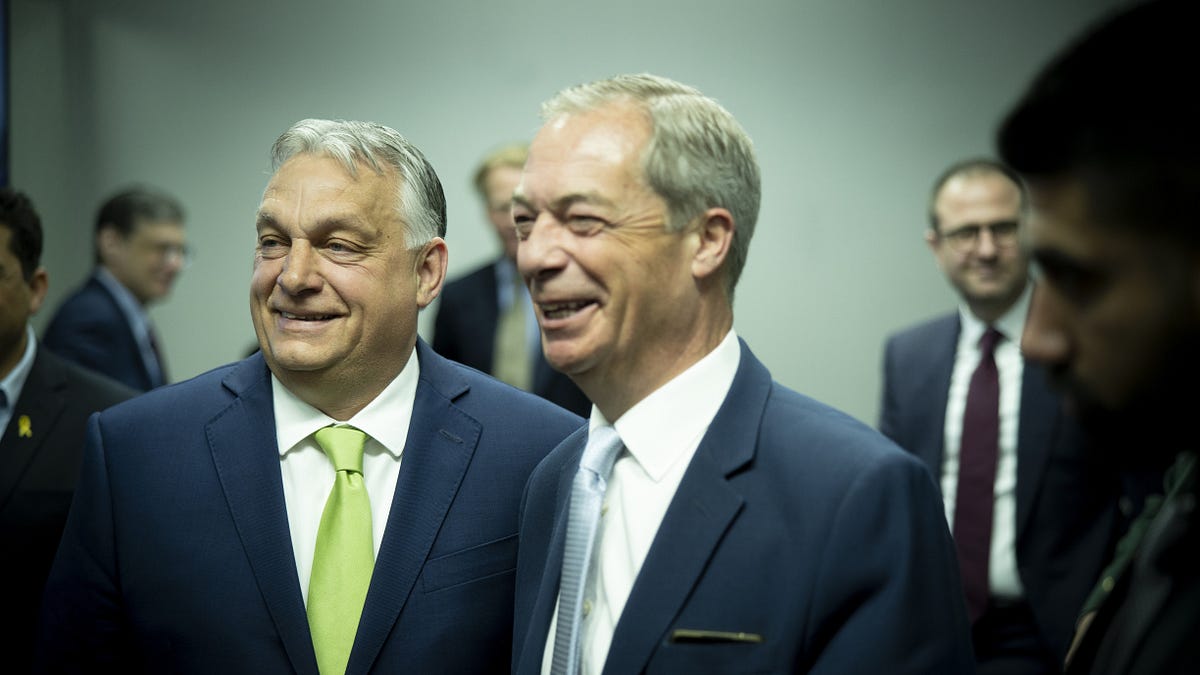
 Hungarian prime minister Viktor Orbán and Nigel Farage at the National Conservative Conference (NatCon) in Brussels, 2024. (Photo: MTI)
This weekend, Hungary is holding what observers have described as the EU’s most consequential election this year.
Viktor Orbán has presided since 2010 over what he calls ‘illiberal democracy’. He’s also become one of the global figureheads of the radical right.
Donald Trump, Nigel Farage and a growing number of figures on the British right have long looked to Budapest for inspiration. J.D. Vance is set to arrive there tomorrow to lend his support.
With Orbán’s Fidesz party trailing in the polls – and growing allegations of dirty tricks by the incumbent ahead of Sunday’s vote – I wanted to find out what’s happening in Hungary, and what it might mean for Britain.
So I commissioned Dan Nolan, a seasoned Hungary-watcher, to follow the money connecting Budapest and the British right. The results are well worth your time today.
Before we get to Dan’s wonderful piece, I wanted to update you on our membership drive. Nearly 100 of you have decided to support Democracy for Sale since we asked for your help just two weeks ago. We’re incredibly grateful and if you’ve already signed up, go ahead and skip down to Dan’s reporting with our thanks.
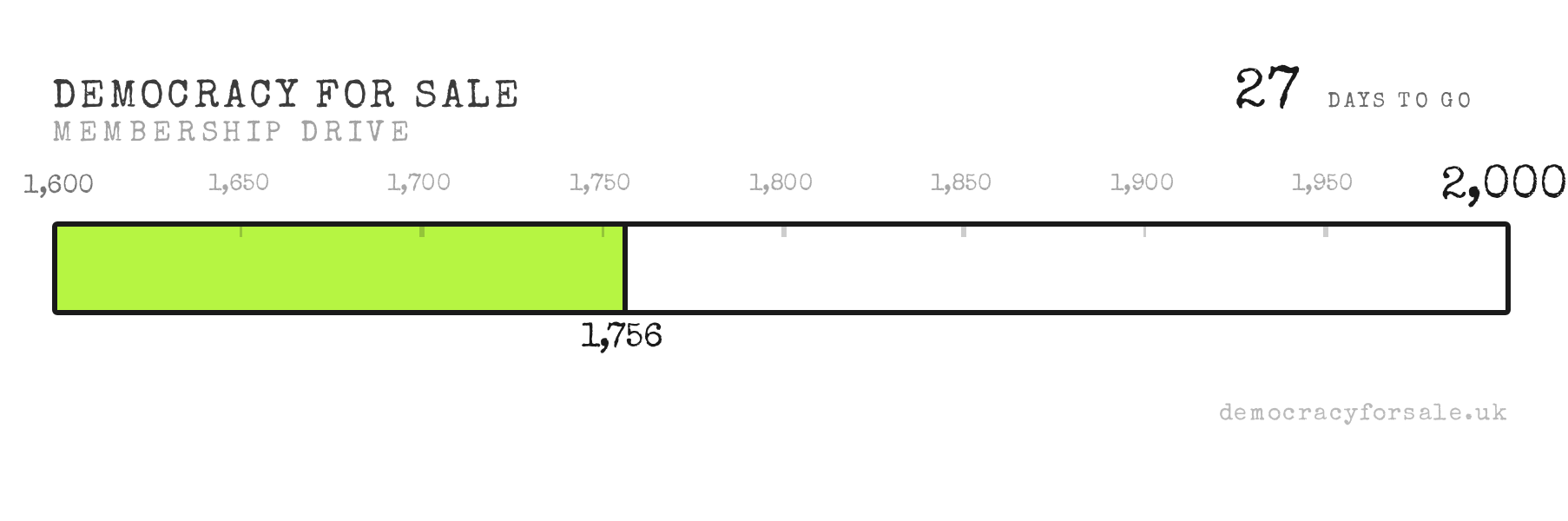
If you aren’t already, please do consider becoming a paid supporter. Just 50 quid a year, or 5 a month, helps us fund complex investigations and vital cross-border work like today’s piece. It’ll also give you access to our members’ only livestream later this month.
We now need 10 new supporters each day to meet our goal of 2,000 by the end of the month. Will you be one?
By Dan Nolan
In June 2015, Hungary’s state-backed tech festival, Brain Bar, had a special guest speaker: British historian Niall Ferguson. But Ferguson wasn’t appearing in person. In a regional first, he beamed in as a hologram at a Budapest arts space.
Ferguson started to speak, but the volume stayed on zero. Worse, the world’s leading conservative historian was three feet tall. The hologram continued inaudibly until a panicked soundman appeared and “rewound” the mini-historian like a Betamax tape.
 Are Friends Electric? Ferguson beams into Budapest
Eventually, Ferguson began his speech. Hungary, he said, might have the answers to the West’s “institutional degeneration.” With a nod to the upcoming Brexit referendum in his native land, Ferguson wondered aloud whether Budapest was “the perfect place to ask the question: What is Europe in the 21st century?”
A decade later, Viktor Orbán has answered that question in ways Ferguson probably didn’t anticipate. Using Hungarian public money – funnelled through legally insulated foundations partly funded by Russian oil revenues – Orbán has built a cross-border network of populist right think tanks, journalists and activists.
Over the intervening years, too, Budapest has become a stomping ground for many on the British right, from Matt Goodwin and Margaret Thatcher’s former speechwriter John O’Sullivan, to a cast of characters that includes commentators with salaries and contractual obligations to place pro-Budapest arguments in UK media.
With Orbán facing the most serious electoral challenge of his career on Sunday April 12, that network is no longer merely a cultural project: it has become active infrastructure in a live campaign, raising urgent questions about foreign funding, undisclosed influence and the outsourcing of political messaging to paid allies.
Hungary under Orbán funds a network of institutions designed to shape conservative debate both at home and abroad, encompassing annual events such as Brain Bar and CPAC Hungary – the first time the American Conservative Political Action Committee brought its annual conference to Europe – as well as universities, think tanks and media outlets
Many of these nodes have ties back to the British right. Take the Danube Institute. The Budapest-based think tank was founded by John O’Sullivan and employs mainly British and American fellows.
The first wave of British recruits – O’Sullivan, historian Norman Stone, traditonalist conservative philosopher Roger Scruton in his final years – lent intellectual credibility to Orbán’s project. A subsequent cohort included Douglas Murray, while Tim Montgomerie’s role as Boris Johnson’s social justice adviser was not renewed after he was recorded, in 2019, praising the Hungarian leader’s “interesting early thinking on the limits of liberalism” and calling for a “special relationship” between Britain and Hungary, at a Danube Institute event in Budapest. Montgomerie has since joined Reform.
By the early 2020s, the Institute had acquired a permanent London presence. Its “Anglosphere Fellow” David Oldroyd-Bolt is based in London where he often appears in The Telegraph, The Spectator and GB News and hosts a podcast series entitled “View from the Thames.”
The Danube Institute is funded by Batthyány Lajos Foundation (BLA), which Orbán repurposed from an existing organisation and gave the unusual status of a publicly managed body governed by private individuals, placing it outside ordinary treasury oversight.
The specifics of what fellows are paid – and what they are required to produce – became public through contract documents obtained by investigative outlet Átlátszó after a protracted legal battle. The Institute’s payments to visiting scholars and guest speakers more than tripled in under three years: from €197,000 in 2022 to €730,000 in the first ten months of 2024.
The contracts are explicit about deliverables. Fellows are required to give speeches, attend events, network, and place articles in Western outlets. The UK publications specifically named as placement targets: GB News, The Spectator, The Critic and UnHerd.
US Christian writer Rod Dreher receives $8,750 a month. In 2023, Dreher, a noted Orbán supporter credited with influencing JD Vance’s conversion to Catholicism, appeared at the National Conservatism conference in London alongside Jacob Rees-Mogg, Suella Braverman and Michael Gove.
There are other financial ties between Orbán’s administration and the British right. A foundation set up in the name of the late Roger Scruton has received more than £512,500 from the Hungarian government since 2023 – over 90% of its total funding.
The Roger Scruton Legacy Foundation (RSLF) has used these funds to host events at leading British universities with speakers aligned with Budapest’s cultural priorities. In 2023, the foundation invited US tech billionaire Peter Thiel to speak at Oxford, where he compared equality, diversity, and inclusion initiatives to the Chinese Communist Party.
Last year, RSLF hosted a conference called ‘Now and England’, where politicians from both the Conservative party and Reform spoke. Meanwhile, the Hungarian embassy in London hosted the foundation’s symposium.
Scruton’s name also adorns not only a London-based foundation but a chain of more than half a cafes in Hungary, to which his widow, Lady Sophie Scruton, donated his library.
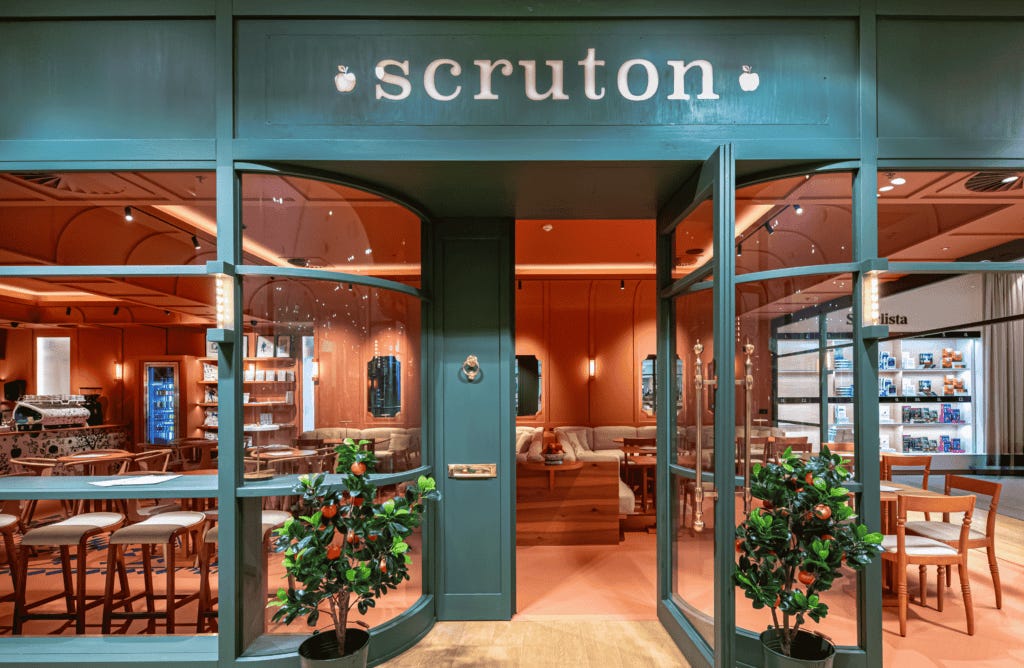 Anyone for a cup of Scruton?
The RSLF’s board connects it directly to the UK political mainstream. Michael Gove joined as a director in May 2025; Nigel Farage’s adviser James Orr, a key figure in the Reform firmament, has served as a director since the foundation’s creation.
The Scruton Foundation’s funding comes from something called the Mathias Corvinus Collegium. Described as Orbán’s ‘pet university’, the MCC’s chair, Balázs Orbán – Viktor’s political director, no relation – has said: “It is our goal for Hungary to become an intellectual powerhouse, in which MCC plays a key role.”
The MCC funds a sprawling network of think tanks, publications, fellowships and summits all pushing a radical right agenda – all bankrolled by the Hungarian government.
The sums involved are remarkable. Founded in 1996 as a modest educational institution for talented Hungarian students, MCC was significantly enlarged in 2020 when Hungary’s Fidesz-majority National Assembly transferred to it 10% stakes in two of Hungary’s largest companies – energy firm MOL and drugmaker Gedeon Richter – along with $462 million in cash and $9 million worth of property. The combined endowment was valued at a whopping $1.7 billion: nearly 1% of Hungary’s Gross Domestic Product.
Much of this cash comes from Russian oil. MOL sources approximately 65% of its crude from Russia. According to an investigation by German broadcaster ZDF, MCC received around €50 million in MOL dividends alone in one recent year.
Among the initiatives that this money has funded is MCC’s Brussels outpost, launched in 2022 under the aegis of Frank Furedi, the Hungarian-born former chairman of the Revolutionary Communist Party and a long-time contributor to Spiked, the online magazine that grew out of the RCP’s network.
Furedi’s trajectory – from the Marxist far left to a Budapest-funded operation focused on opposing migration, net-zero policy and EU progressive funding streams – is not completely unique. His long time collaborator Claire Fox was put into the House of Lords by Boris Johnson.
MCC Brussels declared income of more than €6.3 million in 2024, reportedly more than any other political think tank in the city apart from Bruegel. The advocacy group Corporate Europe Observatory filed a formal complaint over what it described as MCC’s incomplete transparency filings.
Sunday’s election looks set to be the toughest yet for Orbán since he re-won power in 2010 after ditching his previous centrist persona and pushing hard to the right. As Orbán’s poll ratings have faltered, the radical right internationale that Hungary has underwritten has become increasingly belligerent.
In late February, Irish macroeconomist Philip Pilkington – who holds a double affiliation with the Danube Institute and the Hungarian Institute of International Affairs – posted on X that “the increasingly desperate Hungarian opposition is releasing really crazy polls now.” The post was shared by AfD co-chair Alice Weidel, who accused the EU of “desperately trying to overthrow” Orbán.
By mid-March, Pilkington was posting a thread on X accusing Meta of “boosting [opposition leader] Péter Magyar artificially” and “suppressing Viktor Orbán’s posts.” He named the Meta employee responsible for Central and Eastern European operations, described him as “a Ukraine fanatic and an LGBT activist” based on his personal Facebook profile, and published his details.
The thread was amplified the same day by Fidesz government spokesman Zoltán Kovács and by RT, Russia’s state broadcaster. The distance between a Danube Institute fellow’s personal commentary and material appearing in Fidesz’s official pre-election communications had, at that point, effectively collapsed.
Pilkington is not alone. In early March, MCC visiting fellow and recently failed Reform candidate Matt Goodwin delivered a keynote at MCC’s Budapest Summit.
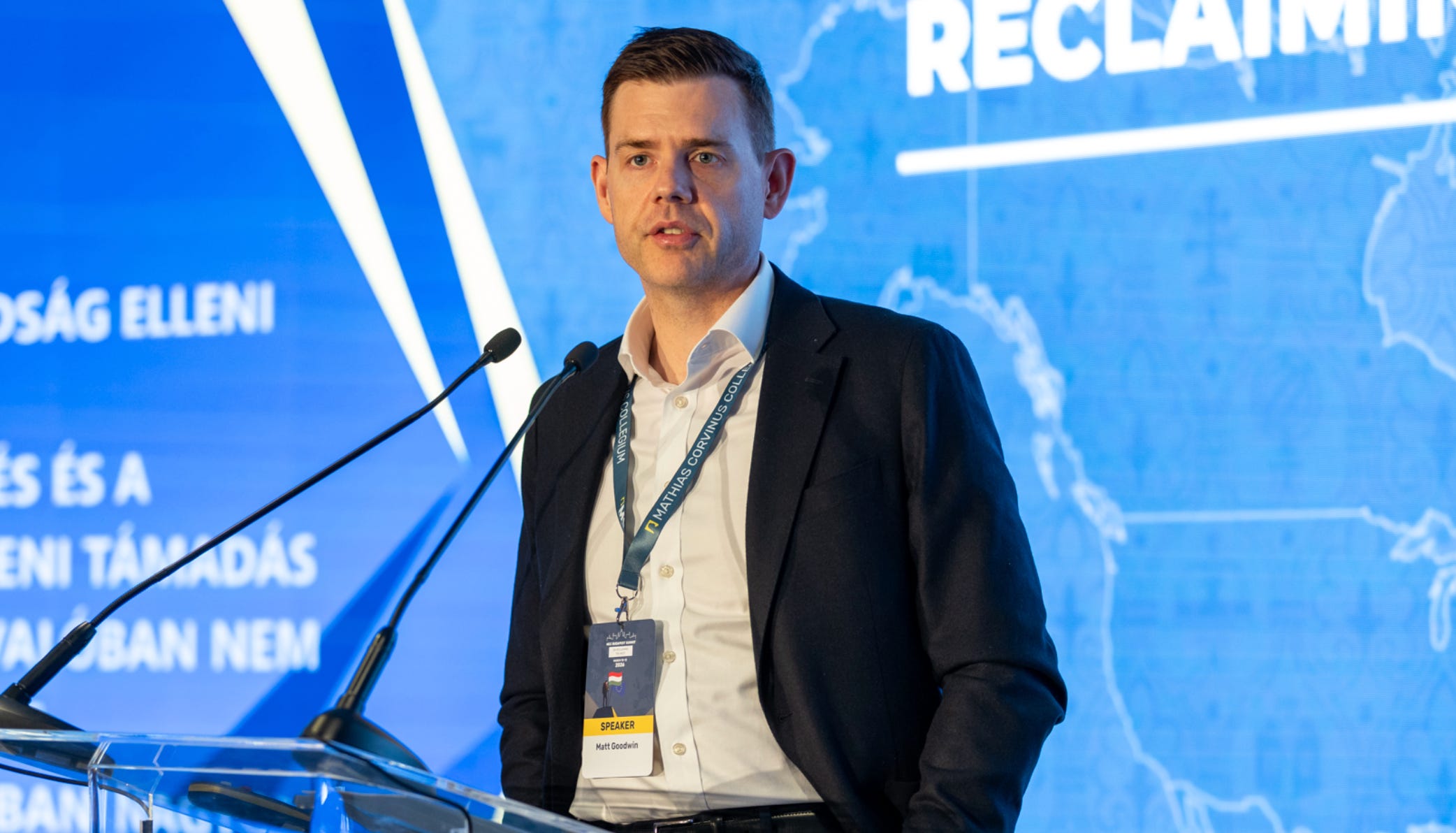 Matt Goodwin in Budapest last month (Photo: The Hungarian Conservative)
Goodwin has long been a fellow traveller in the Orbán project. The previous month, at an MCC Brussels event, he claimed that “by the end of this century, one in three of the under 40s in the United Kingdom will be following Islam”.
Whether Goodwin’s statistic came from ChatGPT isn’t clear but what we say is that he’s been a direct beneficiary of Orbán’s politically-motivated largesses. Goodwin has been paid a salary of up to €10,000 a month, according to leaked documents obtained by Hungarian investigative journalists Direkt36 and reported by the Good Law Project.
Sunday’s election could mark the beginning of the end of Orban’s propaganda network. Most independent polls have consistently shown Magyar’s Tisza Party ahead by double digits. Tisza’s election programme commits explicitly to recovering MCC’s state assets and ending the practice of using public funds to build political networks.
“Taxpayers’ money can only be spent on education, research and genuine, merit-based talent development. We will draw a clear line between education and propaganda,” the opposition has said.
But unpicking Orbán’s network of radical right influence might prove easier said than done. Magyar would need a two-thirds parliamentary majority to alter the governance of foundations like the Danube Institute and MCC.
But even a simple majority would likely mean fellowship contracts not being renewed and budgets for London events and media outlets being reduced. The Roger Scruton Legacy Foundation would need to find alternative sources for the £500,000-plus it receives annually from MCC.
The newer cohort of British fellows – whose publication records and speaking engagements have been shaped substantially by Budapest’s contractual infrastructure – would face a considerably thinner market for their work.
What began as cultural outreach has evolved into a cross-border political network with a growing UK presence. Whether it can sustain itself without Hungarian state backing may be tested after Sunday.
Thank you for reading. We’re trying to reach 2,000 paid supports by the end of April to fund vital investigations. Will you help?
The cost is just £50 a year. Paid subscribers can add comments and access other exclusive content. You can unsubscribe at any time and receive a refund of your unused subscription.