
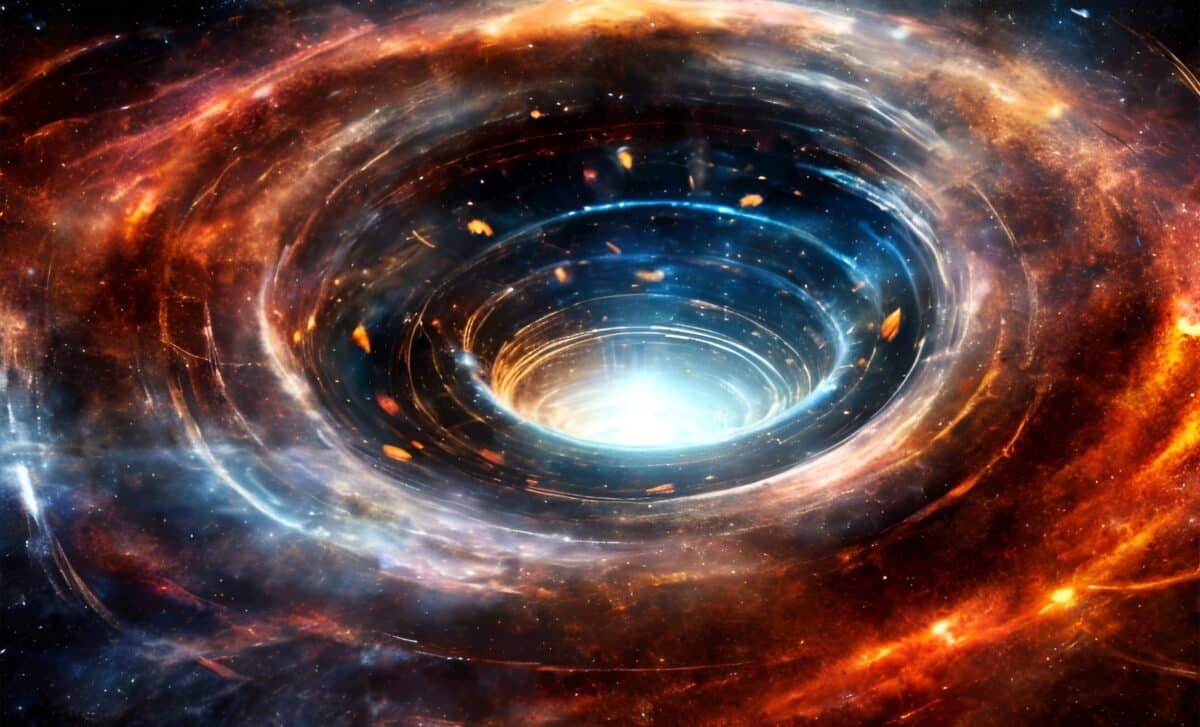
A vast reservoir of water vapor has been detected around the quasar APM 08279+5255, located more than 12 billion light-years from Earth. The amount of water identified equals roughly 140 trillion times all the oceans on our planet, making it the largest known supply of water in the universe.
This quasar is powered by a supermassive black hole with a mass estimated at 20 billion times that of the Sun. It releases energy comparable to a thousand trillion Suns, creating an extreme environment where gas and dust are heated and transformed. Such conditions allow astronomers to observe how matter behaves near one of the most energetic phenomena in the universe.
Observing objects at this distance means looking back in time. The light captured today began its journey when the universe was still in its early stages. This makes the system an important reference point for understanding how galaxies formed and evolved over billions of years.
A Region Defined by a Supermassive Black Hole
At the heart of APM 08279+5255 lies a black hole pulling in surrounding matter. As this matter spirals inward, it heats up and emits intense radiation across multiple wavelengths, turning the quasar into one of the brightest known cosmic objects.
According to Astrophysical Journal Letters, this process creates a unique environment where molecules can form and survive despite extreme radiation. The energy released does not remain confined; it affects the surrounding gas across vast distances, reshaping the structure of the region.
Quasars like this one have long fascinated astronomers because they outshine entire galaxies. Their brightness allows scientists to probe distant regions of space that would otherwise remain hidden, offering insights into the large-scale distribution of matter.
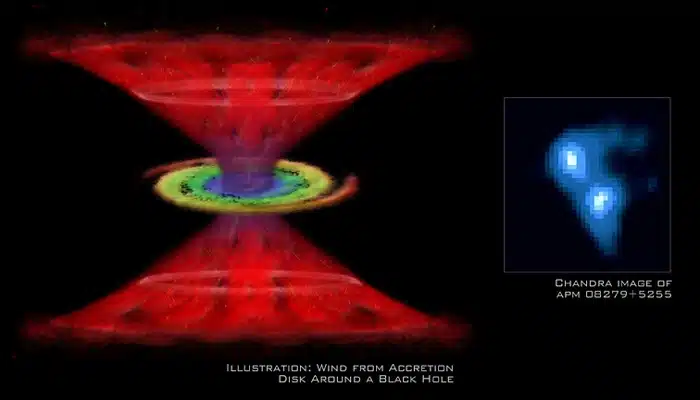 llustration of high-velocity outflows generated by an accretion disk around a supermassive black hole. Credit: Chandra X-ray Observatory
A Record-Breaking Quantity Of Water Vapor
The detected water extends across hundreds of light-years. While the gas is extremely thin compared to Earth’s atmosphere, it is still significantly warmer and denser than typical interstellar material. According to Matt Bradford, who led one of the research teams:
“The environment around this quasar is very unique in that it’s producing this huge mass of water,” he said. “It’s another demonstration that water is pervasive throughout the universe, even at the very earliest times.”
The gas temperature is around -63°F, which is relatively warm for such a distant cosmic region, and its density exceeds that of similar environments by a wide margin.
Other molecules, including carbon monoxide, were also identified. Their presence suggests a chemically rich environment with abundant material. This gas could continue feeding the black hole, allowing it to grow further, or it could contribute to the formation of new stars within the region.
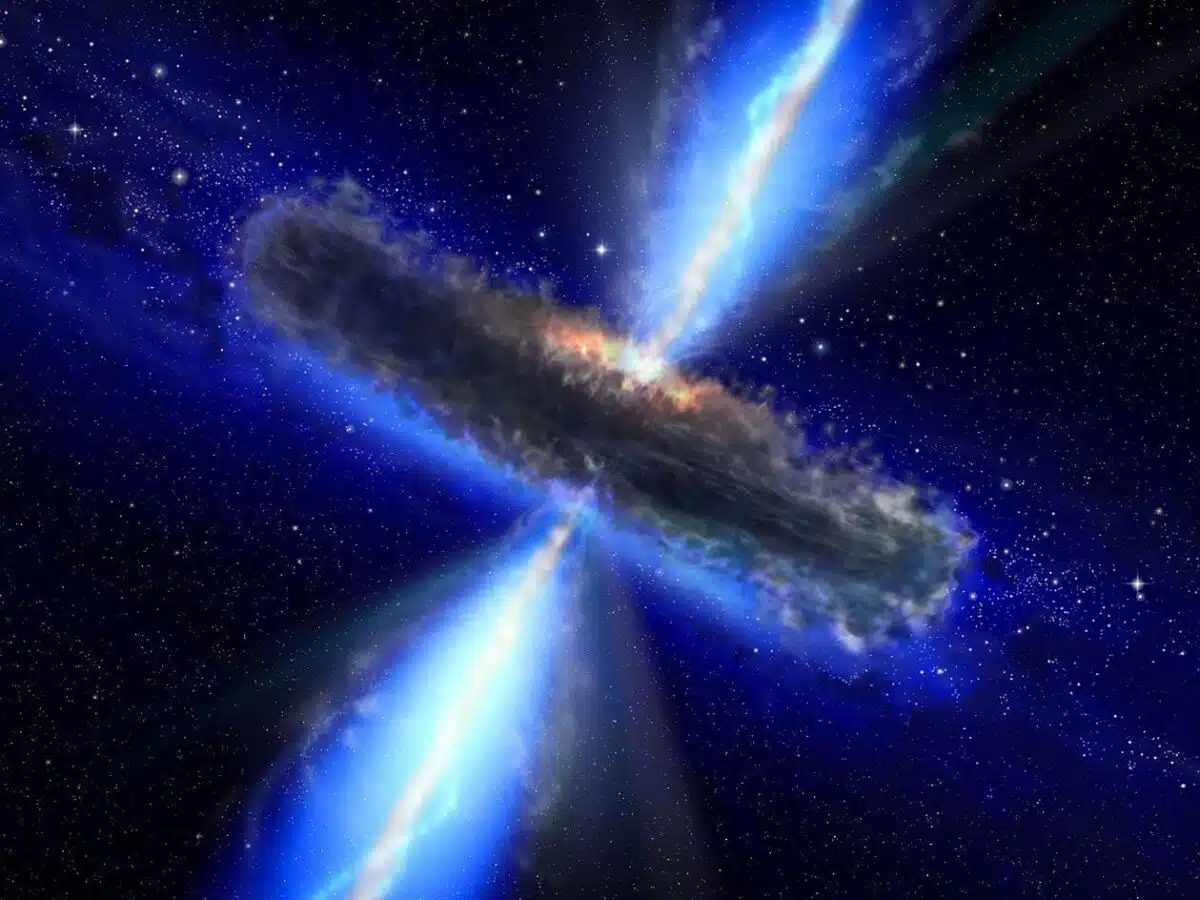 Conceptual illustration of a quasar similar to APM 08279+5255. Credit: NASA/ESA
The Early Universe Is Revealing Its Wildest Side
The discovery was made using a combination of advanced instruments. Initial observations were carried out with Z-Spec at the Caltech Submillimeter Observatory in Hawaii, which first detected signals associated with water vapor.
Researchers involved in the observations noted that, these findings were later confirmed using the Combined Array for Research in Millimeter-Wave Astronomy (CARMA) in California. Additional observations from the Plateau de Bure Interferometer in France helped validate the results and refine measurements.
Earlier studies had only suggested water might be there, based on a single spectral signal. Later observations picked up several more, confirming not just its presence but also how massive the reservoir really is. Using multiple instruments made it clear this is both the largest and most distant water supply ever detected.