

With grocery prices expected to climb and B.C. residents looking to cut down on costs, there’s a new tool Vancouverites can use to try to cut down their spending on food.
Camille Baycroft and Jacob Bildy recently launched Dishlist, a platform that helps people meal plan using the ingredients they already have on hand and what’s on sale at the grocery stores.
It also has a “super budget” option, which promises to try and keep the cost-per-meal below $3.25.
Baycroft said that a lot of the available meal planning apps or websites tend to “stop at the point of inspiration.”
“What we’re trying to do is merge the inspiration with helping people make practical grocery decisions, given what they have, and what’s on sale, and what they like to eat and what’s left over from one recipe to another,” she said.
People can snap a photo of the food in their pantry or fridge and upload it to Dishlist. It then identifies the ingredients and finds recipes they can make with them.
It has access to 45,000 recipes from Google. While Dishlist shows the list of ingredients, users still have to go to the original recipe website if they want instructions. This means that Dishlist isn’t compromising recipe blogs’ web traffic or revenue potential, as AI companies have done.
The platform also has a meal planning tab, which allows users to select how many meals they want to make in a given period and choose different categories — like super budget or vegan, for example. It then generates a meal plan and grocery list based on this.
Dishlist is connected to Instacart, and Baycroft and Bildy earn a commission if people decide to order their groceries that way. But people can also take the list to the grocery store if they want to do their shopping themselves.
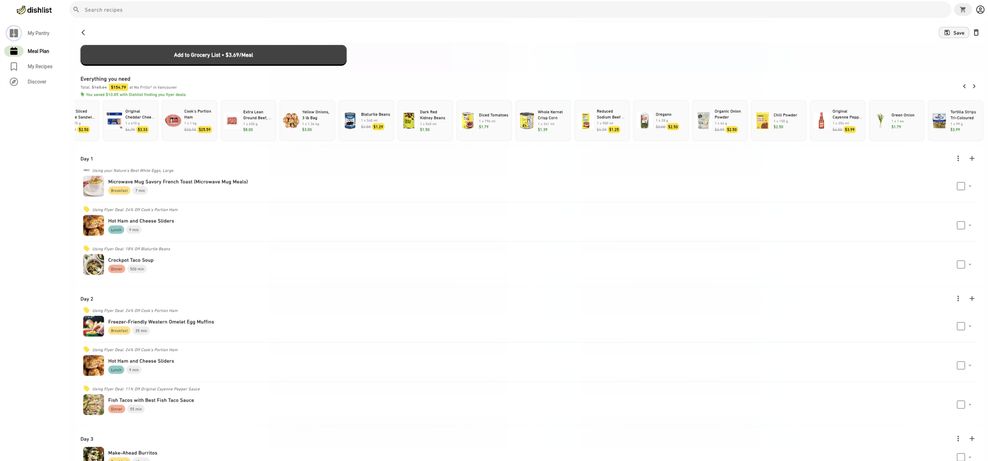
An example of a Dishlist meal plan. (Camille Baycroft/Supplied)
“We’re really just focused on trying to help in whatever way we can … with solving food waste and helping people save a little bit of money,” said Bildy.
Currently, they are working with No Frills, but said they hope to expand to other grocery stores in Vancouver.
The story behind the app
Bildy said they decided to build this based on problems that they were experiencing in their own lives.
“We would try our best to meal plan. We would pick recipes, and we would go and get all the ingredients we needed, and try our best. And then we get stuck with leftover ingredients that would go bad,” he said. “And then we default to Uber Eats, which is just so expensive.”
“Obviously, we have no control over the price of groceries, but we did feel like, ‘Hey, we’re wasting all this food, and it feels like maybe there’s something we could do to try to fix this.’”
Since both Baycroft and Bildy worked in software, they looked at this problem from a technical perspective. They realized that people are “disconnected” from what’s in their pantry, what’s on sale at the store, what the product quantities are, and the leftover ingredients they have.
“That’s what led us to build Dishlist,” said Bildy.
Both quit their jobs as software engineers and started working full-time on Dishlist last October. Baycroft had a background with algorithms, and Bildy with user experience, and so their skillsets complemented each other.
“It [was] a hard problem [to solve],” said Bildy, “which is why we don’t think anyone’s built this yet, because it’s taken both of us obsessing over this every waking hour for months and months to really figure out how to even approach this.”