
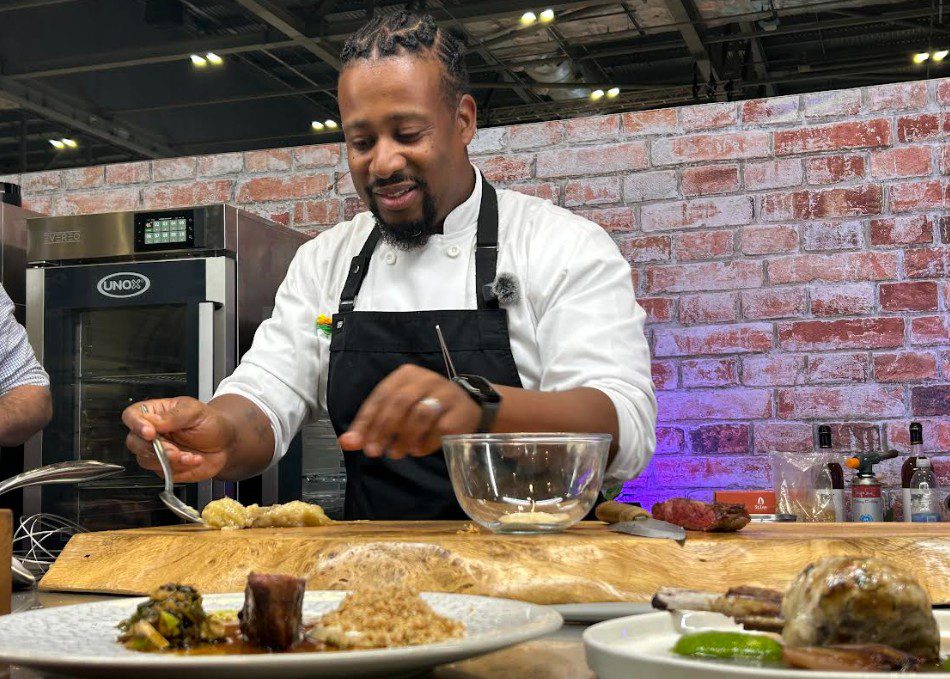
Chef Mike Reid plates up lamb cutlets cooks with a farci of sweatbreads, wild garlic and lovage wrapped in caul fat.
NEW Zealand lamb predominates in United Kingdom supermarket sales, but the nation’s food service industry favours the milder taste of Australian lamb, a meat expert told a large food expo in London this week.
Addressing crowds at UK’s premier hospitality and foodservice trade event, Meat & Livestock Australia’s country manager for UK and Europe Richard Sanders said the Merino-based background of Australia’s flock delivered a milder-flavoured meat preferred for highly-flavoured foods.
“Nothing against UK, lamb, the Welsh, Irish or NZ lamb … but their taste is really lamby and some people don’t like that. Australian lamb is really mild and that is why the Indian chefs love it, because the lamb doesn’t overpower the spices,” he said.
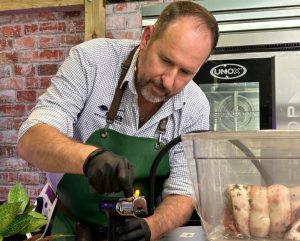
MLA’s Richard Sanders tackles smoking a rolled lamb shoulder.
“Australian lamb is different. It has a different texture and it’s a different flavour as well.”
The shift in UK demographics has been a strong factor in increased sales of sheep and goat meat into that country, according to an established exporter attending the event.
Gerard Meyn of Stella Foods said the demand for Australian product has been driven by the bazaars of major Muslim population centres, he said, citing the claim of Richard Saunders that 6 percent of Britain’s population accounts for 30pc of the nation’s sheep meat consumption. According to the 2021 Census, Muslims make up 6.5pc of the population in England and Wales, up from 4.9pc in 2011.
“There’s a lot of bazaars and that halal market is significant,” Mr Meyn said, adding that the newly inked Australia-EU Free Trade Agreement offered a good opportunity to enter and expand into that market.
He was among the 13 sheep meat, goat meat and beef exporters attending the three-day Hotel Restaurant and Catering expo under MLA’s Aussie Beef, Lamb and Goat campaign. The expo attracted more than 25,000 attendees under the banner of Food, Drink and Hospitality Week to the sprawling 44,546 sq m Excel pavilion space in east London.
The combined MLA platform comprised a commanding display stand in the vast expo complex and team members took over the central cooking demonstration site for most of the expo’s second day. They drew crowds for most of the session which saw two full cooking demonstrations, food sampling and a discussion panel examining the role Aussie beef and lamb in the UK.
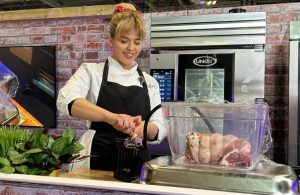
Chef Lara Norman prepared a Middle-Eastern inspired lamb dish with date glaze.
The cooking demonstration featured chefs, Lara Norman and Aussie Beef, Goat and Lamb brand ambassador Mike Reid who operates two – soon to be three – restaurants and features across TV and other media in the UK and Australia.
“English lamb is incredible, but Aussie lamb at the moment is probably the best,” he said.
“The marbling we’re getting at the moment is just next level.
“The flavour we’re getting is insanely good,” he said.
“And that’s what we look for; we look for that flavour, the ‘je ne sais quoi’, that point of difference. It’s so important.”
Mr Reid cooked cutlets with a farci of sweetbreads, wild garlic and lovage in a caul fat coating (‘nature’s cling film’).
Grilled cutlets were shared with the appreciative crowd who were unaware of an earlier drama in the behind-the-scenes kitchen. The cooking staff had to get creative when the stoves failed temporarily mid-sear. The meat had to be stashed in a warming oven until the grill was restarted.
Back at the demo kitchen, Mr Reid discussed the tension between local lamb producers opposing Australian imports.
“From a chef’s perspective the pressure is on buying local. And I understand that pressure, I feel that pressure,” he said.
“But ultimately I would rather give my guests the best experience.
“So having access to incredible meat, incredible lamb, consistent all year round with the attention to detail, for me that’s the most important thing.”
He also addressed the issue of Australian lamb size compared with lamb from other countries.
“It’s bigger, yes, but it’s consistent.
“It’s always the same size,” he said.
“Your recipes are influenced by your produce so – to me – we are giving more to our guests. they are getting more value for the same price and the quality is second to none so for me, the size is perfect.
“A lamb cutlet in the UK, it’s not cheap,” Mr Reid said.
“It’s a very expensive cut so if you can get a thicker cutlet with incredible flavour for comparable pricing, I’d think you’d be crazy not to.”
Smaller NZ lamb legs appeal to UK consumers
The comparative size of the smaller NZ carcases and Australian lamb gives the Kiwis an advantage in supermarket retail sales, according to UK-based Mark Smith who trades for the Swiss-based GVFI.
“The smaller legs appeal because the discretionary spend is less,” he said.
The NZ producers also match the UK seasonal demand.
“The two peak times are Christmas, when the NZ production season is just beginning but Easter is peak production,” he said, adding that recent years have also seen the growth of boneless cuts during the UK summer months.
Frozen lamb legs from NZ have traditionally dominated exports to the UK, providing up to 52% of volumes in 2024.
Visiting a London supermarket the week before Easter, Sainsbury’s was offering 50pc off NZ lamb – bringing it to around £8/kg.
“That’s a loss leader to get people into the store,” Mr Smith said.
More widely; however, domestically-sourced lamb was priced up to 33pc higher from last year, according to the industry’s The Grocer.
Lower UK production, driven down by unpredictable weather and disease, along with high demand for Easter and Ramadan, has led to a shortage of UK-sourced lamb for retailers.
Most UK sheep meat demand is met domestically or by NZ imports, although volumes of Australian exports destined for the UK are increasing.
There is certainly room for growth. Australia has undershot its quota allocation every year of the UK-FTA. It fulfilled only 47 percent of its sheep meat quota in 2025. However, sheep meat imports from Australia totalled 25,800 tonnes for that year, representing a 35pc lift on the year; and 2024 saw a 47pc rise in volumes from 2023.
Usage of Australia-UK FTA sheep meat quota
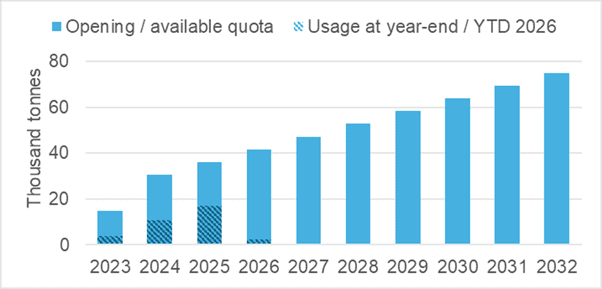
Source: Australia DAFF
The UK represents only 0.3pc of total Australian sheep meat exports by volume.
In the evening, the Australian Trade Commission hosted around 300 guests at Australia House.
Australian Trade and investment Commissioner James Fairley praised the UK-FTA “that has made Australian products more accessible and made Australian products more competitive in the UK market, enabling Australian suppliers to diversify the goods they can send and helping British companies to diversify their sources more.”
He praised South Australia’s Vili’s pies, which is now the official supplier of pies to the London Broncos.
Mr Fairley also praised Australia’s recently inked free trade agreement with the European Union.
“This one in a generation with the world’s second-largest economy will open up access to 27 member countries and about 450m consumers,” he said.
“But it’s not all about the FTA and tariffs.
“Australian and UK industry, processors and consumers, are relying on high-quality, sustainable products,” Mr Fairley said.
“Australia and the UK should work together to drive solutions for key global challenges facing our agricultural producers.
“Together we can work to diversify the products available on our shelves, collectively promote sustainability and health benefits and continue to supply high-quality, premium products,” he said.
“We are pleased to see the initial benefits of the FTA continue.
“It’s a win for industry and consumers, there’s no doubt about that,” he said.
“It’s a great deal for the UK and for Australia.
“There are countless opportunities for us to explore, resulting in significant benefits to both economies.”
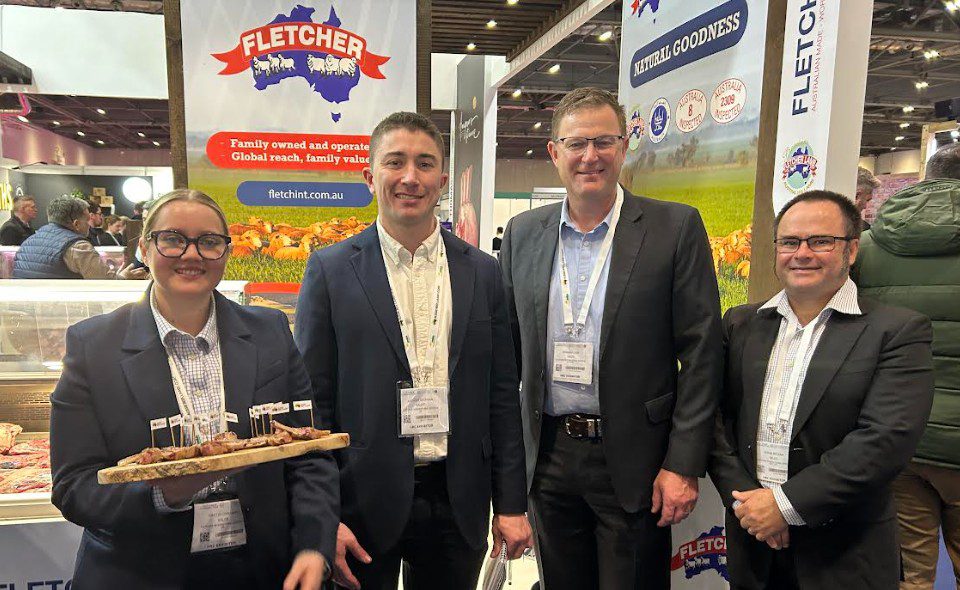
Serving up for Fletcher International, from left, Emily Coleman, Anthony Sheridan, Graham Lyon and Keiran McLean.
Exhibitors participating in the MLA-supported display were Ausvision Meat Producers (trading as Beaufort River Meats), Endeavour Meats, Fletcher International Exports, Greenham Australia, Jack’s Creek, JBS Foods Australia, Marble King, Mulwarra Export, Providore Global, Signature Beef, Stella Foods Australia, Teys Australia and Thomas Foods International.