
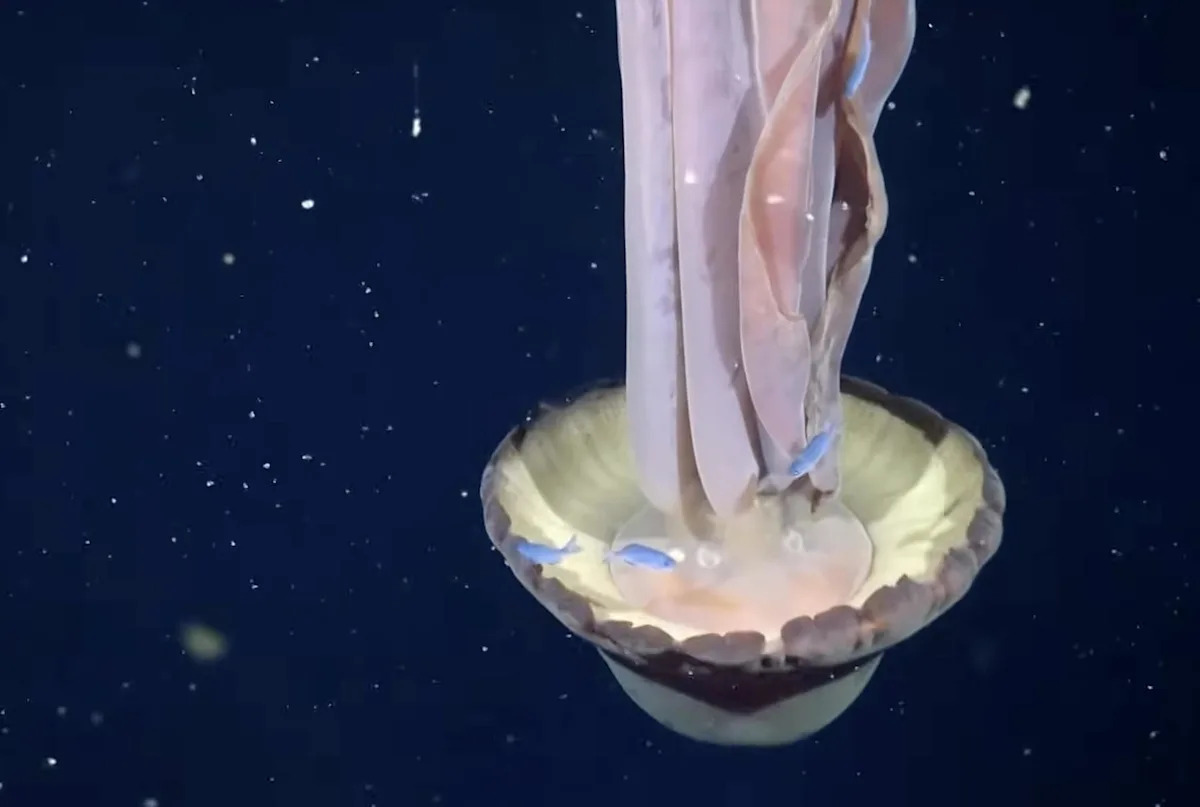
The post A Mysterious Giant Phantom Jellyfish Appears in Rare Deep Sea Encounter appeared first on A-Z Animals.
Quick Take
Researchers filmed the elusive Stygiomedusa gigantea nearly 3,000 feet below the surface off Argentina’s coast.
This “phantom” jellyfish features a bell over three feet wide and four ribbon-like arms reaching 33 feet.
With fewer than 130 sightings ever recorded, this encounter provides rare data on a mysterious midnight-zone predator.
Field expeditions in marine biology can be unpredictable. Sometimes, they yield little more than old barnacles; other times, they result in stunning ocean footage and the discovery of dozens of potential new species. This was the case in January 2026 off the coast of Argentina, when a group of scientists searching for cold seeps unexpectedly found and filmed a giant phantom jellyfish.
The expedition, operated by the Schmidt Ocean Institute, originally ventured to the Argentine coast in search of cold seeps. These are cracks in the ocean floor that release chemicals such as methane and hydrogen sulfide. They provide energy to the foundational layer of the marine food web. While researchers surely found the cold seeps, they also found a giant phantom jellyfish, Argentina’s first deep-water whale fall, and 28 potentially new species. Let’s learn more about this fantastic underwater voyage and all of its aquatic delights.
Academic Ambitions
As previously mentioned, the reason that scientists with the Schmidt Ocean Institute were 10,000 leagues underneath the Argentine sea was to find cold seeps. These cracks in the ocean floor release chemicals that microbes use as energy, forming the foundation of the marine food web. Until recently, however, no one had observed these cold seeps up close. Advances in remote-operated technology have now allowed scientists to explore these deep-water habitats in detail. Known as remotely operated vehicles (ROVs), these unmanned robots can dive deep, gather data, and allow marine biologists to study the ocean without risking decompression sickness.
However, in the process of looking for these cold seeps, the expedition’s scientists came across something unexpected. As María Emilia Bravo, the expedition’s chief scientist, explained to the New York Times, it was a shock. “There was a mixture of excitement and disbelief,” she said. “Its ethereal and delicate presence in such an extreme environment was deeply surprising.”
The King Phantom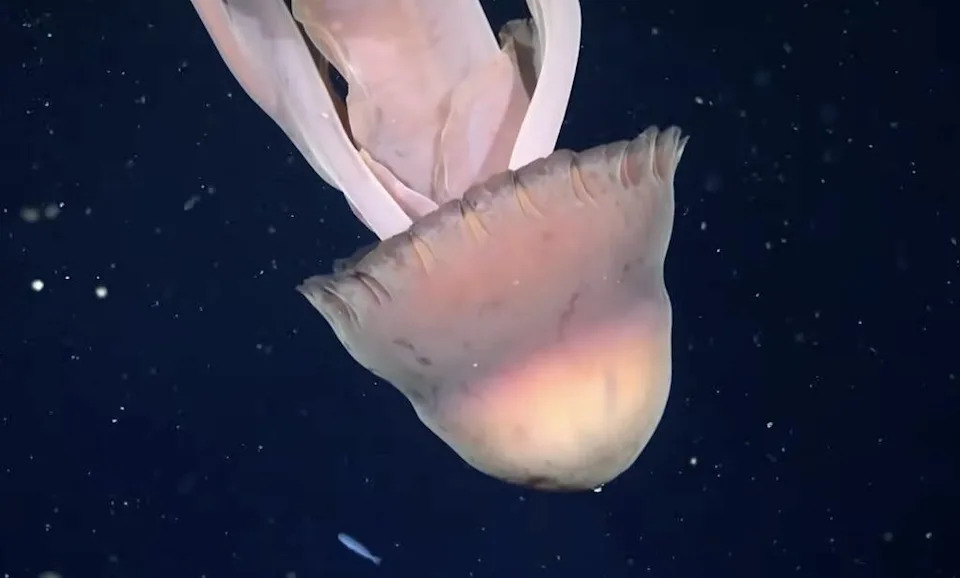
Giant phantom jellyfish can grow up to 33 feet in length, with bells that reach more than three feet wide.
©YouTube/Reuters – Original
(YouTube/Reuters)
Entirely unexpected, the expedition ran into one of the biggest jellyfish in the world—the giant phantom jellyfish. SuBastian, the ROV, spotted it along the Argentine coast about 820 feet below the surface. These formidable creatures can reach up to 33 feet in length, with bells that reach more than three feet wide. And while they may be big, they are elusive; people have only spotted giant phantom jellyfish about 120 times since the first specimen was collected in 1899. Their preference for living in the ‘midnight zone’—depths between 3,000 and 13,100 feet—helps keep them hidden from view.
Intimidating and ghostly, giant phantom jellyfish (Stygiomedusa gigantea) are somewhat different from other jellyfish. Giant phantom jellyfish lack stinging tentacles, so they grab prey using their ribbon-like arms and pull it into their mouths. Despite their size, they usually feed on plankton or small fish. For comparison, the specimen spotted by the research team was roughly the length of a school bus. The last time one of these rare and massive jellyfish was seen was in 2021 off the California coast.
Other Surprises
The team may have thought that the surprises were over after seeing the giant phantom jellyfish, but they could not have been more mistaken. Indeed, several discoveries happened on the trip. For one, they discovered the largest known Bathelia candida coral reef. Comprising about 0.15 square miles of ocean, the coral reef is almost the size of Vatican City. Furthermore, the expedition team found it about 370 miles farther south than its known range.
Later, the team discovered a whale carcass on the seafloor. While this might not seem significant at first, its location—about 12,800 feet below the surface—marks Argentina’s first recorded deep-sea whale fall. Such remains are important for the overall health of the ocean, as they create complex but temporary ecosystems that provide food and shelter for deep-sea organisms. Finally, the Schmidt Ocean Institute researchers found and documented 28 potential new species. These included corals, worms, sea snails, sea urchins, and sea anemones.
Mission Accomplished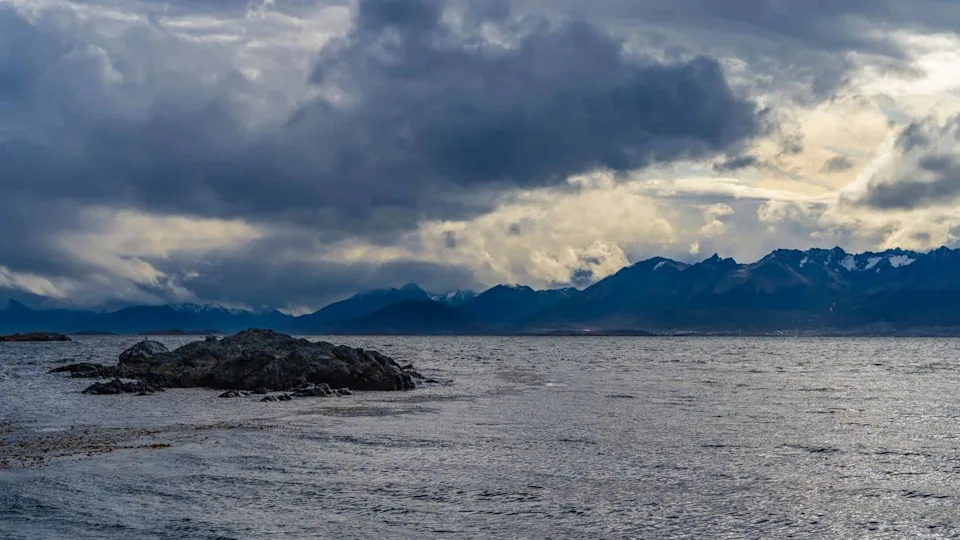
Researchers were shocked at the biodiversity in the ocean waters off Argentina.
©Veranika848/Shutterstock.com
(Veranika848/Shutterstock.com)
As an added scientific achievement, the research team also found what they originally set out to discover. According to a statement published by the Schmidt Ocean Institute, researchers found “one active seep measuring just under half a square mile.”
The researchers came away from the expedition more excited than ever. Marine biologist and chief scientist of the expedition, María Emilia Bravo, said in the statement: “We were not expecting to see this level of biodiversity in the Argentine deep sea and are so excited to see it teeming with life. Seeing all the biodiversity, ecosystem functions, and connectivity unfolding together was incredible. We opened a window into our country’s biodiversity only to find there are so many more windows left to be opened.”
The post A Mysterious Giant Phantom Jellyfish Appears in Rare Deep Sea Encounter appeared first on A-Z Animals.