

Yuancheng Ryan Lu could barely breathe while he waited for his labmate to adjust the microscope focus.
On the slide in front of them were the results of Lu’s latest attempt to turn back time for ageing retinal nerve cells. If it worked, the method he was using could help to restore eyesight to older adults with glaucoma, an age-related condition that damages the optic nerve. And perhaps some day it could be used to rejuvenate organs such as the kidneys or liver — maybe even the brain.

Longevity is in the genes: half of lifespan is heritable
Lu had spent three years trying different approaches — and had failed. But this time looked different. Lu had introduced three genes into mouse eyes that should revert cells to a younger developmental state. And there under the microscope he thought he could see signs of new growth. Now, he was asking his labmate to confirm his suspicions. “I was so nervous,” says Lu, now a geneticist at the Whitehead Institute in Cambridge, Massachusetts.
When the verdict was in, Lu remembers jumping up and down and high-fiving his colleagues in the microscope room. Yet, he couldn’t help but worry that the celebration might be short-lived.
Lu and his colleagues were among several teams trying to ‘partially reprogram’ cells to a younger state. Now, seven busy years later, his discovery1 is the basis for a clinical trial set to start this year. It will be a pivotal test of a burgeoning field that has attracted researchers in academia and industry — as well as billions of dollars of private investment and the attention of Silicon Valley’s tech elite. The trial will attempt to answer an evocative question: can old cells safely be made young again?
The answer, some say, could reshape the very concept of ageing. It could provide a way to rejuvenate old organs — or, in its most extreme and optimistic formulation, the entire human body. Partial reprogramming also promises to write a new chapter for the foundational discovery, 20 years ago, that adult cells can be reprogrammed to an embryonic-stem-cell-like state2.
But risks loom just as large as the promises: push a cell too close to that stem-like state and it could lose its ability to function properly, and even become cancerous. “When cells lose their identity, we know that comes with some forms of danger,” says Tamir Chandra, who studies ageing at the Mayo Clinic in Rochester, Minnesota.
Rejuvenation factors
In 2006, Shinya Yamanaka, a stem-cell biologist then at Kyoto University in Japan, and his colleague discovered that four proteins known as transcription factors — later dubbed Yamanaka factors — could transform an adult cell into an induced pluripotent stem (iPS) cell that is capable of taking on new identities2. The finding was hailed as breakthrough that could pave the way to stem-cell based therapies in which iPS cells are coaxed into adopting a certain fate and then injected into a patient. In February, regulators in Japan endorsed the approval of the first such iPS-cell-based therapies — for severe heart failure and Parkinson’s disease.
But some researchers wondered whether the Yamanaka factors might be put to another use. In 2010, Prim Singh, a chromatin biologist now at Nazarbayev University in Astana, Kazakhstan, and his colleague Fred Zacouto proposed that researchers could introduce the genes that encode the factors briefly, but then turn them off before cells become completely reset (see ‘Turning back cellular time’). Then, they suggested, the cells might become younger without losing their identity3.
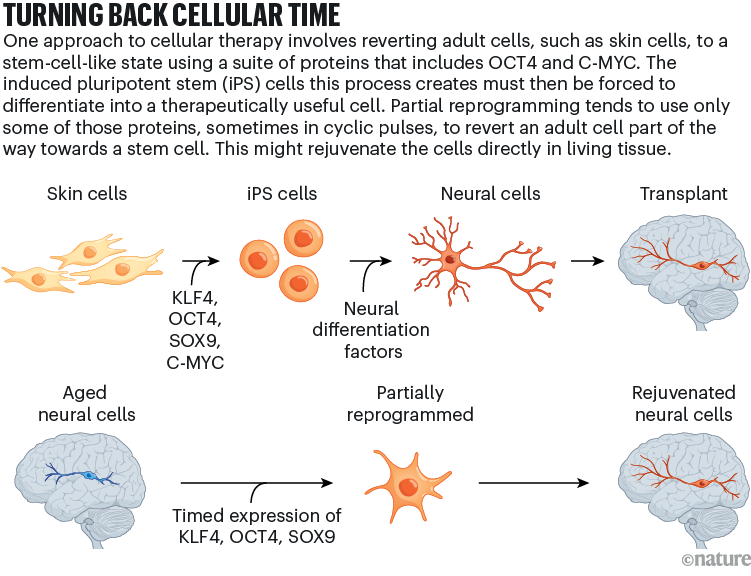
It was a difficult idea for some researchers to accept, Singh says: at the time, most were focused on exploring iPS cells, not rejuvenation.
In 2016, another publication pushed the nascent field into the limelight. Juan Carlos Izpisúa Belmonte, a stem-cell biologist then at the Salk Institute for Biological Studies in La Jolla, California, and his colleagues reported that they had temporarily and repeatedly turned the Yamanaka factors on and off in mice4. This cyclic expression extended the lifespan of model animals with a condition called progeria, which causes accelerated ageing. In normal, old mice, the factors improved regeneration of damaged muscle and pancreatic tissue.
The next few years were a boon for partial reprogramming efforts in mice. Scientists applied Yamanaka factors to rejuvenate skin cells and reduce scar tissue5, to boost muscle regeneration6 and to allow the heart cells to regenerate after injury7, to name just a few examples. One study even suggested that cyclic expression of the Yamanaka factors in the brains of aged mice improved their performance on memory tests8.
Different groups experimented with ways to make the Yamanaka factors safe. Some researchers cycled genes on and off, others turned them on only transiently, in the hope that they would not be active long enough to fully reprogram the cells. Although the approaches seemed to be safe in mice, doubts lingered about leaving cells with unknown potential in the body. “I’d argue that a dinosaur is not a good pet, even if you trained it very well,” says Daniel Ives, chief executive of Shift Bioscience in Cambridge, UK.
How your brain controls ageing — and why zombie cells could be key
Lu and others decided to remove one of the factors, the protein c-Myc, high levels of which can cause cancer. In one attention-grabbing study9, researchers introduced the three remaining factors into cells throughout the bodies of old mice. “We injected the mice and expected them to die, to be honest,” says Noah Davidsohn, lead author on the study and chief scientific officer at Rejuvenate Bio, an ageing-focused biotechnology company in San Diego, California.
But months ticked by, and no tumours formed. Instead, several measures of health improved, and the mice lived longer than their unreprogrammed counterparts. It was a preliminary study, but others have also found that the three Yamanaka factors can be used in mice safely, says Vittorio Sebastiano, a stem-cell and reproductive biologist at the University of California, Irvine. Even so, he worries that leaving out c-Myc could have drawbacks; the protein’s other functions, such as aiding cell division, might be important for some partially reprogrammed cells.
For now, the field is showing enough promise to draw the eye of some of the technology industry’s wealthiest investors. In 2020, a select group of researchers gathered in Los Altos Hills, California, to discuss the future of partial reprogramming with Internet entrepreneur Yuri Milner. “There was a lot of excitement,” says Vadim Gladyshev, a researcher who studies ageing at Harvard Medical School in Boston, Massachusetts, and who attended the meeting. “There was the feeling of something big.”
Record investment
The meeting led to the founding, with Izpisúa Belmonte, of Altos Labs, a reprogramming-focused company that launched in 2022 with US$3 billion from Milner and other investors. It set a world record for biotech start-up financing. That show of support popped the cork for investment, and other Silicon Valley backers entered the fray. Altos Labs “was like a giant X-marks-the-spot”, says Ives. “Now all of a sudden you had a lot of investors that wanted exposure on this opportunity.”

How quickly are you ageing? What molecular ‘clocks’ can tell you about your health
Sam Altman, the chief executive of Open AI in San Francisco, California, invested in a longevity company called Retro Biosciences in Redwood City, California, which is working on partial reprogramming, among other projects. Brian Armstrong, the chief executive of the cryptocurrency exchange Coinbase, helped found a partial-reprogramming company called NewLimit in South San Francisco, California.
But it is Life Biosciences, a biotechnology company in Boston, Massachusetts, that will probably be the first to test partial reprogramming in people. The company was co-founded by Lu’s PhD adviser, David Sinclair, who studies ageing at Harvard Medical School and has been criticized by other researchers for making bold claims about purported anti-ageing treatments. Life Biosciences aims to build on Sinclair and Lu’s work by using a virus to shuttle three Yamanaka factors, without c-Myc, into one eye in people who have retinal nerve damage because of glaucoma.
The company will proceed slowly, says Sharon Rosenzweig-Lipson, chief scientific officer at the company, treating up to 12 people with a specific type of glaucoma, and then up to 6 people with another condition, called NAION, that causes acute optic nerve damage. The genes will be regulated by a genetic switch that turns them on only when participants take a certain antibiotic. Studies in monkeys have found no evidence of cancer or other harmful effects from the procedure, Rosenzweig-Lipson says, and participants will be followed up for at least five years.
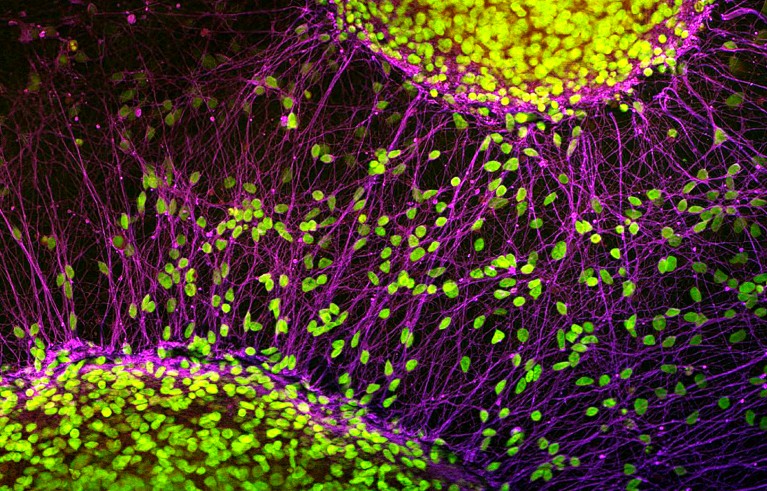
Researchers can reprogram cells to become neurons.Credit: IKELOS GmbH/Dr. Christopher B. Jackson/SPL