

A new seismic study has uncovered large-scale deformation patterns nearly 1,800 miles beneath Earth’s surface. The findings point to a strong link between these movements and ancient tectonic slabs that have sunk deep into the planet over millions of years.
Deep within the mantle, slow but constant motion drives geological processes that shape Earth’s surface. While scientists have long understood how this works in the upper mantle, the lowermost mantle just above the core-mantle boundary has remained far more difficult to observe directly.
According to research in The Seismic Record, this region acts as a kind of engine for heat and material circulating deep within Earth. Studying it helps connect what’s happening far below to tectonic activity at the surface.
Vast Seismic Dataset Maps The Deep Mantle
To investigate this hidden layer, researchers led by Jonathan Wolf at the University of California, Berkeley analyzed more than 16 million seismograms collected from 24 data centers worldwide. As explained by the study, this represents the largest dataset of its kind used to examine the lowermost mantle.
The team focused on shear waves generated by earthquakes, which travel through the mantle, pass into the core, and return. These waves behave differently depending on the internal structure of the material they cross. This phenomenon, known as seismic anisotropy, reveals where rock has been deformed.
Using this method, scientists mapped nearly 75% of the mantle just above the core, identifying anisotropy in about two-thirds of the regions studied.
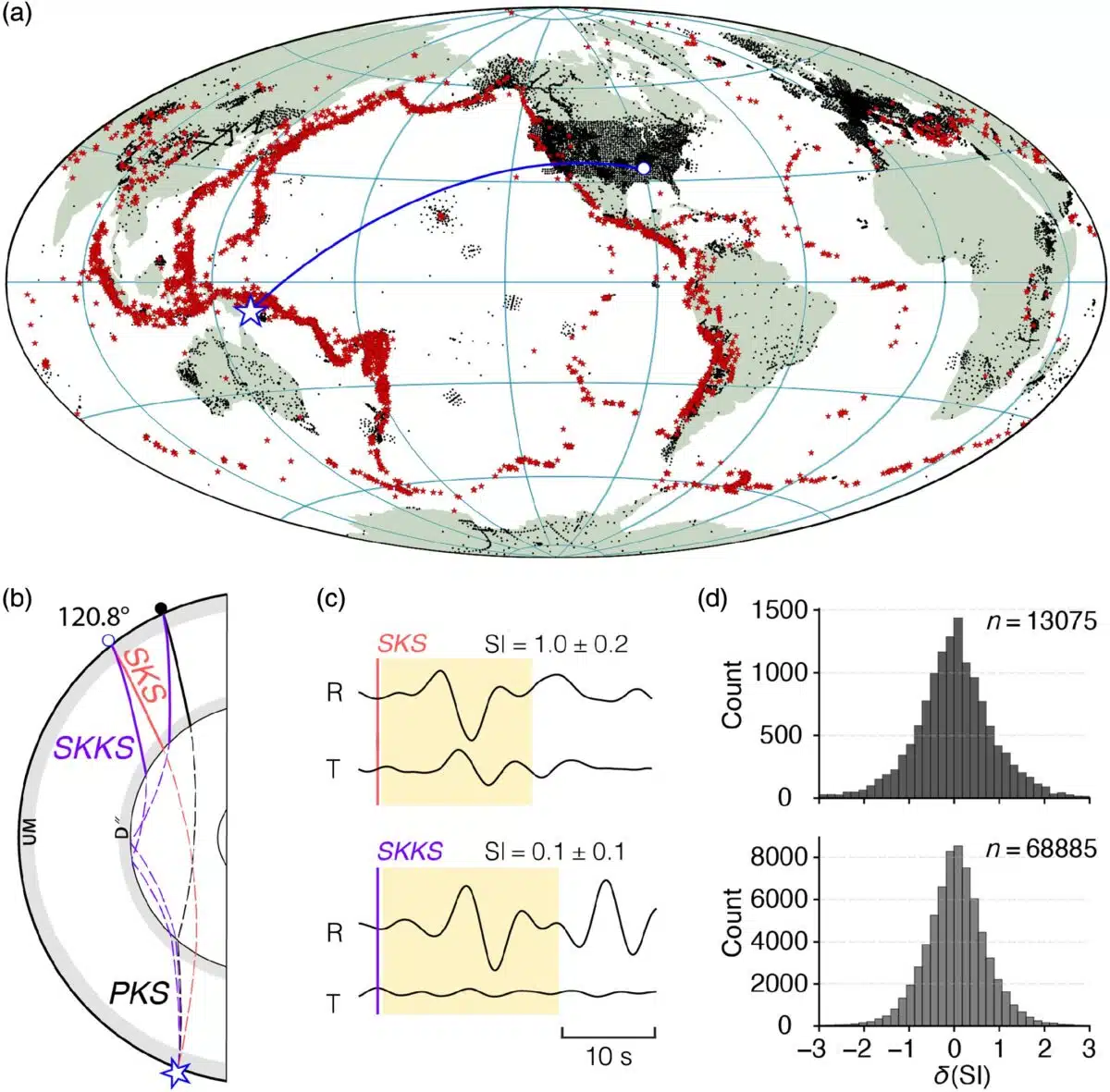 Seismic observations of Earth’s deep mantle. Credit:The Seismic Record
Subducted Slabs Are Driving Massive Deformation
One of the clearest patterns to emerge is the concentration of deformation in areas where ancient tectonic slabs have accumulated. These slabs, once part of Earth’s surface, were pushed downward through subduction and now rest deep in the mantle.
According to The Seismic Record, the presence of anisotropy aligns closely with these regions. This supports earlier predictions from geodynamic simulations, though such a global confirmation had not been achieved with seismic data until now.
“This isn’t that surprising in a sense, because that is predicted by geodynamic simulations,” Wolf said. “But at the scale that we’re looking at, it’s not really been shown using those methods that we’re using.”
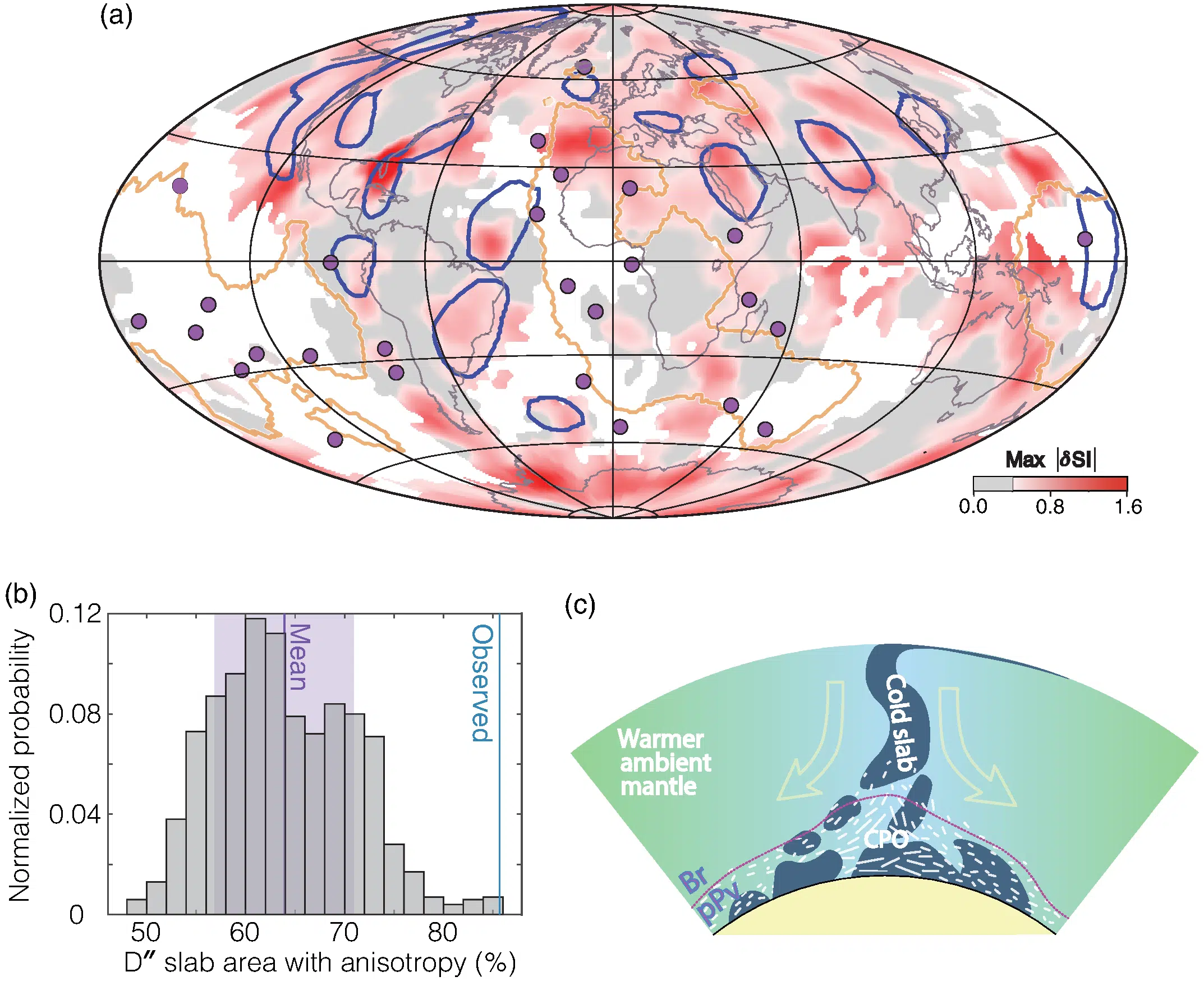 Global distribution and interpretation of seismic anisotropy in Earth’s lowermost mantle. Credit: The Seismic Record
Mantle Materials Under Extreme Stress
At depths approaching 2,900 kilometers, pressure and temperature reach extreme levels. These conditions can alter the internal structure of minerals, creating new forms of anisotropy. Based on the researchers’ findings, this may explain much of the deformation detected near the core. Wolf noted that:
“We know that deformation in the upper mantle is dominated by the drag of the plates that move across it. And that extremely well approximates what we know from seismic anisotropy about the deformation of the upper mantle.” He added: “but we don’t have any of this kind of large-scale understanding for flow in the lowermost mantle. And that’s really what we want to get at.”
Some slabs might also retain older structural signatures formed when they were closer to the surface. Still, the study suggests that active deformation near the core-mantle boundary is the more likely explanation in many cases. Not all regions showed clear signals of anisotropy. The researchers caution that this does not indicate an a bsence of deformation, but rather limits in current detection methods.
As noted in the latest research, weaker signals may simply remain below the threshold of current observational tools. The dataset itself is described as a “treasure trove,” leaving room for further analysis.