
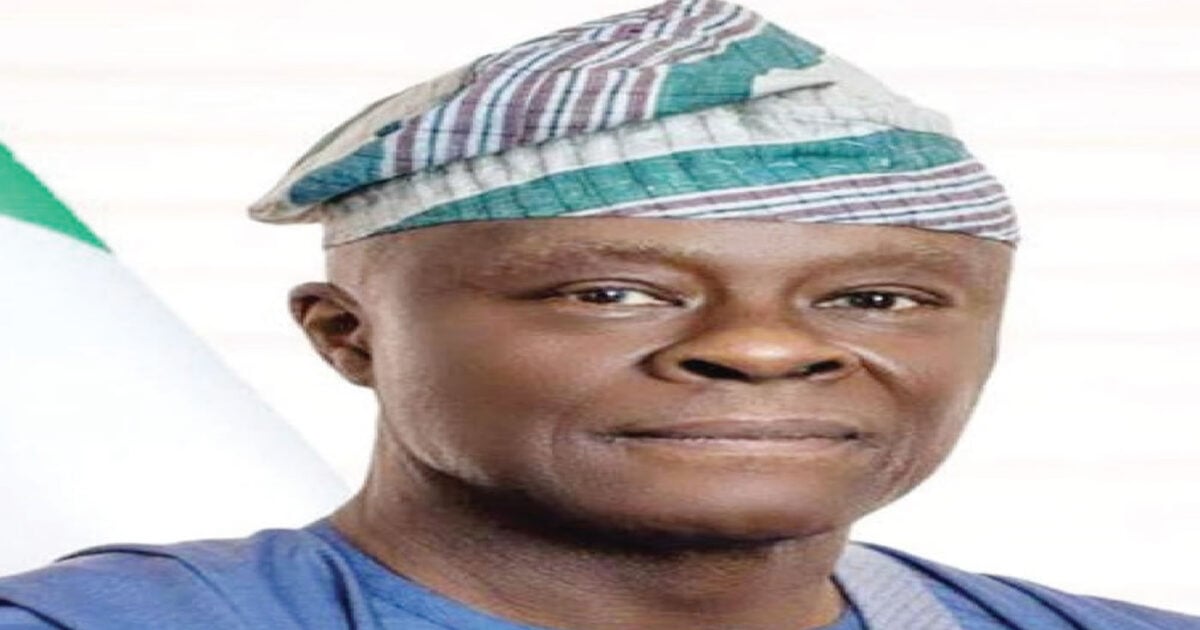
The Federal Government has unveiled plans to introduce a mass savings scheme aimed at reducing reliance on borrowing and expanding domestic investment, the Minister of Finance and Coordinating Minister of the Economy, Wale Edun, has said.
Edun disclosed this during a panel session on Tuesday, at the launch of the latest Nigeria Development Update by the World Bank in Abuja, noting that the initiative would enable Nigerians across income levels to invest and earn returns while supporting economic growth.
He said, “There are mass savings schemes which allow people at all levels of society to save and earn unearned income, including from companies such as refineries and other large firms listed on the stock exchange.”
The minister explained that the government was deliberately shifting away from heavy reliance on debt financing, particularly amid rising borrowing costs.
“I think my first answer is that we do not intend to keep going cap in hand to the debt markets, particularly at the elevated cost, even internationally, for developing countries,” he said.
According to him, alternative funding options such as domestic savings mobilisation and equity participation would play a larger role going forward, especially as the government seeks to crowd in private capital.
He said the initiative aligns with broader reforms aimed at strengthening public finances, including improved revenue tracking and expenditure control.
“We have migrated all the revenue-generating ministries, departments, and agencies onto a platform where we can see all the revenue, what is expected, and confirm that it is actually received,” he said.
Edun added that the government was also reviewing cost-of-collection frameworks across agencies to ensure efficiency and transparency.
“Some agencies operate what they call the cost of collection, but it is the excess, the surplus, that belongs to the government. We are shining a light on that,” he stated.
He said forensic audits were being deployed as part of efforts to curb leakages and ensure value for money.
“Forensic audits are useful to check and double-check that the government is not paying too much. They are a constant tool used to ensure that public finances are not shortchanged,” he said.
The minister further noted that asset optimisation strategies such as privatisation and public-private partnerships were being pursued to support fiscal sustainability.
“We are looking at optimising assets, including divestment, privatisation, and PPP arrangements,” he said.
He also pointed to ongoing efforts to reduce the cost of governance, including personnel-related expenses, as part of measures to improve spending efficiency.
Edun acknowledged the strain posed by rising debt service costs, noting that interest rates had increased sharply in recent years.
“The interest rate that the government was paying rose from about eight per cent to about 24 per cent by late 2024,” he said.
He explained that the reforms being implemented — ranging from revenue recovery to expenditure control and private investment mobilisation — were designed to ease fiscal pressures over time.
On the broader economy, Edun said Nigeria remained resilient despite the impact of the Middle East conflict on global energy markets.
“Yes, prices have gone up, but supply remains available. There is resilience that keeps the wheels of the Nigerian economy and society turning,” he said.
He attributed this to reforms carried out under the administration of President Bola Tinubu, noting that the economy was now better positioned to absorb external shocks.
Edun added that while higher oil prices could boost government revenues, they also come with rising costs and inflationary pressures.
“There is the prospect of increased revenue for the government, but on the other hand, costs have also gone up,” he said.
He noted that the government was taking a cautious approach to the uncertain global environment.
“We are hoping for the best, but planning for the worst,” he said.
The minister stressed that beyond fiscal and monetary measures, investment remains the key driver of poverty reduction.
“The way we are going to substantially lift millions of Nigerians out of poverty is through investment — not only large-scale investment, but also small and medium-scale investment,” he said.
He added that ongoing reforms have created a more open and market-driven economy.
“We now have market pricing of foreign exchange, market pricing of petroleum products, and an economy that offers opportunity,” he said, urging Nigerians to take advantage of emerging investment opportunities.
At the opening session of the G-24 Technical Group Meeting in Abuja, Edun had earlier said Nigeria was deliberately shifting from expensive external borrowing to a growth model anchored on private capital and domestic reforms.
However, PUNCH Online earlier reported that the Federal Government increased its borrowing plan for 2026 to N29.20 trillion following an expansion in the proposed budget size.
The figure represents an increase of N11.31tn compared to the earlier N17.89tn borrowing projection contained in the 2026 Abridged Budget Call Circular issued by the Federal Ministry of Budget and Economic Planning.