
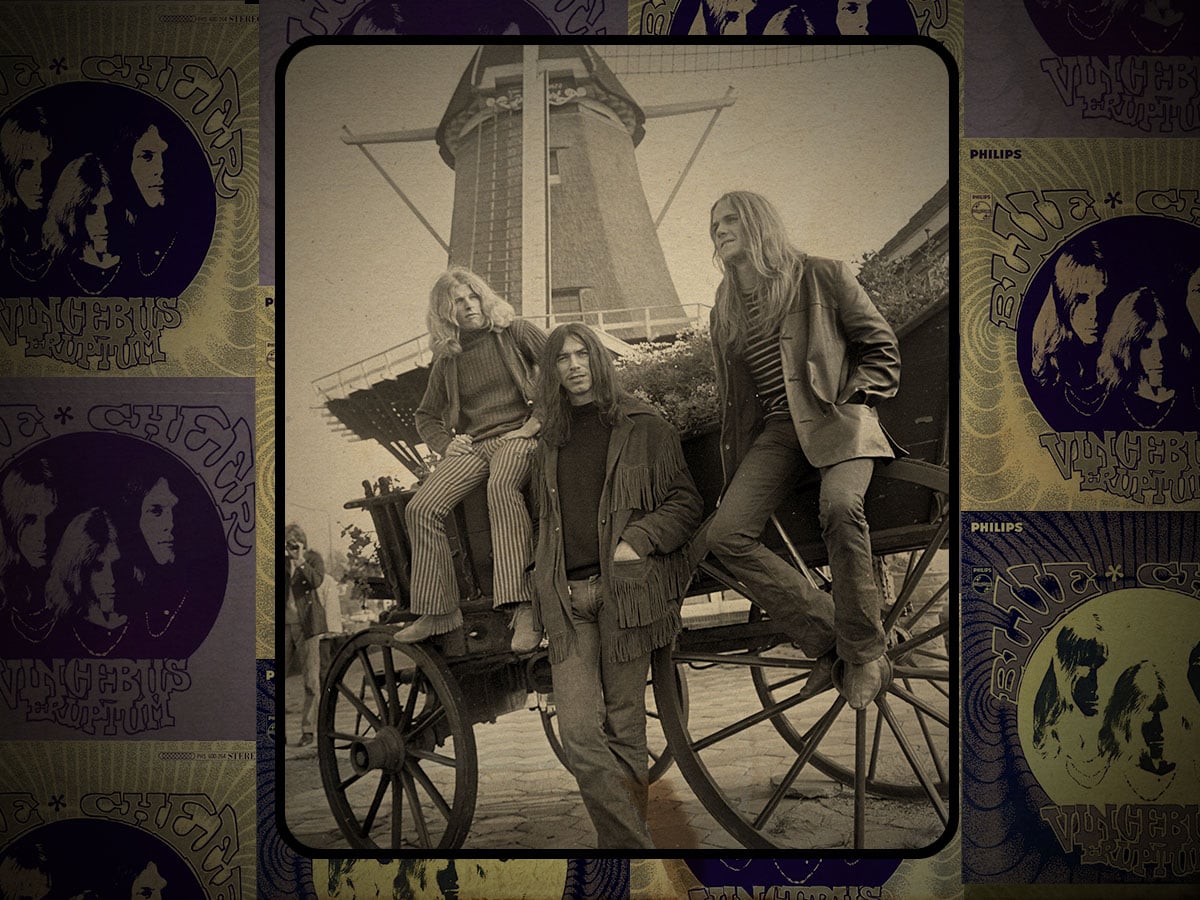
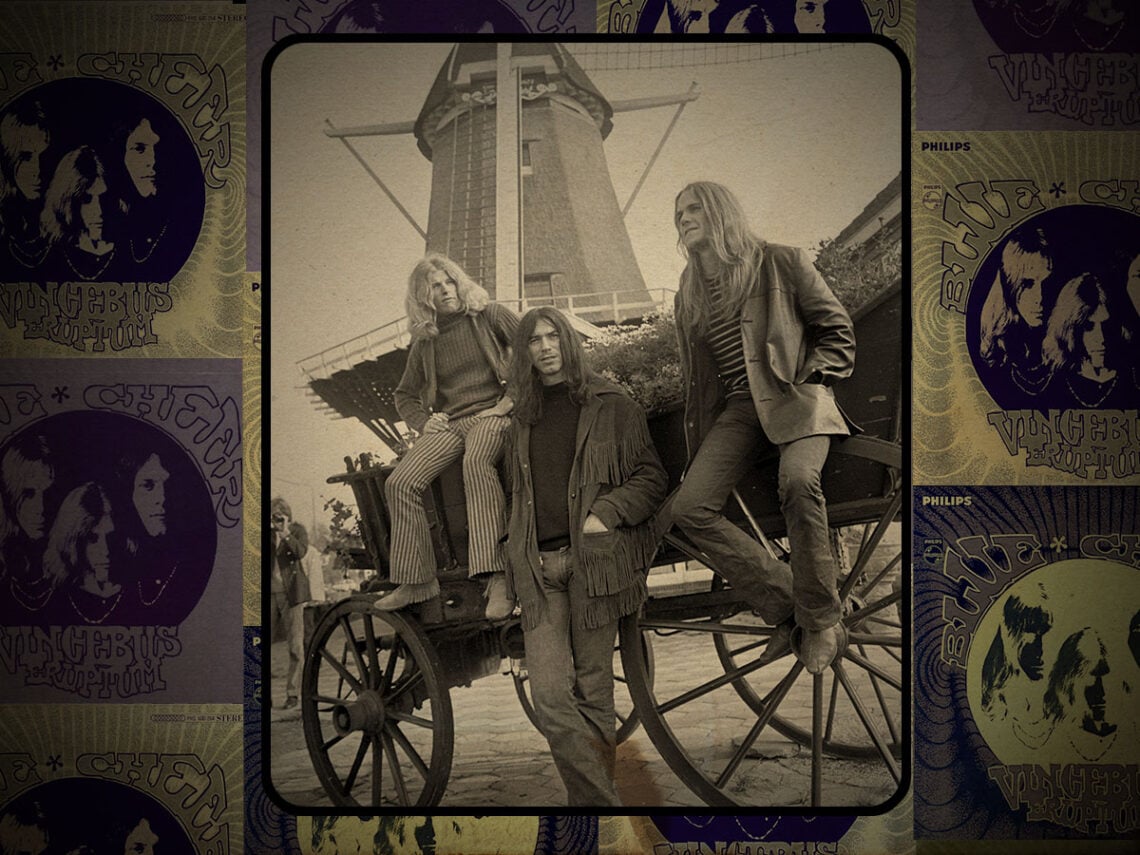
(Credits: Far Out / Jack de Nijs / Album Cover)
Tue 7 April 2026 16:45, UK
LSD’s introduction to the artistic realm of the 1960s certainly has a lot to answer for, but much of it is dominated by floaty flower power, ‘peace and love’ politics, and pretty kaleidoscopic patterns. There was only one band that used the power of acid to finally succumb to the temptation of turning their amps up to ten and making a right racket, and that was Blue Cheer.
Taking their name from Owsley Stanley’s personal variety of LSD, Blue Cheer emerged during the eye of the hippie storm, back in 1966. At the time, the music scene of their native San Francisco was dominated by transformative counterculture icons, the likes of Jefferson Airplane, Grateful Dead, and Janis Joplin’s Big Brother and the Holding Company, all of which were exercising their newly-established psychedelic muscles. That is where Blue Cheer differed.
Rather than following the crowd into that colourful age of psychedelia, the Dickie Peterson-formed group decided to pursue a far more abrasive, raw kind of sound. With a Hells Angels biker for a manager and the kind of naive arrogance that suits teenage bands so well, Blue Cheer unknowingly revolutionised the rock and roll landscape, simply by turning their amplifiers up to the max.
“People thought we were just making noise,” Peterson told Classic Rock back in 2009. “They thought we were a detriment to the scene.” Detriment or not, the band certainly stood out when compared to their Bay Area comrades, playing louder, faster, and with a greater fury than any of their bare-footed, acid-dripped peers.
“I just knew we wanted to be loud,” he continued. “I wanted our music to be physical. I wanted it to be more than just an audio experience. This is what we set out to try and do.” Admittedly, the group were pretty successful in those aims, although it did little to endear them towards the rest of the musical realm. “We ended up being in a lot of trouble with other musicians of the time,” Peterson admitted.
Those other musicians became particularly miffed when the band scored a hit record with their 1968 cover of Eddie Cochran’s classic ‘Summertime Blues’, giving the old rock and roll anthem a far more anarchic, proto-metal feeling.
That hit earned Blue Cheer a ticket into the primetime, playing legendary venues and even making an appearance on Dick Clark’s American Bandstand, during which Clark reportedly declared, “It’s people like you that give rock ’n’ roll a bad name.”
Clark wasn’t the only one who couldn’t see the appeal, either. As Peterson recounted, “I remember Mike Bloomfield came up to me at the Avalon Ballroom, and he says, ‘You can’t do that’. I said, ‘C’mon, Mike, you can do it, too. All you gotta do is turn this knob up to ten.’” The songwriter added, “He hated me ever since.”
Blue Cheer might have been written off by their fellow musicians back in the 1960s, but their endearingly anarchic playing style far outlasted that criticism. ‘Summertime Blues’, in fact, is routinely hailed as being a touchstone for the early days of hard rock and metal, predicting the kind of sounds that would dominate the next few decades of rock expression – not that they meant to, of course.
