
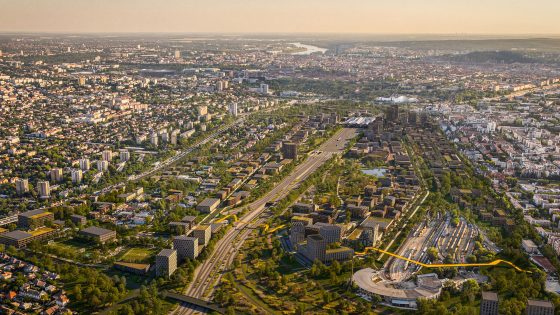
The contest sought a multidisciplinary team to draw up a scheme to regenerate an abandoned 86ha railway yard in the Hungarian capital. The site was recently acquired by the Budapest Metropolitan Municipality.
The winning submission was led by French architect Coldefy and also included Marko&Placemakers, CityFörster, Sporaarchitects, Treibhaus Land.
Second place went to a collaboration between Cologne’s Astoc Architects and Planners, while joint third place went to a team led by Superwien of Vienna and a team led by Chybik + Kristof, featuring London practice Gumuchdjian Architects.
The jury described the winning proposal as a ‘strong, distinctive urban architectural vision’, highlighting its proposal for ‘a liveable residential environment’ and ‘the exceptional quality of its public space system.’
The scheme will transform the existing railway station into a new multimodal hub featuring a plaza providing a year-round civic space for markets and cultural events. Former railway buildings and depots will meanwhile be repurposed as a cultural centre featuring a municipal library and a railway museum.
Coldefy partner Zoltán Neville said: ‘The project envisions an urban framework that is open, adaptable and inclusive.
‘Rather than fixed narratives, we propose open systems and spatial stories that can communicate and evolve over time – shaped by occupation and reinterpretation to create a place that belongs to the future.
‘Our design learns from Budapest’s past, engages with its present and prepares for what is to come.’
Budapest’s mayor, Gergely Karácsony, who chaired the competition jury, said: ‘During the evaluation process, the submitted proposals were assessed in detail across multiple criteria, leading to a complex and integrated decision on which concept offers the strongest response to the future of the area.
‘In fact, we are not closing a process but starting one: we now have the team we will work with in the coming years, and this is the most important outcome of the competition.’
Rákosrendező is immediately north of Budapest City Park, home to a range of landmark venues including the historic Széchenyi thermal bath and the Pannon Park Biodome in the Budapest Zoo, designed by Paulinyi-Reith & Partners.
Over the next 15 years, the scheme, backed by the Budapest Capital Asset Management Centre, will transform the large underused brownfield site into a new urban district.
The masterplan is expected to deliver a new dense yet liveable area with a public space network, urban centre, and parkland, designed to accommodate up to 10,000 apartments and a gross floor area of 1,250,000m².
Judges included Zoltán Erő, chief architect of Budapest; Beatrix Frankfurt, senior project expert at BFVK; and Andreas Trisko, director of urban development at the City of Vienna.
The competition had a £315,000 (141 million HUF) prize fund with the overall winner receiving £40,000 (18 million HUF).
In recent years, Budapest has been the focus of several large-scale regeneration projects.
The Rákosrendező competition comes four years after Grimshaw won a competition to overhaul and expand Budapest’s main Nyugati station. In 2021, Studio Egret West won the £15,000 third prize in a competition for a major retrofit of Budapest’s abandoned market halls.