
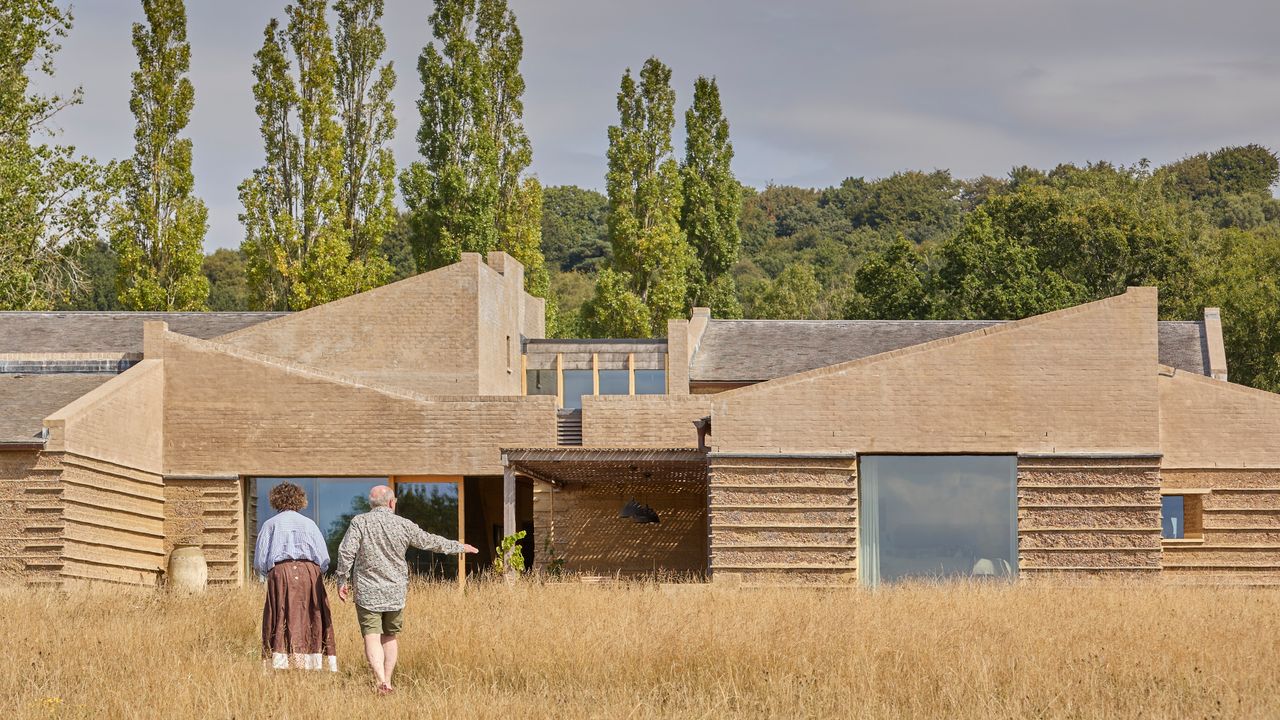
‘We bought it for the views,’ says the wife. With no heritage listing restrictions to navigate, they were able to remove unwanted structures and reimagine the classic English country house. ‘We were after a higgledy-piggledy home that would feel like part of the landscape,’ says the husband. They wanted it to be inventive and low slung, with strong eco credentials and a nod to local vernaculars.
Jonathan Tuckey, with whom the owners had an instant rapport, was drawn to rammed earth when he visited the Chapel of Reconciliation, built by Austrian pioneer Martin Rauch at the Berlin Wall Memorial several decades ago. ‘It’s a very evocative building and the material struck me deeply,’ he says. But he had not found the right project. ‘A lightbulb moment came when we learned that the house was on the site of an old brickworks, so we knew it was sitting on clay,’ he says. ‘We realised it had the perfect imperfections we were after.’ Most of the buildings were demolished and their materials were crushed to form an aggregate that was mixed with clay, local limestone gravel and water. Where the earth is polished internally, such as on the floors, the brick fragments have a beautiful, terrazzo-like effect that speaks of the site’s past.
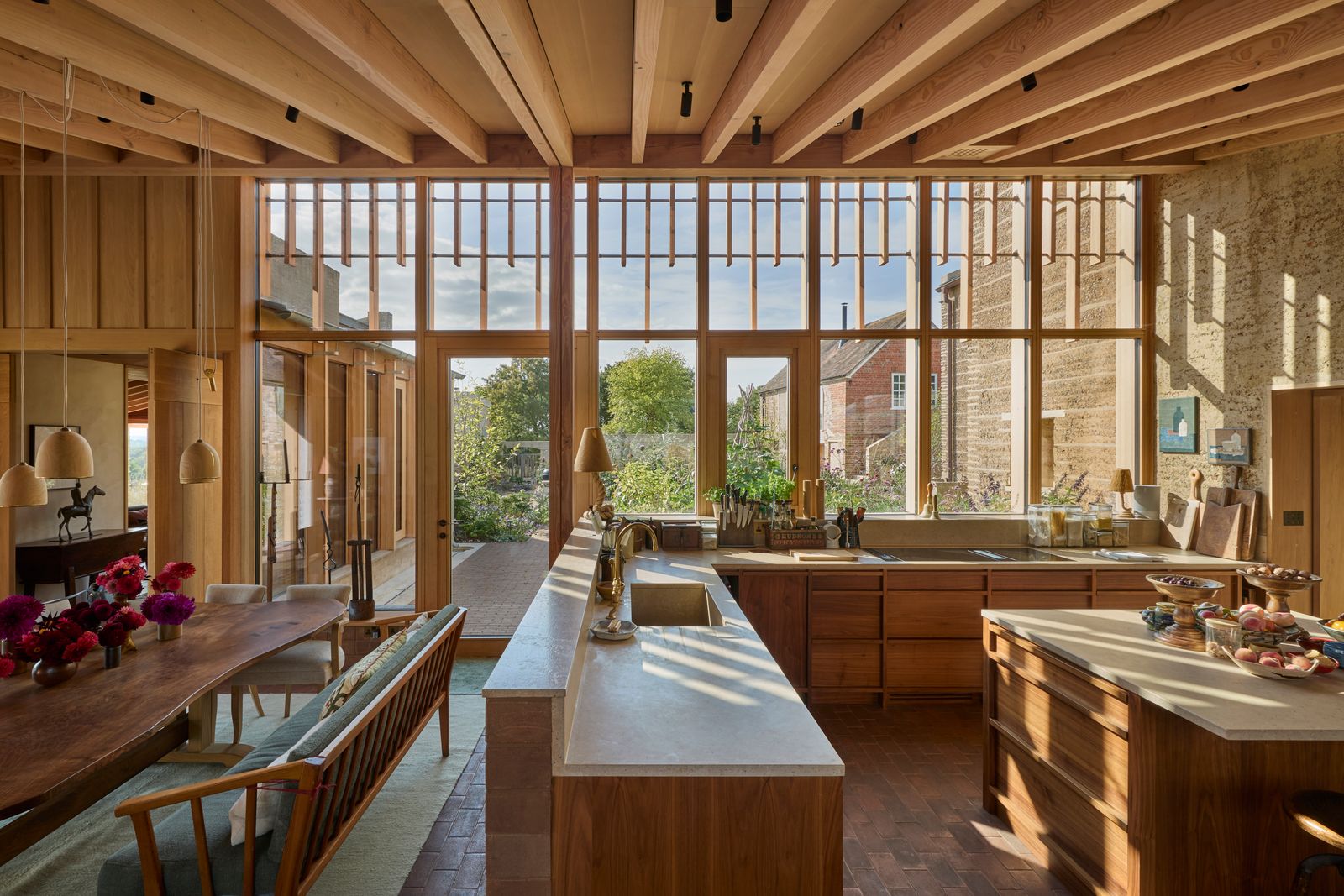
A glass and timber pavilion, housing a kitchen and dining area, links the two main rammed-earth volumes. A table by David J Haddock is paired with a bench from 8 Holland Street, on a bespoke rug by Nancy Nicholson.
Ray Main
Still, the project involved a leap of faith for all involved. This was not just Jonathan’s first rammed-earth construction, but actually his first newbuild – he is known for masterfully layering old and new within historic buildings. But, as he puts it, the project was still ‘building on the built’. The new house is knitted within the Victorian walled garden and the foundations of the previous larger house are left visible in the gravel garden. ‘These act as anchors, giving the new building a sense of a longer lifespan,’ he explains.
The owners also had a team they could trust: Todhunter Earle Interiors, which had designed their London home, was on board from the start, as was landscape architect Pip Morrison, who has helped them to regenerate biodiversity across the grounds. Jonathan also tapped specialist Martin Rauch, who advised the builders – locally based firm Stonewood – on the perfect rammed-earth recipe that wouldn’t require the addition cement or lime, which are often used as stabilisers in wet climates but negate the material’s circularity.
‘This is a handmade house,’ says Jonathan, describing how the builders compressed the earth manually in layers inside the formwork, using a ramming tool. The cylindrical stairwell is an artwork in itself, featuring a spiral oak staircase crafted by joiner Robert Lynch. Niches carved into the stairwell’s thick exterior wall reveal its sculptural heft and show off the owners’ extensive art collection, including a horsehair sculpture by 2022 Loewe Foundation Craft Prize winner Dahye Jeong.