
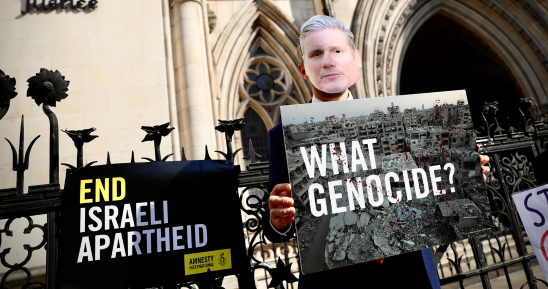
Responding to Keir Starmer’s visit to the Gulf to support efforts following the US-Iran ceasefire, Amnesty International UK said the Prime Minister must ensure his commitments are backed by meaningful action, not just words.
This trip must also mark a clear and unequivocal shift in UK policy: no more military assistance to Israel or any other state involved in violations of international law, no more impunity for war crimes, and no more looking away from systemic human rights violations.
Kristyan Benedict, Amnesty International UK’s Crisis Response Manager, said:
“This visit is an opportunity for Keir Starmer to show his commitment to the rule of law is backed by meaningful action, not just words.
“The Prime Minister should use this trip to not only address the fragility of the US-Iran ceasefire, but to set out concrete steps the UK will take to protect civilians across the region, with particular attention to the Occupied Palestinian Territory, which has been neglected in recent weeks.
“The violence across the region – Gaza and Lebanon among the hardest hit – long predates the latest escalation. A genocide is ongoing in Gaza, there is a surge in state-backed settler attacks in the West Bank, and a system of apartheid that the UK must no longer ignore. Israel remains an ongoing concern for its repeated violations of international law in the region.
“There can be no return to normal politics with Israel. The UK must use every political and diplomatic tool to help end Israeli human rights violations – suspending all arms transfers, banning trade with illegal settlements, and fully backing international justice through the ICC and beyond. The Prime Minister must be unequivocal: there must be no more business as usual with Israel while it commits genocide and tears apart international law.
“The UK should also make every political and strategic effort available to ensure the current de-escalation continues, including making clear it will not provide military assistance to the US or any other state where there is a risk of crimes under international law, including war crimes and genocide.
“Now is the time for the UK to demonstrate that its commitment to international law is not merely rhetorical, but shapes how it acts on the world stage.”