
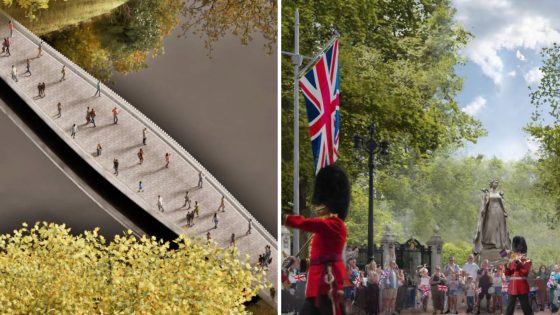
The memorial, which includes a stainless-steel and cast-glass bridge, sculptures, landscaping and new furniture in St James’s Park, was unanimously backed by the council’s planning committee last night (7 April).
This was despite objections from residents’ groups, which argued that the scheme would have a detrimental impact on the character of the Grade I-listed park and would create risks of anti-social behaviour and crime.
Committee members cited the proposal’s national public benefit, and said the creation of a wider bridge and a more accessible landscape would significantly outweigh any harm to heritage or biodiversity.
Councillor Robert Rigby said: ‘I have sat on planning [committees] for many years and it’s not often that we get an application with such a national significance, and I think what we have in front us is something to be commended. What a fitting tribute to the longest serving monarch that we have ever had.’
Queen Anne’s Gate Residents Association vice chair Cathy Jones told the committee: ‘‘We fully support the principle of a national memorial to Queen Elizabeth II, but what we can’t support is the detrimental impact on St James’s Park in this proposal, in this location and at this scale.’
Jones argued that the proposal would turn an ‘everyday green space’ into a ‘focus for tourism and crowd management’, threatening the ‘unprogrammed space and tranquillity for regular use’.
In its formal response to the application in February, Historic England backed the proposal, while raising concerns that the some elements of the design did not fit well into the existing landscape.
The government heritage watchdog said the proposals ‘would provide a fitting national memorial to Her Majesty Queen Elizabeth II in a way which would both change and respond to the character of St James’s Park’.
But it added: ‘There are aspects of the design, though, which we strongly suggest should be rethought or refined to ensure that the memorial as a whole is well-integrated with the existing historic landscape where possible.’
Specific concerns raised included the ‘proposed surface treatment, which we would consider would benefit from simplification and design development’ and designs for seating, which it said it had ‘a clear preference for the more traditional style seating, which would help to limit the extent to which the memorial is experienced as separate to the wider park’.
Foster + Partners is working with heritage specialist architect Purcell, French landscape architect Michel Desvigne, artist Yinka Shonibare and sculptor Karen Newman, who is responsible for the main statue of the late Queen.
The submitted plans are an evolution of the contest-winning scheme, which featured a statue of the Queen on horseback but now has her standing on top of a plinth.
Further details of design elements are expected to be outlined at a later stage, such as bench designs and the balustrade for the bridge, while sculptures are figurative at this stage in the process.
Foster + Partners founder Norman Foster said in planning documents: ‘It is an honour and a privilege for our team to be awarded this project. Her Majesty loved history and tradition, so this is reflected in the inspiration of the original design of St James’s Park by Sir John Nash. Some of his principles have survived, whilst others have been lost and will be restored, creating a family of gardens joined by gently meandering paths.’
As the AJ first reported last summer, Fosters saw off four other bids, including one from Heatherwick Studio, following the high-profile competition.
Thomas Heatherwick’s firm headed up a team including British sculptor Halima Cassell, landscape architect MRG Studio, and multidisciplinary practices Webb Yates and Arup.
The three other shortlisted teams were led by architecture practice WilkinsonEyre; landscape architect J&L Gibbons with William Matthews Associates; and landscape architect and garden designer Tom Stuart-Smith with Jamie Fobert Architects.
The five teams had been briefed to ‘create a memorial masterplan that celebrates Queen Elizabeth II’s extraordinary life of service and provides a space for pause and reflection’.
The competition was criticised by AJ columnist Ike Ijeh as a flawed and closed process only open to established designers, which failed to reflect a meritocratic Britain. In a second column on the subject, Ijeh predicted that the Foster design would be the most popular with the public as it ‘comes closest to the public idea of what a memorial should look like’.
When the competition was launched, the memorial had a provisional construction budget in the range of £23-46 million.