
The UK has a “job” to help reopen the strait of Hormuz, Keir Starmer has said, as Iranian reports said the key shipping route was closed again just hours after a supposed ceasefire.
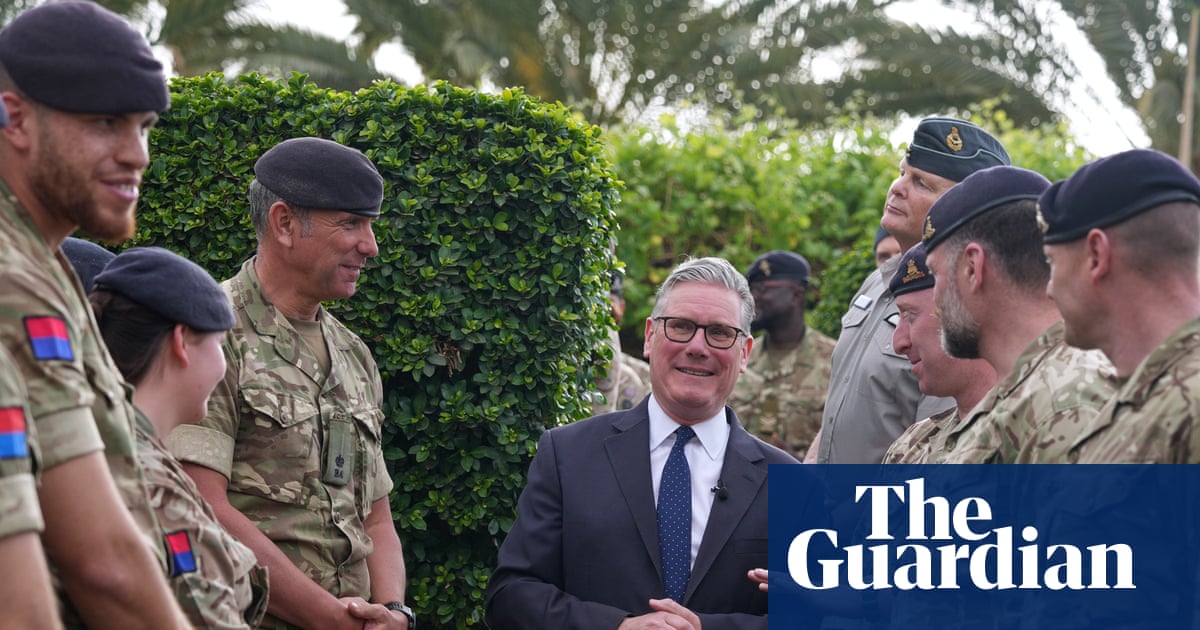
The prime minister met UK and local personnel at an airbase in Taif, Saudi Arabia, at the start of what is expected to be a wider trip to Gulf allies, one billed as a mirror to his efforts to pull together a plan for how a ceasefire might operate in Ukraine.
While UK officials portrayed the visit as “complementary” to Pakistan-brokered talks between the US and Iran, Starmer is likely to be viewed in Gulf states as a more predictable and reliable partner than a US led by Donald Trump.
The ceasefire was agreed little more than an hour before a deadline set by the US president, who had threatened that Iran’s “whole civilisation” would die if it did not meet US demands. As part of its terms, the strait of Hormuz was intended to be reopened, with Starmer’s trip aimed at building on a UK-led gathering of military planners on Tuesday as to how this could happen in practice.
But Iran’s Fars news agency said oil tankers passing through the strait had been blocked again because of what it called a ceasefire breach by Israel, which has intensified its attacks on Lebanon.
Starmer was due to talk later on Wednesday with Mohammed bin Salman, Saudi Arabia’s crown prince, with his discussions in the Gulf expected to cover issues such as dealing with Iranian mines and ensuring the tankers that use the strait as a key transport route can be insured.
“There are a lot of practicalities about how this might work, and given the situation, there are a lot of moving parts,” one UK official said. “This isn’t the sort of thing that happens at the flick of a switch.”
Speaking to broadcasters at the King Fahd airbase earlier in the day, Starmer said that while there was a sense of relief at the ceasefire, it was “early days” in restoring full shipping traffic.
“What people in the United Kingdom want to know, who will share that relief, is that this needs to be permanent, and it’s our job to work with other countries in the region, not only on the cessation of hostilities, but also on opening the strait of Hormuz,” he said.
“Because the impact on our energy prices, you can see it on a daily basis over the last 39 days, it’s our job to make sure that the strait is open, that we’re able to get the energy that the world needs out and stabilise the prices back in the United Kingdom.”
Starmer has provoked the ire of Trump several times during the conflict by refusing to support the initial US-Israeli attack on Iran, and by only allowing US forces to use UK airbases for missions seen as defensive, for example targeting Iranian missile sites.
Speaking on Wednesday, Starmer reiterated his insistence that the UK was not “getting drawn into this war”. He said: “We’ve always acted in collective self-defence, but my job is to protect the UK lives, of course, which is what we’ve been doing here from this place, but also to protect our interests and through our interests, our national interest, to get the strait of Hormuz open.”
Starmer’s timetable for the rest of the visit has not been announced, and it is not known which other Gulf countries he will travel to from Saudi Arabia.
“The ceasefire is obviously good news, but we need to make sure that the strait of Hormuz is fully open, as this will have the biggest impact on people at home,” one government source said, likening Starmer’s role to that he had in convening the so-called coalition of the willing, the group of countries that offered to help guarantee any peace in Ukraine. “It is also the first opportunity for the PM to visit allies in the region and show that we stand with them.”