
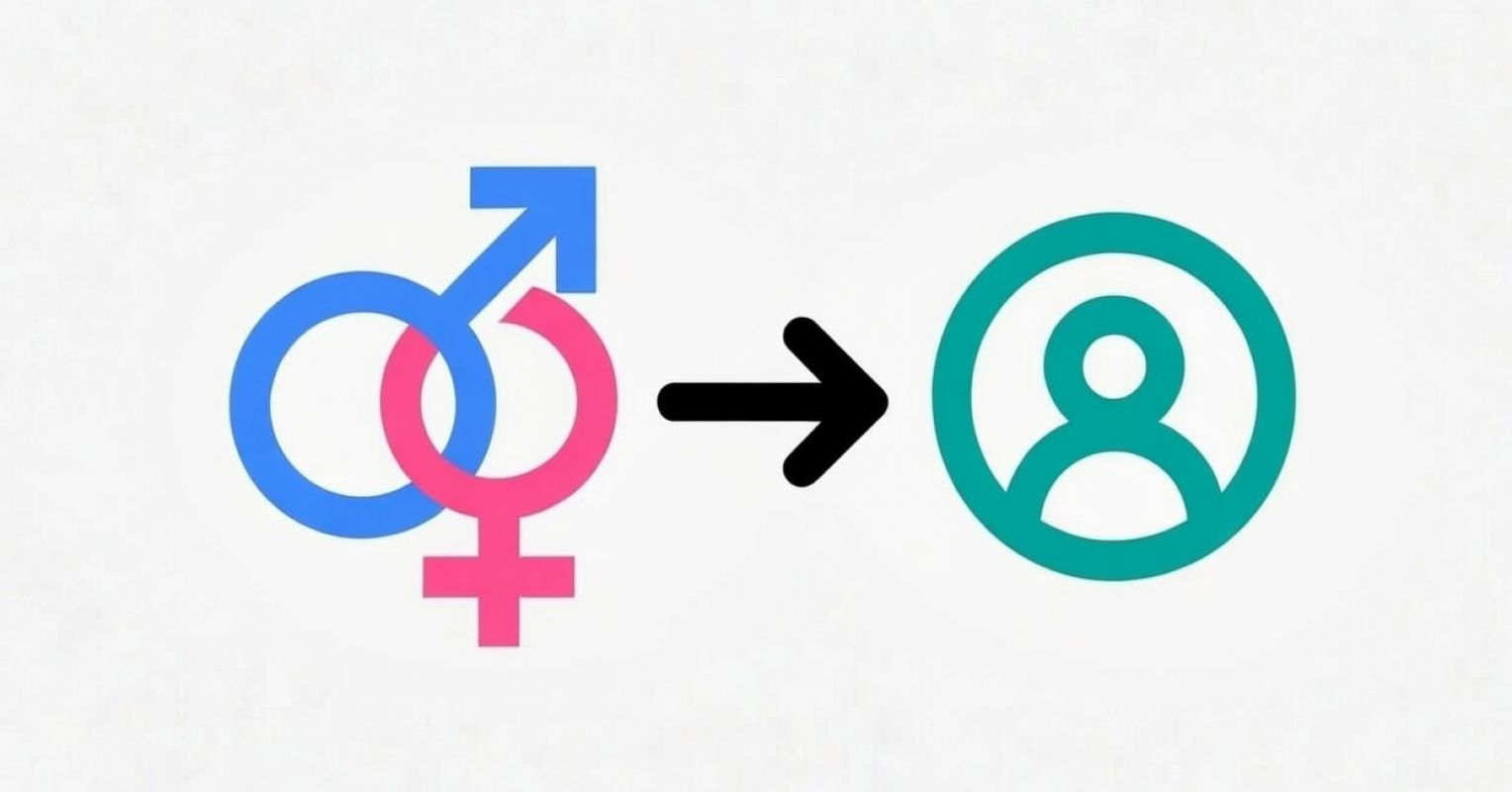
In Ernest Hemingway’s The Sun Also Rises, Bill Gorton asks Mike Campbell how he went bankrupt. “Two ways,” Mike replies: “Gradually and then suddenly.”
This exchange came to mind when thinking about how English is losing its gender markers: It’s been going on for centuries, in fits and starts, but has accelerated rapidly during the past couple of decades.
Gradual Grammatical Change
As a Germanic language, the form of English spoken a thousand years ago had three genders, and these dictated the grammatically correct forms of articles, pronouns, and adjectives.
But during the next two centuries—partly through contact with Old Norse, and partly through the adoption of French terms treated as gender-neutral—English gradually lost this system. By about 1300, the speakers of what we call Middle English were employing a language that was grammatically simpler—much less tied to gender, and much more like modern English.
We are now experiencing a much more rapid shift in usage, driven by advocacy for gender equality and nonbinary acceptance. The most obvious example is the adoption of the singular “they” to replace clunky constructions like “he or she” and “he/she.”
Language purists argue that this is ungrammatical, even though “they” has been employed in just this way by authors as diverse as Chaucer, Shakespeare, Austen, Dickinson, and Shaw.
But it was a rapidly shifting cultural landscape that led to the swift adoption of the singular “they,” with most journalistic style guides endorsing its use during the 2010s. In 2019, this usage reached the height of linguistic respectability by being enshrined in the Merriam-Webster dictionary.
Of Storms, Ships, and Countries
But a wholesale transformation of English is far from complete, and referents involving gender can still be found, even in places where they don’t really make much sense.
Tropical storms and hurricanes originating in the Atlantic, for example, received female names starting in 1953, and this practice continued until 1979, when male names were added.
And it’s still traditional to refer to ships and countries as feminine—although this is not as common as it used to be. For example, one popular search engine returns about 118,000 results for the phrase “Mexico itself,” but only 3,210 for “Mexico herself,” and 59,300 results for “Poland itself,” but only 1,940 for “Poland herself.” In English, the identities of countries seem to be losing their gender.
Progressions in the Professions
During the 21st century, the focus has shifted to removing gender from occupations.
This hasn’t been an issue in some domains, as many professions have always been gender-neutral. “Carpenter,” “dean,” “doctor,” “lawyer,” and “professor” would be examples of this.
In other cases, a gendered term exists but is almost never used: “authoress,” “aviatrix,” “executrix,” “huntress,” “murderess,” and “usherette” can be employed to denote gender, but female members of these groups are typically just authors, aviators, executors, hunters, murderers, and ushers.
In some domains, there have always been two terms that are relatively equivalent, such as “cowboy” and “cowgirl,” “landlord” and “landlady,” “headmaster” and “headmistress,” and “host” and “hostess.”
But even here, the word pairs can have different connotations, and so a degendering process has been taking place. A “barmaid” is not the same as a “barman” (and both have largely been replaced by “bartender”). “Salesgirl” and “salesman” imply different professional activities, so gender-neutral forms, such as “sales representative, “sales associate,” or “salesclerk,” are now preferred.
Some occupational titles seem to have lost their gender markers relatively quickly. “Bag boys” are now “baggers,” “doormen” have become “door attendants” or “concierges,” and “mailmen” are usually called “letter carriers.”
And in many cases, the transformation can be as simple as the dropping of the gendered element. This has given us “chair” instead of “chairman/woman,” “camera operator” instead of “cameraman/woman,” and “anchor” instead of “anchorman/woman.”
Gender equality can, of course, operate in both directions. As men began to enter occupations traditionally dominated by women, “chambermaids” and “cleaning ladies” became “housekeepers,” “stewardesses” became “flight attendants,” and “waitresses” became “servers.”
Occupational Oddities
Some professions have been traditionally gendered for so long that one member of a gendered pair is rarely used.
For professions that were historically dominated by women, this includes “masseuse/masseur” (who have evolved into “massage therapists”), “seamstress/seamster” (now usually just “tailors”), and “ballerina/ballerino” (they have all become “ballet dancers”).
For professions that were dominated by men, the gendered term may still be the preferred one. In the world of music, for example, we have “maestro”—even though the word “maestra” exists—and also “concertmaster,” which is the preferred term over “concertmistress,” even for women who serve in this role.
In some cases, the gendered professional term remains in use, either out of tradition or for some other reason.
Female performers, for example, prefer to be called “actors,” even though an Academy Award is still given annually for Best Actress in a Motion Picture.
Some professions that require a large amount of physical strength remain gendered, and with a masculine bias: We have “lumberjacks” but don’t often refer to “lumberjills” or “lumberpersons” (although the gender-neutral “logger” now seems to be preferred). And “handyperson” hasn’t really replaced “handyman.”
In short, the modern degendering of English is continuing a centuries-long trajectory—gradually, in terms of its grammar, but also suddenly—and unevenly—for its occupational vocabulary.