
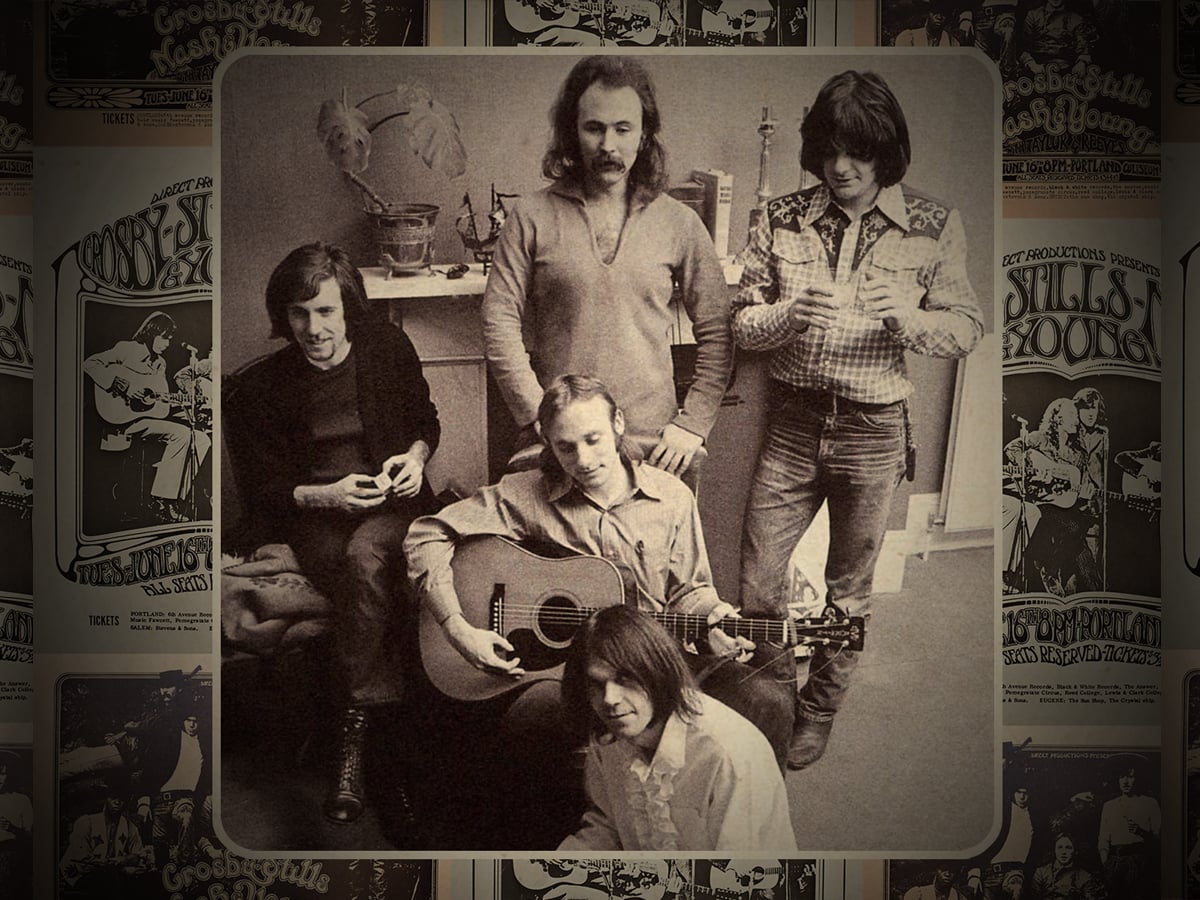
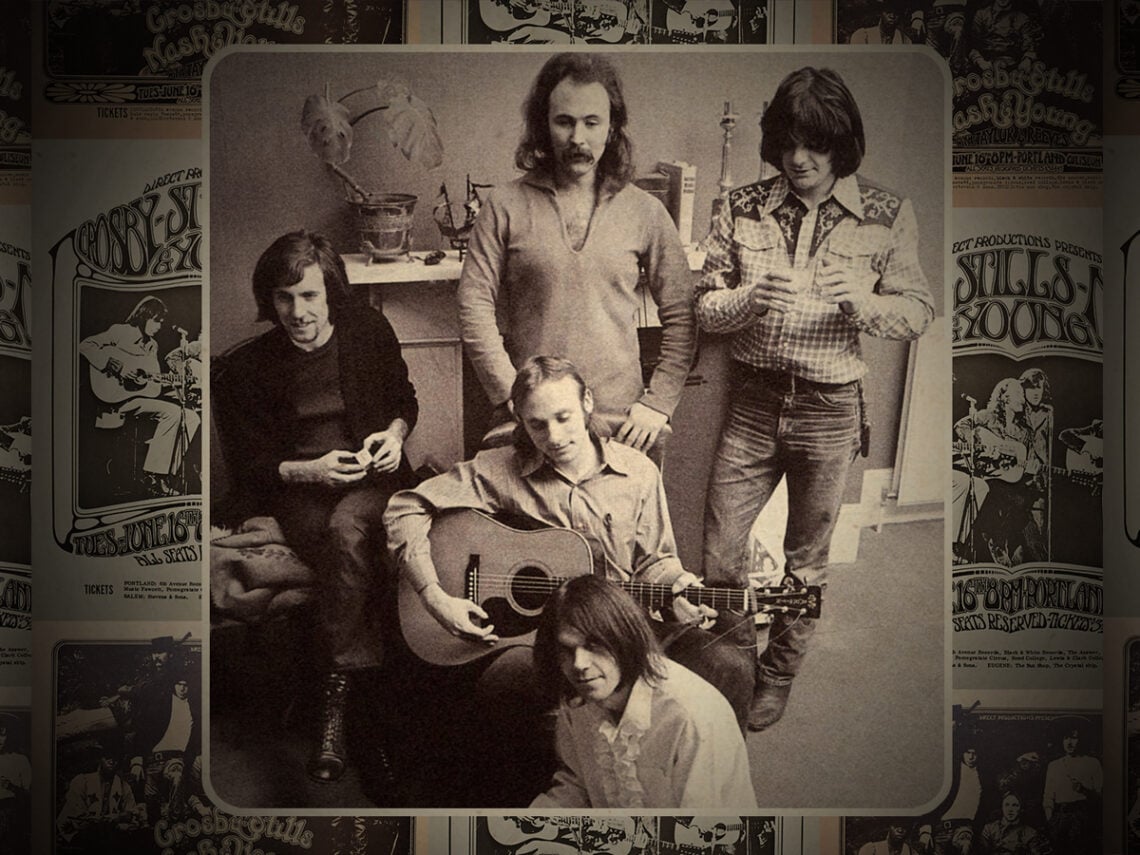
(Credits: Far Out / Crosby Stills Nash and Young / Original Posters)
Wed 8 April 2026 19:45, UK
“Groups are always changing, breaking up, going through all kinds of last farewell appearances,” Neil Young told a Canadian newspaper in 1970, letting his familiar cynic flag fly.
He explained, “What they do first is they get very funky, and everybody really likes them. Then they go down to Hollywood and buy a whole bunch of clothes because they made a little bit of money. Finally, they look like all the other groups, and they’ve got all the stuff, and then eventually nobody likes them anymore, and they break up and go back to their other clothes.”
He was 25 when he gave that assessment, an age when most chart-topping musicians are just getting their first taste of the rock and roll lifestyle, wide-eyed and optimistic. Young, by contrast, was already a grizzled old pro, long since disillusioned with the LA dreams he’d left Canada to pursue. The industry hadn’t necessarily let him down; both his solo work and his records with the Buffalo Springfield and Crosby, Stills, Nash & Young had proven commercially and critically successful. The trouble, he’d learned, was an as-yet unmanageable combination of young egos and drugs in a scene that was a lot less chilled out and groovy than all those Laurel Canyon photo shoots would suggest.
The story of the rise and fall of Crosby, Stills & Nash (and sometimes Young) is one of the more famous examples in rock history of petty infighting ruining a beautiful collaboration. The argument could be made, though, that the writing was on the wall for CSNY before they’d even put their first harmonies on tape. There are several different ways to form a so-called supergroup.
In a lot of cases over the past 60 years, the idea has been to bring together four or five musicians from existing, successful bands in order to join forces on something new, not as an escape from their other projects, but as a nice, temporary change of pace, and other times, as a slightly more tenuous proposition, a supergroup is formed from the flaming wreckage of other bands, as the disgruntled cast-offs from toxic outfits find one another wandering through the California desert, angry and alone with no studio to go home to.
 (Credits: Far Out / Atlantic Records)
Then, these jaded and routinely stoned vagabonds share stories of their unjust betrayals at the hands of their ex-bandmates, and someone eventually floats the idea that the cast-offs should come together and start their own, far superior group, and this, in a nutshell, is the origin story of Crosby, Stills, Nash & Young.
David Crosby’s exit from The Byrds was perhaps the most dramatic of the four, and it set the tone for everything that followed. By 1967, The Byrds were already a band in flux, having shed multiple founding members in quick succession, but Crosby’s dismissal still landed like a bomb, and while creative tensions had been simmering for months, Crosby was pushing the group toward longer, more experimental compositions, laced with jazz influences and surreal lyrical detours, as the rest of the band, particularly Roger McGuinn, was trying to maintain some semblance of structure and commercial viability.
The breaking point came during a series of high-profile appearances, including the Monterey Pop Festival, where Crosby openly criticised the band onstage, rambled about his JFK conspiracy theories, and insisted on performing his own material against the wishes of his bandmates, whereas offstage, he was just as confrontational, second-guessing arrangements and clashing over songwriting credits.
The Byrds, never the most stable collective to begin with, finally decided they’d had enough, and in the autumn of 1967, Crosby was fired, while on the other end, Stephen Stills was watching the once-mighty Buffalo Springfield disintegrate in slow motion.
Formed in 1966, the band quickly established itself as one of the leading lights of the new American folk-rock movement, but success came with complications, as Neil Young, Stills’ primary foil and creative partner, had a habit of disappearing without notice, distracted by his own ambitions, and bassist Bruce Palmer was repeatedly deported to Canada on drug charges.
 Credit: Alamy
Internal rivalries simmered, and management struggled to keep the whole enterprise on track, while Stills found himself acting as the band’s de facto leader, holding sessions together as well as keeping an eye on better prospects emerging around him. By 1968, the juggling act became pointless, and Buffalo Springfield officially broke up that spring, though in truth they’d ceased functioning as a coherent unit well before then. Stills had no shortage of other friends in LA willing to work with him, but he assumed he wouldn’t be playing with Neil Young again any time soon.
Unlike Crosby and Stills, Graham Nash decided to end his affiliation with The Hollies on his own terms, walking away from one of the most successful pop bands in the UK primarily for creative reasons. It was a far riskier play for Nash to jump ship, not just from a proven entity, but from his own country, as he decided to relocate to Los Angeles in 1968 with the hopes of re-inventing himself in the welcoming arms of the Laurel Canyon community. The songs he’d been writing in his final months with The Hollies were already more suited to the SoCal state of mind, and David Crosby was among the first to appreciate them.
“This is why The Hollies lost Nash,” Crosby told MusicRadar years later, referring specifically to the Nash-penned track ‘Marrakesh Express’, adding, “He was writing songs like this. If they had realised how good his songs were, I don’t know what would have happened.”
If Nash had felt misunderstood and underappreciated by his old pals in the Hollies, the experience was a complete 180 in California, at least at the beginning.
“We used to go to our friends’ houses in Laurel Canyon, me and David and Stephen with a couple of guitars, and we’d kill them,” Nash told The Guardian in 2022, recalling CSN’s earliest, organic jam sessions, adding, “We were fucking fantastic. We had discovered a new way of singing, of creating a vocal blend, making our three voices into one. We would kill them. They could not believe what we were doing. Then we’d follow that with ‘Guinnevere’, then ‘Lady of the Island’, then ‘Helplessly Hoping’, and ‘You Don’t Have to Cry’, and they’re all on the floor with their fucking brains melting. That’s the image I see every time I think of those moments.”
 (Credits: Spotify)
Nash followed that gruesome-sounding description of his own greatness by adding, with no irony intended, “When we first started, there were no egos”, rather claiming it was the coke that eventually changed that, saying, “There was an enormous amount of drugs being taken… I’d get high in the morning and snort in the afternoon, and I’d keep going till 3 or 4am.”
Cocaine had originally been a component of a celebratory atmosphere, as Crosby, Stills and Nash had managed to translate the sound and energy of their house party gigs onto their self-titled debut album in 1969, to incredibly fruitful returns. As each individual’s old rebellious tendencies started to sprout up again, though, the idea was hatched to bring in a fourth member to potentially bring the group into balance.
“We needed somebody just to keep Stephen on his game and competitive and on fire,” Nash claimed, “And I think basically that Stephen and [producer] Ahmet [Ertegun] came up with the idea, or maybe it was Ahmet to Stephen, of getting Neil on board.”
Young had released two solo albums by this point, but he hadn’t yet become the Neil Young, so the idea of joining the emerging CSN juggernaut for the group’s performance at a peace and love festival called Woodstock sounded too good to pass up. Any lingering animosity with Stills from the Buffalo Springfield days was easily set aside for the occasion.
“It was a different band when Neil joined,” Nash explained, “Not a lot of people understand that. They think it’s just an added voice. But it’s not. It’s an added attitude. Neil brings a sharper edge. I was gonna say a darker feeling, but I don‘t mean that in a negative way. He brings this edge to us that we don’t have. And, of course, you have to take into account his ability to play lead guitar against and with Stephen.”
And so, at 0330 hours on the final morning of Woodstock, all four Avengers had finally assembled, joined together on a path that would produce one more great album, 1970’s Déjà Vu, before rising turmoil within the group created a déjà vu scenario of its own. Four men who’d bonded over their shared desire to have more control over their bands ultimately couldn’t decide who should have more control over their band, and the CSNY train derailed, only to return years later when cooler heads and less cocaine finally prevailed.
