
image:
The constellation of Ursa Major (The Great Bear) is home to Messier 101, the Pinwheel Galaxy. Messier 101 is one of the biggest and brightest spiral galaxies in the night sky. Like the Milky Way, Messier 101 is not alone, with smaller dwarf galaxies in its neighborhood.
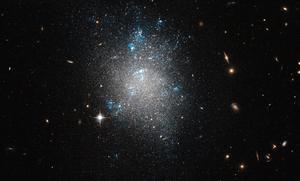
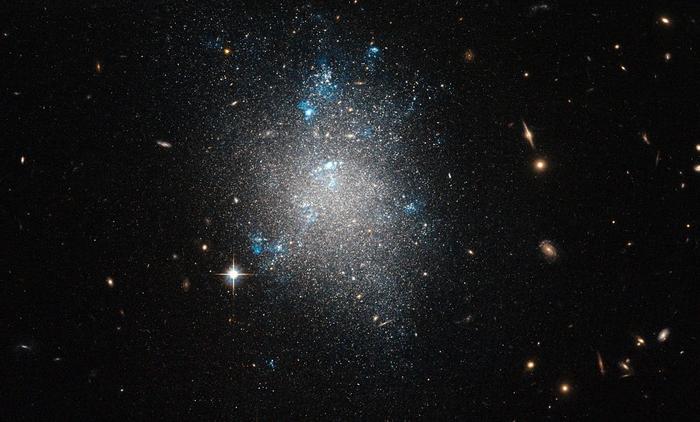
NGC 5477, one of these dwarf galaxies in the Messier 101 group, is the subject of this image from the NASA/ESA Hubble Space Telescope. Without obvious structure, but with visible signs of ongoing star birth, NGC 5477 looks much like an typical dwarf irregular galaxy. The bright nebulae that extend across much of the galaxy are clouds of glowing hydrogen gas in which new stars are forming. These glow pinkish red in real life, although the selection of green and infrared filters through which this image was taken makes them appear almost white.
The observations were taken as part of a project to measure accurate distances to a range of galaxies within about 30 million light-years from Earth, by studying the brightness of red giant stars.
In addition to NGC 5477, the image includes numerous galaxies in the background, including some that are visible right through NGC 5477. This serves as a reminder that galaxies, far from being solid, opaque objects, are actually largely made up of the empty space between their stars.
This image is a combination of exposures taken through green and infrared filters using Hubble’s Advanced Camera for Surveys. The field of view is approximately 3.3 by 3.3 arcminutes.
Credit: ESA/Hubble & NASA
The absence of a signal could itself be a signal. This is the idea behind a new study published in the Journal of Cosmology and Astroparticle Physics (JCAP), which aims to redefine how we search for dark matter, showing that it may not be necessary to find the same “clues” everywhere in order to interpret it.
In particular, the study suggests that even if we observe a certain type of signal at the center of our galaxy — an excess of gamma radiation that could result from the annihilation of dark matter particles — failing to detect the same signal in other systems, such as dwarf galaxies, is not enough to rule out this explanation.
Dark matter, in fact, may not consist of a single particle, but of multiple slightly different components, whose behavior varies depending on the cosmic environment.
The galactic center gamma-ray excess
Dark matter: we know it exists and is abundant, but we have never observed it directly and therefore we still do not know what it is. For decades, it has been a major focus for cosmologists and astrophysicists trying to understand its nature. Its presence is inferred mainly from the gravitational effects it exerts on visible matter, but so far none of the proposed hypotheses has received definitive confirmation from data. The search therefore continues.
Many leading dark matter models describe it as being made of particles. In some of these scenarios, when two particles meet, they can annihilate, producing high-energy radiation such as gamma rays, which astronomers attempt to detect.
“Right now there seems to be an excess of photons coming from an approximately spherical region surrounding the disk of the Milky Way,” explains Gordan Krnjaic, a theoretical physicist at the Fermi National Accelerator Laboratory (Fermilab) in the United States and one of the study’s authors. This excess of gamma-ray photons observed by the Fermi Gamma-ray Space Telescope could be due to dark matter annihilation. However, there are also alternative explanations, in which the gamma-ray emission would be produced by astrophysical sources such as a population of pulsars.
To resolve this question, it is necessary to look elsewhere. “If certain theories of dark matter are true, we should see it in every galaxy, for example in every dwarf galaxy,” explains Krnjaic.
Dwarf galaxies
Dwarf galaxies are very small and faint systems, but extremely rich in dark matter. They have very little astrophysical background — fewer stars and less ordinary radiation — and therefore represent ideal environments in which to search for “clean” signals.
Standard theories that describe dark matter as made of particles generally predict two possibilities for how these particles annihilate. In the simplest case, the annihilation probability is constant and does not depend on the particles’ velocity: in this scenario, if we observe a signal at the center of our galaxy, we should also expect to see it in other dark matter–rich systems, such as dwarf galaxies.
In the second case, the annihilation probability depends on the velocity of the particles. Since dark matter particles in galaxies move at very low velocities, this type of interaction makes annihilation extremely rare, and therefore the signal effectively invisible everywhere.
Within this framework, the absence of a signal in dwarf galaxies would make it difficult to interpret the excess of gamma radiation observed at the center of our galaxy as being due to dark matter.
Krnjaic and collaborators, however, describe an alternative, more complex scenario that could explain the absence of a signal in dwarf galaxies while still maintaining the interpretation of the signal observed in the Milky Way as a possible effect of dark matter.
Two different particles
“What we’re trying to point out in this paper is that you could have a different kind of environmental dependence, even if the annihilation probability is constant in the center of the galaxy,” explains Krnjaic. “Dark matter could straightforwardly be two different particles, and the two different particles need to find each other in order to annihilate.”
The probability that the two components of dark matter meet and annihilate would also depend on the ratio between these two particles within each astrophysical system. This ratio could be different in galaxies like our own — where the two types of particles might be present in similar proportions — and in dwarf galaxies, where it could instead be strongly unbalanced.
“In this way, you get very different predictions for the emission,” explains Krnjaic.
The model proposed by Krnjaic and colleagues therefore represents a more flexible alternative to the simplest standard scenario, as it allows for the possibility of explaining the absence of a gamma-ray signal in dwarf galaxies without ruling out a dark matter origin for the signal observed in the Milky Way.
In the future, the Fermi Gamma-ray Telescope may provide more precise data on dwarf galaxies — currently still limited — helping to clarify whether these systems emit gamma radiation or not. In principle, the observation of a signal would be compatible with a similar distribution of the two components also in dwarf galaxies, while its absence could suggest that one of the two is less abundant. However, this interpretation is not unique and depends on additional astrophysical factors, making it necessary to compare the model with a wider range of observations.
The paper “dSph-obic dark matter” by Asher Berlin, Joshua Foster, Dan Hooper and Gordan Krnjaic is now available in JCAP.
Journal
Journal of Cosmology and Astroparticle Physics
Method of Research
Data/statistical analysis
Article Title
dSph-obic dark matter
Article Publication Date
9-Apr-2026
Disclaimer: AAAS and EurekAlert! are not responsible for the accuracy of news releases posted to EurekAlert! by contributing institutions or for the use of any information through the EurekAlert system.