
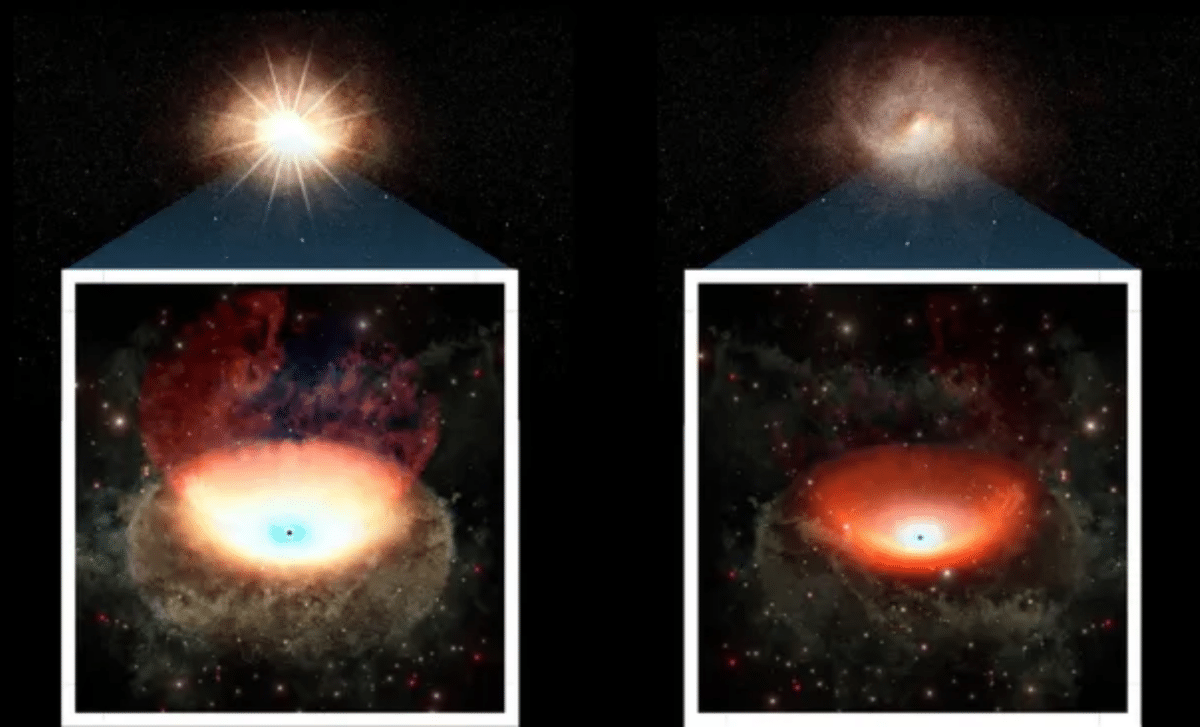
Astronomers have observed a distant galaxy’s supermassive black hole undergoing a dramatic transformation. The galaxy’s black hole experienced a sudden reduction in its gas supply, leading to a staggering 95% drop in brightness over just 20 years. This study, published in the Publications of the Astronomical Society of Japan (PASJ), presents the first evidence of such rapid “starvation” in a supermassive black hole, potentially revolutionizing our understanding of how these cosmic giants behave.
The Mystery of the Fading Black Hole
Supermassive black holes, often found at the center of galaxies, are typically surrounded by glowing accretion disks, dense clouds of gas and dust spiraling toward the event horizon. These disks emit extraordinary amounts of light, often outshining all the stars in the galaxy. This intense brightness has led scientists to believe that the behavior of these black holes is largely stable over long periods. However, the discovery of the galaxy J0218−0036, where the black hole’s brightness plummeted by 95%, has revealed a far more dynamic and unpredictable process.
The decline in brightness began when the galaxy’s black hole experienced a significant reduction in the flow of matter to its accretion disk. Over two decades, the light from the black hole faded from a vibrant glow to a shadow of its former self, challenging the prevailing understanding that such changes would take thousands of years.
“It is fascinating that an active galactic nucleus can change its brightness so dramatically over such a short period of time, and that this fading appears to be caused by a large change in the accretion rate onto the supermassive black hole,” explained team leader Tomoki Morokuma of Chiba Institute of Technology. “Using wide-field survey data, such as those from Hyper Suprime-Cam, we hope to discover more objects like this and learn how the activity of supermassive black holes shuts down and restarts.”
The Role of Gas and the Accretion Disk
Supermassive black holes are not solitary entities but are part of a complex system. They rely on a continuous supply of gas and dust to fuel their accretion disks, the swirling structure that surrounds the black hole. This material heats up as it spirals inward, emitting tremendous radiation across the electromagnetic spectrum. When the supply of gas dwindles, the brightness of the accretion disk decreases as well, which is exactly what has happened in the case of J0218−0036.
Astronomers used data from multiple telescopes, including the Sloan Digital Sky Survey (SDSS) and the Hyper Suprime-Cam on the Subaru Telescope, to trace the dramatic fading of this galaxy’s central black hole. In comparing archival images from 2002 and 2018, they could pinpoint the exact moment when the galaxy’s brightness started to dip.
By examining additional wavelengths of light, from X-rays to infrared radiation, the team tracked how the changes in the accretion disk’s gas supply occurred. The data, published in the journal Publications of the Astronomical Society of Japan (PASJ), revealed that the gas flow had been cut by an astonishing 98% over a mere seven years. This abrupt starvation of the black hole raised new questions about how such changes could take place so quickly.
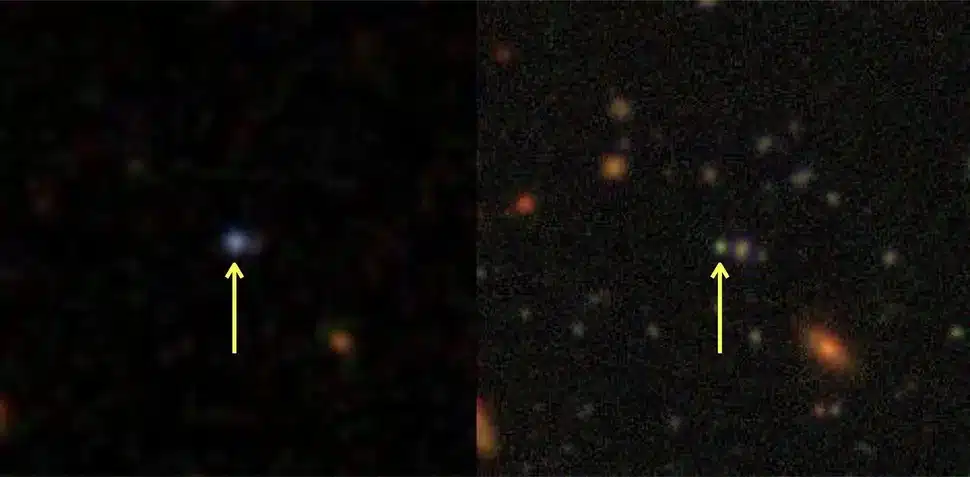 Visible-light images of the galaxy J0218−0036 (redshift 1.8; about 10 billion light-years away), indicated by the yellow arrows. The image on the left was taken by the Sloan Digital Sky Survey (SDSS), and the image on the right by Hyper Suprime-Cam (HSC) on the Subaru Telescope. Because HSC has higher sensitivity than SDSS, many additional faint objects are visible in the HSC image. Comparing the brightnesses in the two images shows that the galaxy faded dramatically between about 2002 (SDSS) and 2018 (HSC). (Image credit: SDSS, HSC-SSP/NAOJ)
Unexplained Behavior: A New Test for Models
While the drop in brightness is unmistakable, the cause behind the cessation of the black hole’s feeding remains unclear. The team ruled out the possibility that a cloud of gas had simply blocked the accretion disk’s light, as such an event could not explain the drop in brightness across multiple wavelengths. As a result, this case represents a unique anomaly that challenges the standard models of black hole feeding and behavior.
“This object shows rapid variability that cannot be explained by standard models. It provides an important test case for developing new theoretical models,” said team member Toshihiro Kawaguchi of the University of Toyama. “We will investigate what physical conditions could reproduce the observed behavior.”