
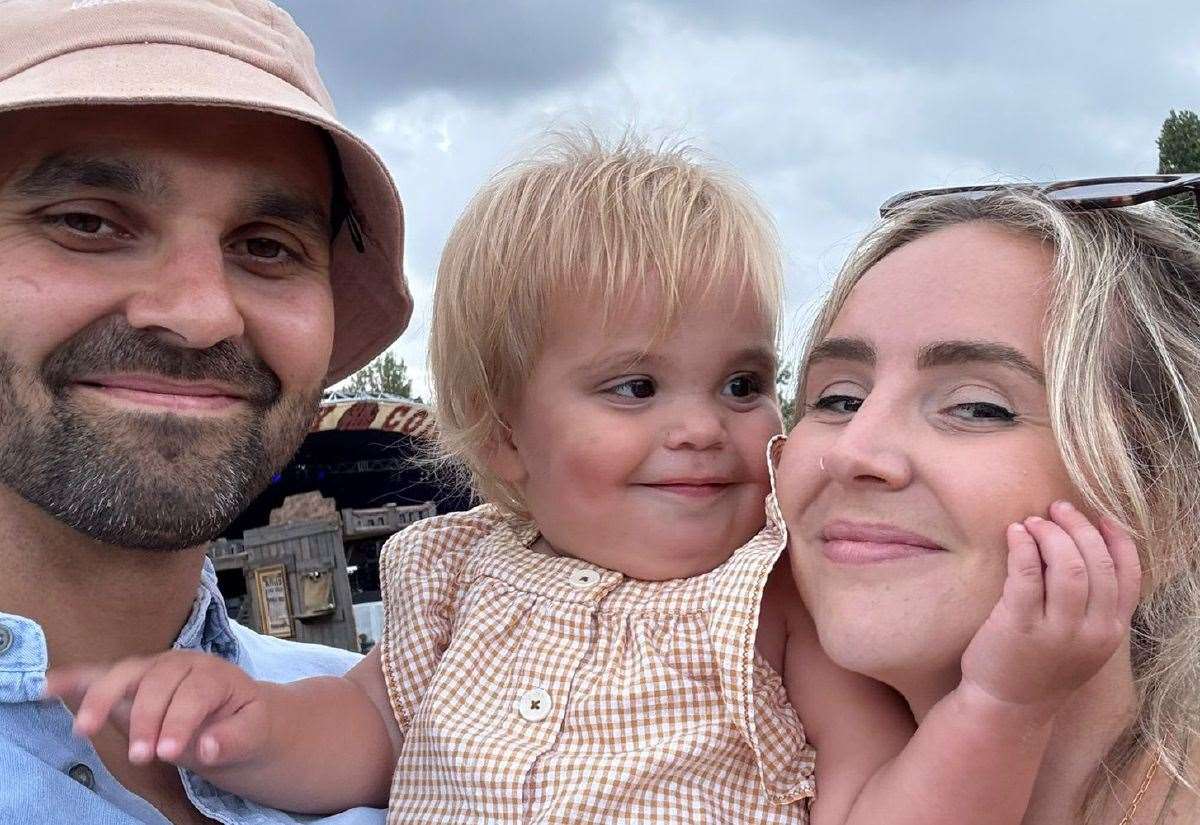
The parents of a two-year-old are in a race against the clock after finding out by chance that their little girl has childhood dementia.
Emily and Gus Forrester from Sevenoaks are desperately fundraising for life-saving treatment for Leni after she was diagnosed with the extremely rare and severe disorder.
 Emily and Gus with daughter Leni
Since she was born, her mum says the tot has been “an exceptionally happy child”, full of energy and laughter. They had no reason to think anything was wrong.
But when she was just 15 months old, a family member going through IVF discovered they were a carrier of Sanfilippo syndrome during a routine genetic screening.
The disorder, also known as childhood dementia, is a condition that causes severe neurodegeneration, behavioural issues, speech delays, loss of motor function, and dementia.
Symptoms appear in early childhood, with those living with it often only reaching their teens or early twenties.
Emily said: “When we looked up the syndrome, and we saw the very early signs, Leni was exhibiting all of them, but they are all things that can be explained away as normal toddler development.
Leni was around 15-months old when they found out she could have Sanfilippo syndrome
“Sanfilippo often has very distinctive facial features, and she has the bushy eyebrows and full eyelashes, but it is more subtle in Leni.
“Then we looked at the other signs, and it was things like frequent ear infections, bloated tummy, loose stools, but all of these things don’t really seem like they’re connected.
“We convinced ourselves that it wasn’t possible, but we thought we’d check it out anyway, just to make sure, so we went to the GP, who, again, agreed it was very, very unlikely.”
But due to a delay in Leni’s speech, she qualified for further investigation and was seen by a paediatrician and several specialists in the following months.
The final stage of the process was a genetic screening. For a child to be diagnosed with Sanfilippo syndrome, both parents must be carriers of the gene.
The Sanfilippo Syndrome traits appeared subtle in Leni
But with the test on the NHS being a 10-month wait for results, the couple, for peace of mind and, with the hope of growing their family, opted to have a private one carried out.
It came back negative.
Emily said: “We thought ‘Brilliant, there’s no way that Leni can have Sanfilippo’.
“But we then went on to have the genetics test with the NHS, and we had the initial consultation, and we both left feeling something was terribly wrong.
“We could just tell from how the geneticist was interacting with Leni – the questions that he was asking, the very detailed analysis, looking at the creases in the palms of her hands and on her feet.
Emily and Gus are desperately fundraising for life-saving treatment for Leni
“You know, you go to a doctor’s appointment with your child, and they don’t believe something’s wrong. It’s a very quick in and out, so we could just tell.”
The following day, the couple received a phone call from the geneticist informing them that money had been put forward for a rapid response test, which would provide the screening results within two weeks.
It revealed that they were both, in fact, carriers of the Sanfilippo gene.
The 33-year-old said: “It was just complete devastation and despair – we just couldn’t believe what we were hearing.
“We were still kind of clinging on to that private test in the hope that the NHS was wrong and a private test was right.
Experimental treatment for Leni is her parents’ only hope
“But in the back of our minds, I think we knew that Leni had this syndrome.”
There is currently no treatment and no cure .
With Leni’s condition, toxic waste builds up in her tiny body every single day, and the damage cannot be reversed once it is done
Emily said: “You are essentially told to just take your child home. There is palliative care only, but beyond that, there’s nothing to be done
“I can’t imagine a worse condition. To be told that you are just going to have to watch your child just sort of slowly disappear in front of your eyes over a 10-year period is just horrific.
Emily and Gus are in a race against the clock to secure treatment before Leni turns three
“As parents, our job is to protect our children, and we cannot do that.”
The couple are now fundraising £500,000 for experimental treatment for Leni and other children suffering from the debilitating condition.
Both avenues they are exploring would involve the trials taking place in America.
Between three and four years old, children with Sanfilippo syndrome begin to regress, and the couple are in a race against the clock to secure funding for the trials before Leni turns three in October.
To donate to the fundraiser, click here.
Emily said: “There are treatments that are proven to be so effective that children can go on to develop completely normally and have normal lives, but they can’t access them because of funding.
“Obviously, it gives us hope, and that’s what we’re now pushing for, but at the same time, this is torture knowing that there is a treatment that could save your child’s life that is sitting on a shelf and we just can’t access it because of money.”