
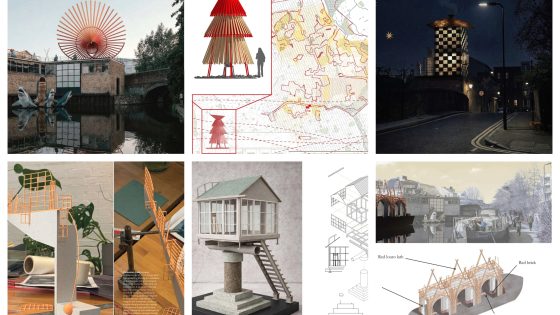
The competition – now in its eighth year – sought proposals for an installation suitable for a future post-AI era ‘in which craftsmanship finds a bigger place in the skill set of architects and reuse of materials becomes routine’.
The six finalists are:
(re)sun(cle) by Xinyi Wang / Xytopia
Holy Spirit by Kryzhanovsky & Poliakov
Feathered Folly by Jonny Buckland of Studio Saar
Holy Crap by Bobby Esposito of Rites Studio.
Calibration Field by German Nieva, Nikolai Delvendahl and Tom Foulsham
Pillar Penthouse by Benedikt Hartl of Opposite Office
Applicants could design their installation for one of two sites: the Hoxton Docks complex on the Regent’s Canal at Columbia and Brunswick Wharf in Hackney, or the land on Page’s Walk in Southwark.
Entries were required to reuse existing construction materials, including scrap steel, reusable masonry, double-glazed units, recycled Tetra Pak sheeting and a large quantity of reclaimed Red Louro lath cladding stored at Hoxton Docks.
During the competition’s second phase, the shortlisted teams will each receive structural engineer support and a £500 bursary to develop their scheme’s realisation and construction strategy.
The overall winner, to be announced later this month, will receive a £10,000 prize plus £5,000 to cover ancillary costs for building their pavilion, such as fixings, adhesives, cement, tools and other recycled materials. The installation is to be completed by 1 August.
The competition is backed by historic regeneration specialist Shiva.
The two-storey 1960s Columbia Wharf and its neighbour Brunswick Wharf stand on a stretch of canal-side site that was originally home to the Gas Light and Coke Company. It was transformed into the Hoxton Docks artist studios more than 30 years ago. The complex, at 53-55 Laburnum Street, overlooks Haggerston Baths and BDP’s 2008 Bridge Academy.
Previous Antepavilion installations to occupy the site include Flood House by Matthew Butcher, Potemkin Theatre by Maich Swift Architects, and All Along the Watchtower by Project Bunny Rabbit.
Last year’s winner was a laminated plywood structure called Moonument, designed by George Gil in collaboration with the Redundant Architects Recreation Association.
The 2024 edition focused on transforming land formerly occupied by a Soviet T-34 tank in Southwark. It was won by Good Shape.
The 2025 edition returned to Hoxton Docks following a legal battle between the client and Hackney Council. The council had previously won an injunction requiring the removal of 2020’s winning scheme: a series of floating polystyrene and fibreglass sharks by architect Jaimie Shorten.
The finalists
Shortlisted: (re)sun(cle) by Xinyi Wang/Xytopia
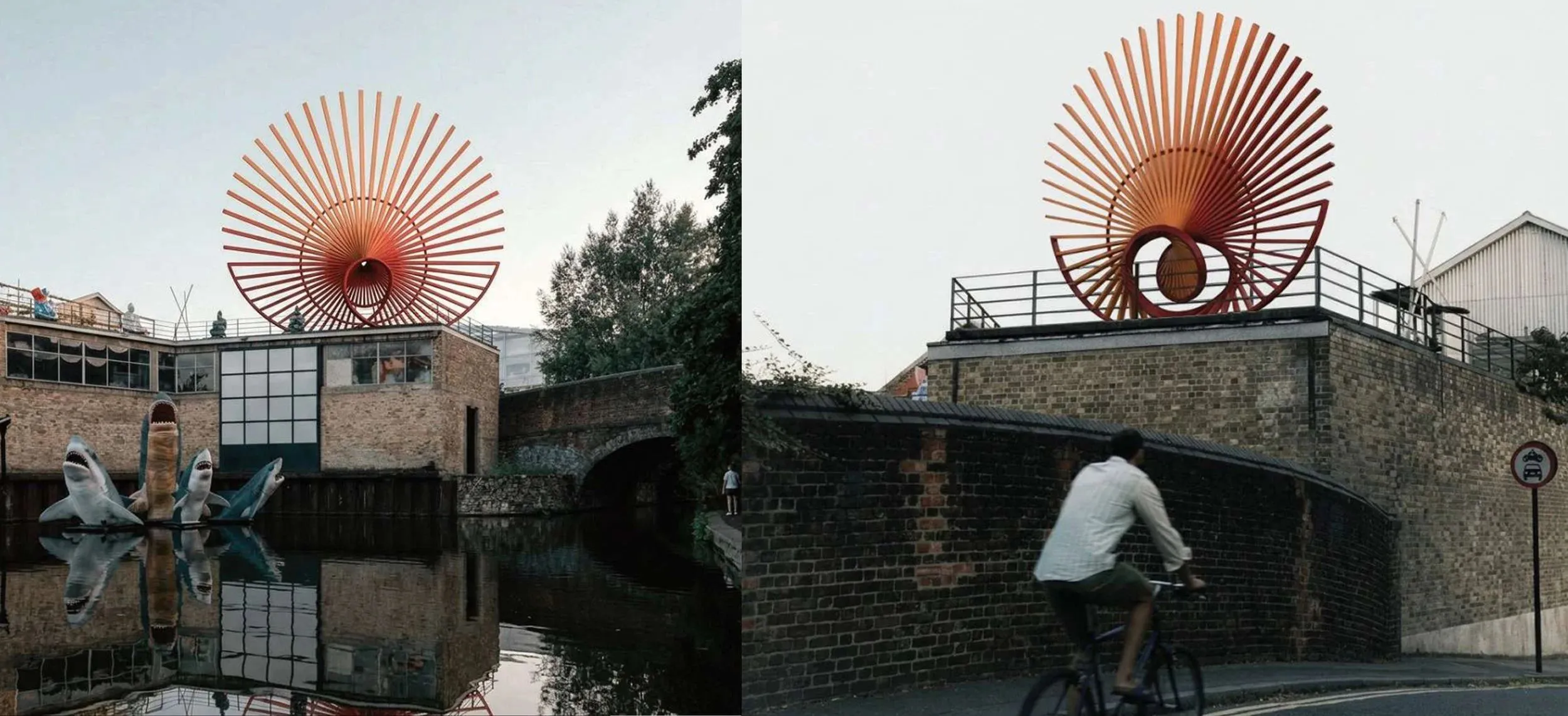
Shortlisted: (re)sun(cle) by Xinyi Wang/Xytopia
Set at the dock, (re)sun(cle) becomes a marker for what architecture can still be after excess, after waste, and after the fantasy of effortless production. It does not hide its age or pretend to be pristine. Its meaning comes precisely from reuse: from taking what has already passed through one life and giving it force, presence and public meaning again. In that sense, this is not just a pavilion. It is a small declaration that the future will not be made from clean beginnings, but from intelligence, labour, memory and care.
The installation is conceived as a simple assembly of reclaimed timber and reclaimed steel. Each red louro plank is fixed back to a sweeping metal armature at two points, either at the mid and end positions or at both ends, so the pieces are held securely and read as one continuous radiating form. The metal armature itself can be fabricated from available reclaimed steel sections in the inventory and assembled as a series of straightforward components.
Shortlisted: Holy Spirit by Kryzhanovsky & Poliakov
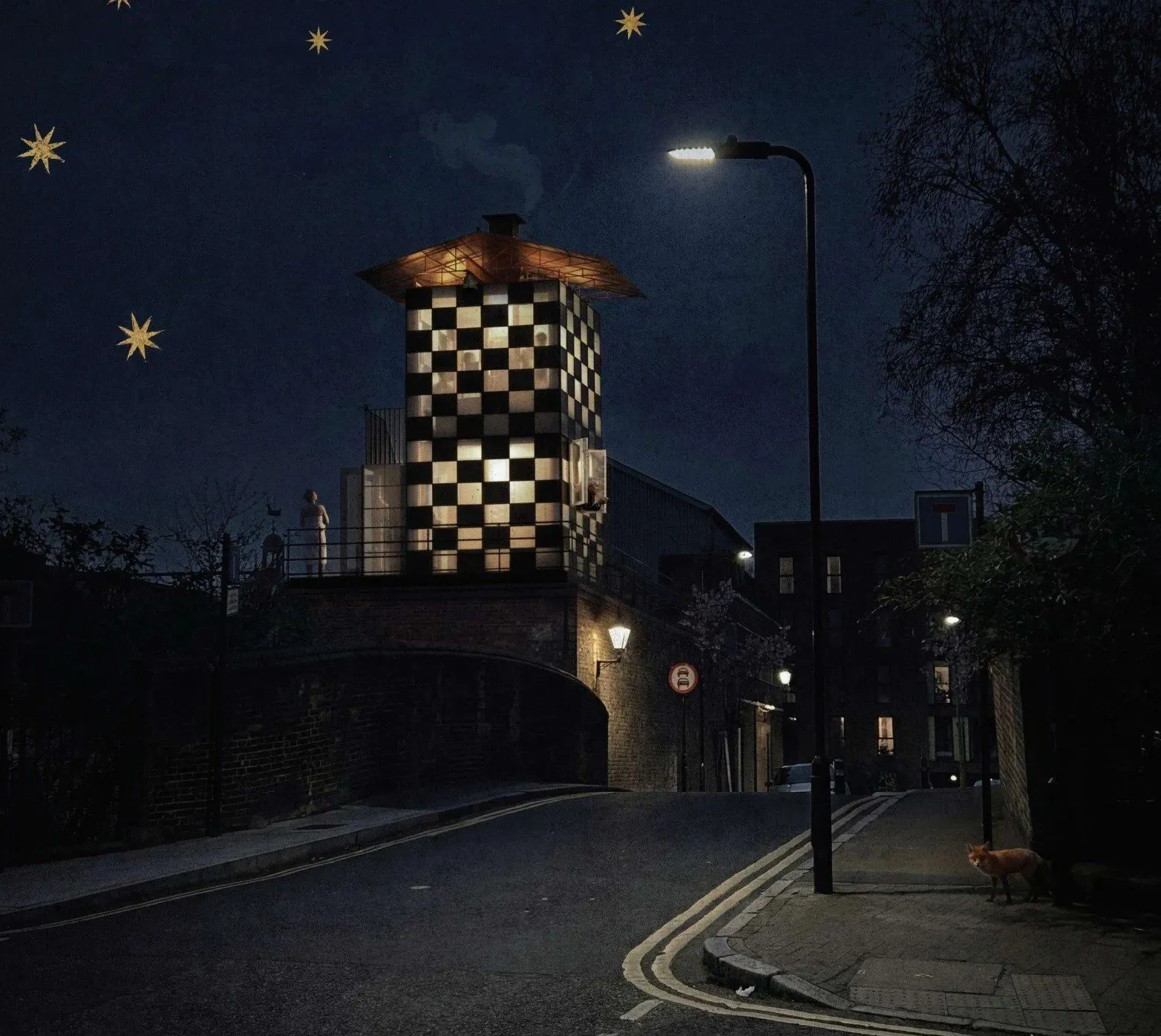
Shortlisted: Holy Spirit by Kryzhanovsky & Poliakov
Holy Spirit is a public sauna and gathering space situated within the industrial fabric of the canal edge. The project is conceived as an art of assembly, bringing together found elements into a new civic structure defined as much by use and atmosphere as form. The pavilion is constructed from standard-sized materials, largely unaltered, a deliberate strategy that both economizes and suggests possibilities for future adaptation and reuse.
At night, the building becomes a glowing lantern on the canal. Its patchwork façade filters light outward, revealing silhouettes within while maintaining a sense of intimacy. It stands as a beacon for occupation, an open invitation to gather, participate, and inhabit.
Shortlisted: Feathered Folly by Jonny Buckland of Studio Saar
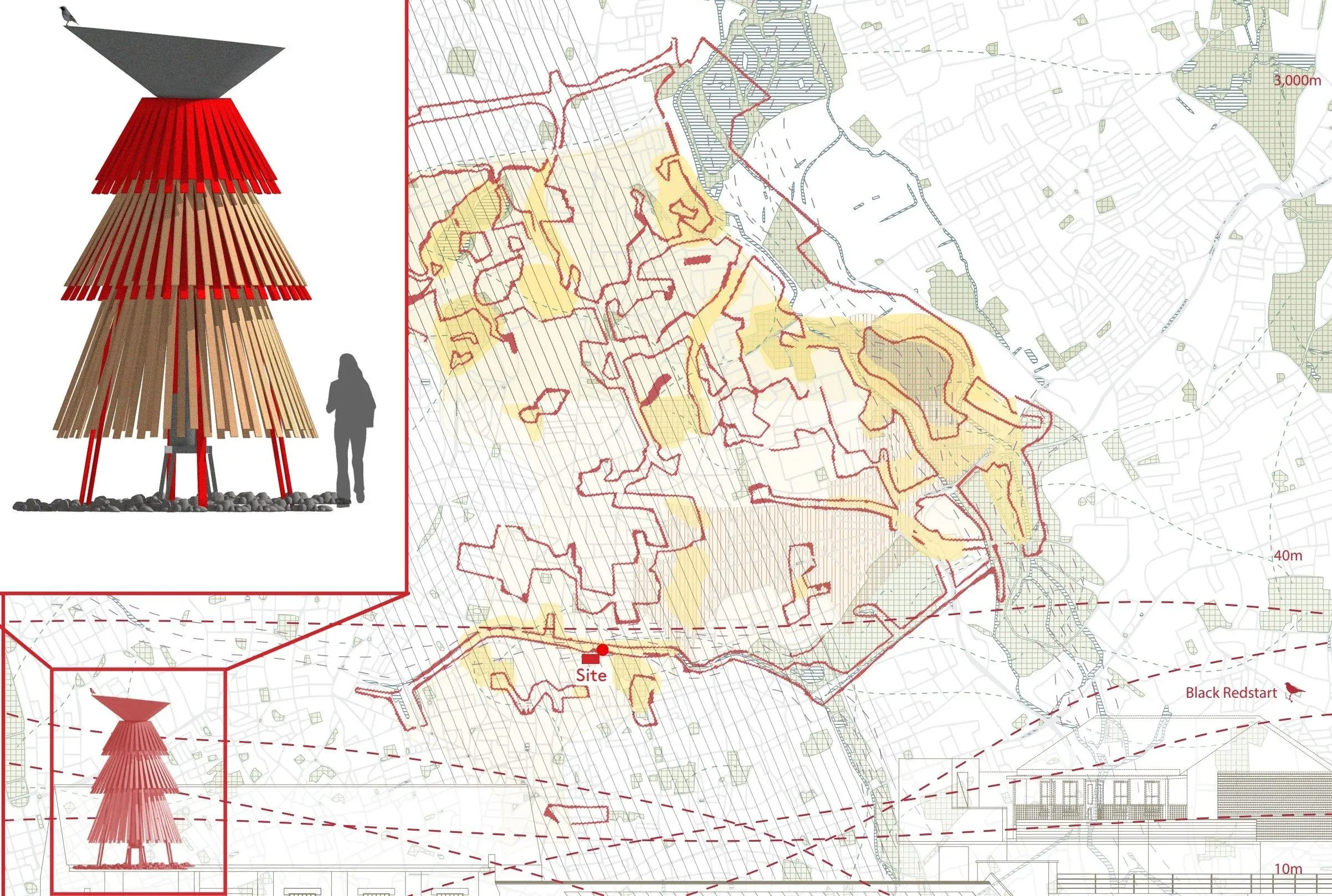
Shortlisted: Feathered Folly by Jonny Buckland of Studio Saar
The Feathered Folly is a reclaimed habitat structure for the rear of Hackney warehouse overlooking the canal backwater, designed to support the Black Redstart, a bird in decline whose urban breeding habitat has been steadily lost through redevelopment. Rather than creating a pavilion centred for human occupation, the project proposes a vertical guildhall for bird life that taps into the city’s existing ecological infrastructure.
In giving form to the needs of the Black Redstart, The Feathered Folly reframes the canal edge as a place of interdependent occupation, productivity and care.
Shortlisted: Holy Crap by Bobby Esposito of Rites Studio
Shortlisted: Holy Crap by Bobby Esposito of Rites Studio
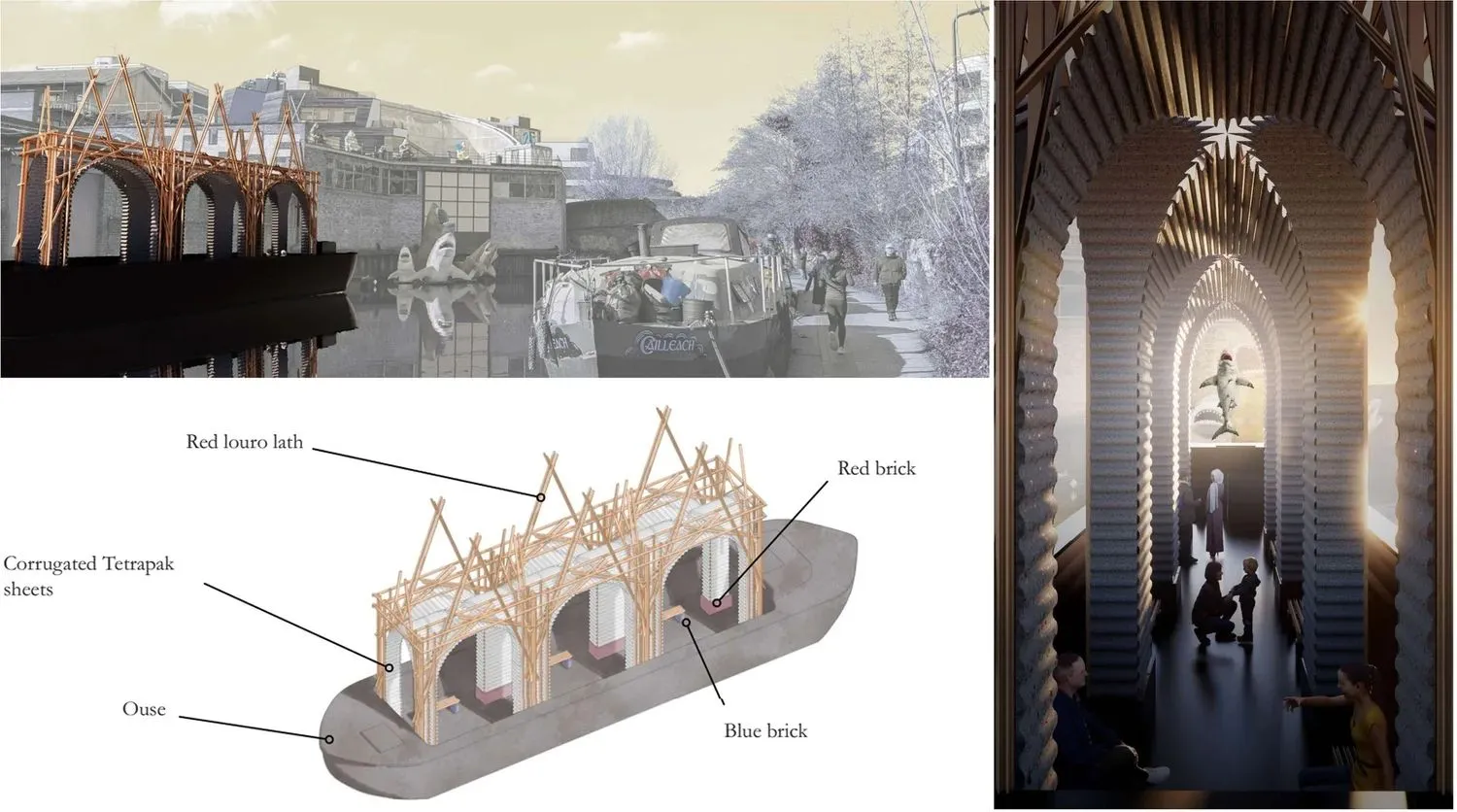
This work is a statement of reclaiming peace and solitude without the subservience to any higher power, whether it be a God or a city council. Instead of a holy torture in the apse, this chapel is oriented toward a crucified martyr of Antepavilion: a shark.
Inspired by medieval construction methods, this structure is frozen in its scaffolding stage. The scaffolding itself is the ornamentation. Benches of reclaimed red louro and brick line the edge of the barge’s hull so people can recant their woes in peace. The exterior appears somewhat chaotic due to the crisscrossing structural ties and supports, but the interior is more understated. Those arriving with frustration and anger can decompress in the Chapel of Scrap.
Shortlisted: Calibration Field by German Nieva, Nikolai Delvendahl and Tom Foulsham
Shortlisted: Calibration Field by German Nieva, Nikolai Delvendahl and Tom Foulsham
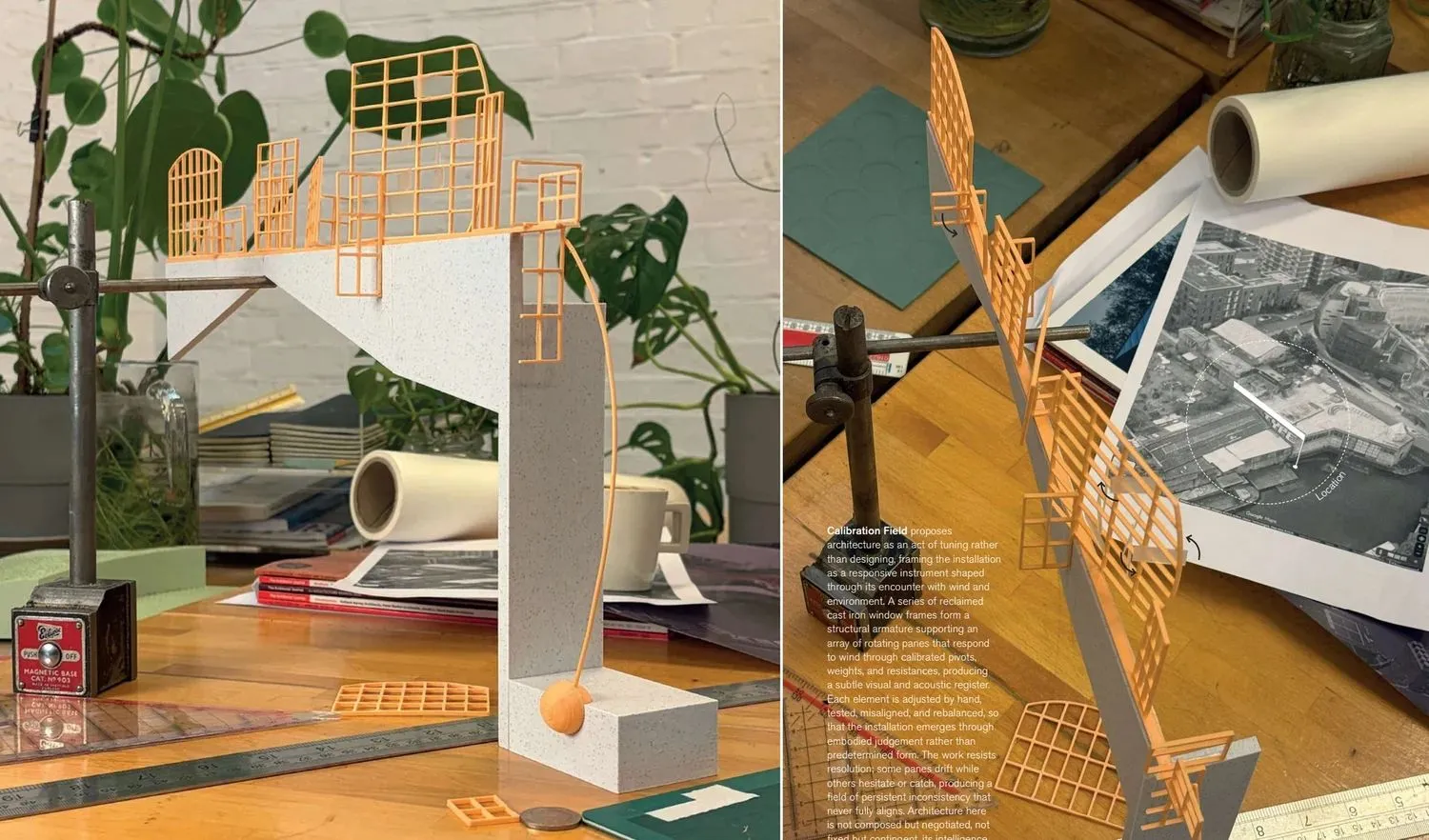
Calibration Field proposes architecture as an act of tuning rather than designing, framing the installation as a responsive instrument shaped through its encounter with wind and environment. A series of reclaimed cast iron window frames form a structural armature supporting an array of rotating panes that respond to wind through calibrated pivots, weights, and resistances, producing a subtle visual and acoustic register.
Each element is adjusted by hand, tested, misaligned, and rebalanced, so that the installation emerges through embodied judgement rather than predetermined form. The work resists resolution; some panes drift while others hesitate or catch, producing a field of persistent inconsistency that never fully aligns. Architecture here is not composed but negotiated, not fixed but contingent, its intelligence located in the calibration of matter rather than in abstract design.
Shortlisted: Pillar Penthouse by Benedikt Hartl of Opposite Office
Shortlisted: Pillar Penthouse by Benedikt Hartl of Opposite Office
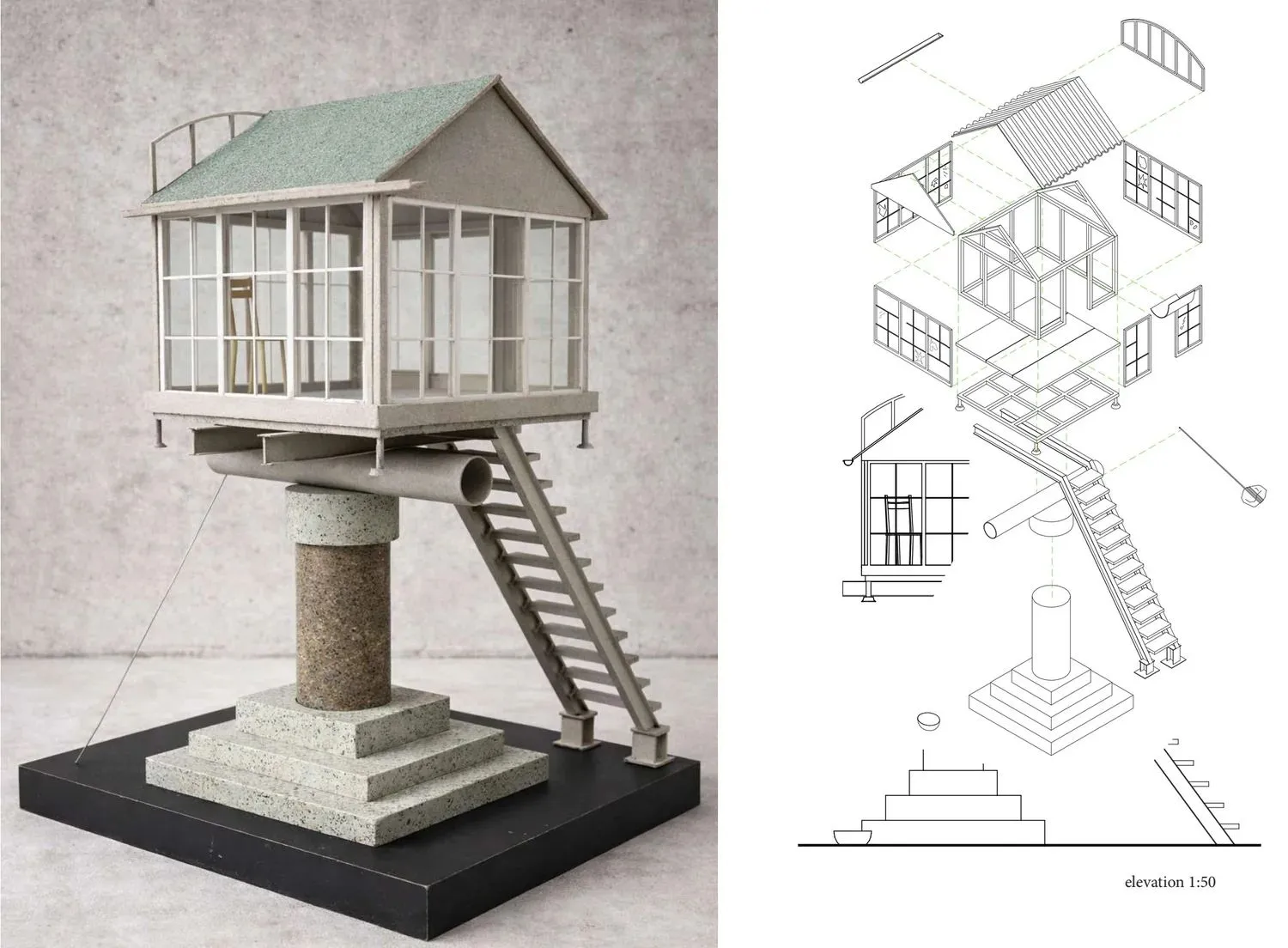
In a city where housing is increasingly unattainable, the Pillar Penthouse proposes a radical inversion: the smallest possible dwelling elevated to the status of a monument. A minimal microhome sits atop a single slender column rising from a plinth, a base traditionally reserved for figures of power. Here, it supports only the most basic unit of habitation: a space just large enough for one person to sit, stand, and lie down. The structure is built entirely from reclaimed materials. The plinth and column reuse terrazzo elements from a previous Antepavilion project.
By elevating this minimal home, the project makes visible the shrinking conditions of urban living. The plinth no longer commemorates power, but supports survival. Positioned in a leftover urban void at a road junction, the structure transforms an overlooked site into a moment of attention. The Pillar Penthouse is not a solution to the housing crisis – it is a monument.