

Artemis II crew wake up to ‘Lonesome Drifter’ as final preparations for splashdown nearYour support helps us to tell the story
From reproductive rights to climate change to Big Tech, The Independent is on the ground when the story is developing. Whether it’s investigating the financials of Elon Musk’s pro-Trump PAC or producing our latest documentary, ‘The A Word’, which shines a light on the American women fighting for reproductive rights, we know how important it is to parse out the facts from the messaging.
At such a critical moment in US history, we need reporters on the ground. Your donation allows us to keep sending journalists to speak to both sides of the story.
The Independent is trusted by Americans across the entire political spectrum. And unlike many other quality news outlets, we choose not to lock Americans out of our reporting and analysis with paywalls. We believe quality journalism should be available to everyone, paid for by those who can afford it.
Your support makes all the difference.Read more
The Artemis II mission astronauts have crossed the halfway mark between the Moon and Earth, with their capsule set to splash down in the Pacific Ocean after a fiery descent lasting about 15 minutes around 8.07pm ET today.
NASA expressed “high confidence” in the Artemis II crew spacecraft’s heat shield ahead of Friday’s historic return.
The shield is a critical part of the Orion capsule, protecting the crew from exposure to lethal temperatures – reaching up to 5,000 degrees Fahrenheit – during their high-speed descent, which is expected to last less than 15 seconds.
“It’s 13 minutes of things that have to go right,” Jeff Radigan, NASA’s Artemis II flight director, said yesterday.
There were problems with the heat shield on the first Artemis flight, which had no human passengers. Gases that were generated inside the shield’s outer material were not able to vent as expected, causing cracks.
Since then, the shield has undergone extensive testing and Amit Kshatriya, the space agency’s associate administrator, says his confidence in the tech is backed up by engineering and flight data.
The astronauts, including NASA’s Christina Koch, Victor Glover, Reid Wiseman and the Canadian Space Agency’s Jeremy Hansen were said to be in “high spirits” as they started their journey to Earth following a record-breaking slingshot around the Moon.
Spacecraft will enter six minutes communications blackout
As the Orion spacecraft begins descending through the Earth’s atmosphere from about 400,000 feet, it will enter a planned six‑minute communications blackout beginning at around 7.53pm ET.
This is due to plasma forming around the capsule during peak heating that could raise temperatures to around 2,760C.
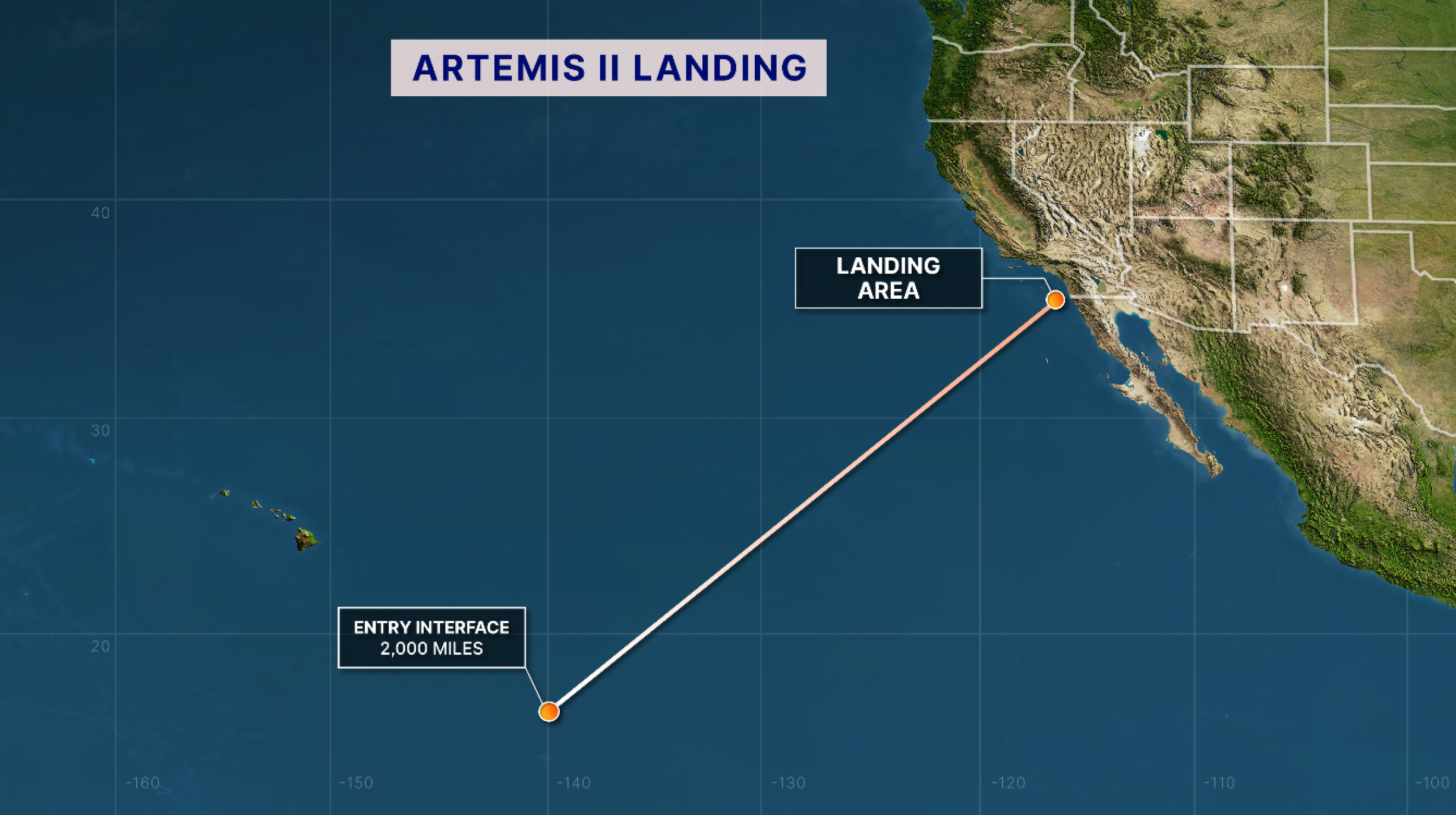 Ground track map displaying the Artemis II Orion parachute sequence (Nasa)
After emerging from the blackout, Orion will jettison its forward bay cover and begin deploying its parachutes one by one for splashdown off the coast of San Diego.
Vishwam Sankaran10 April 2026 08:00
Second spacecraft return correction burn complete
The Artemis II Orion spacecraft ignited its thrusters for about 9 seconds earlier today to push the crew toward Earth.
Ahead of this manoeuvre, Nasa temporarily lost signal from the spacecraft, but two-way communications were soon re-established.
Flight controllers have resumed preparing for the upcoming burn with the crew shortly after.
The next fuel burn is scheduled for 1.53 pm ET ahead of re-entry procedures.
Vishwam Sankaran10 April 2026 07:40
Have to hit re-entry angle correctly: Artemis flight director
Before the Artemis II mission Orion capsule begins its fiery descent to Earth, NASA hopes that it gets the re-entry angle right.
During re-entry, the crew-carrying capsule is expected to reach an estimated maximum velocity of nearly 24,000 mph, with astronauts likely to experience G forces equivalent to around 3.9 times the pull of Earth’s gravity.
The heat shield part of the Orion capsule has come under the scanner since an investigation found that part of the material used in the previous uncrewed Artemis I mission had cracked during atmospheric re-entry.
The Artemis I re-entry had caused some of its capsule’s “charred material to break off in several locations”, NASA found.
Since the Artemis II mission’s capsule had already been built and assembled when NASA learned of the damage sustained during Artemis I, it came up with a modified path for the mission’s re-entry to minimise risk to the astronauts, instead of entirely redoing the heat shield.
But NASA has expressed “high confidence” in the Artemis II spacecraft’s heat shield.
“Let’s not beat around the bush…We have to hit that angle correctly. Otherwise, we’re not going to have a successful re-entry,” Artemis II flight director Jeff Radigan said.
Vishwam Sankaran10 April 2026 06:50
Parachute deploying sequence during splashdown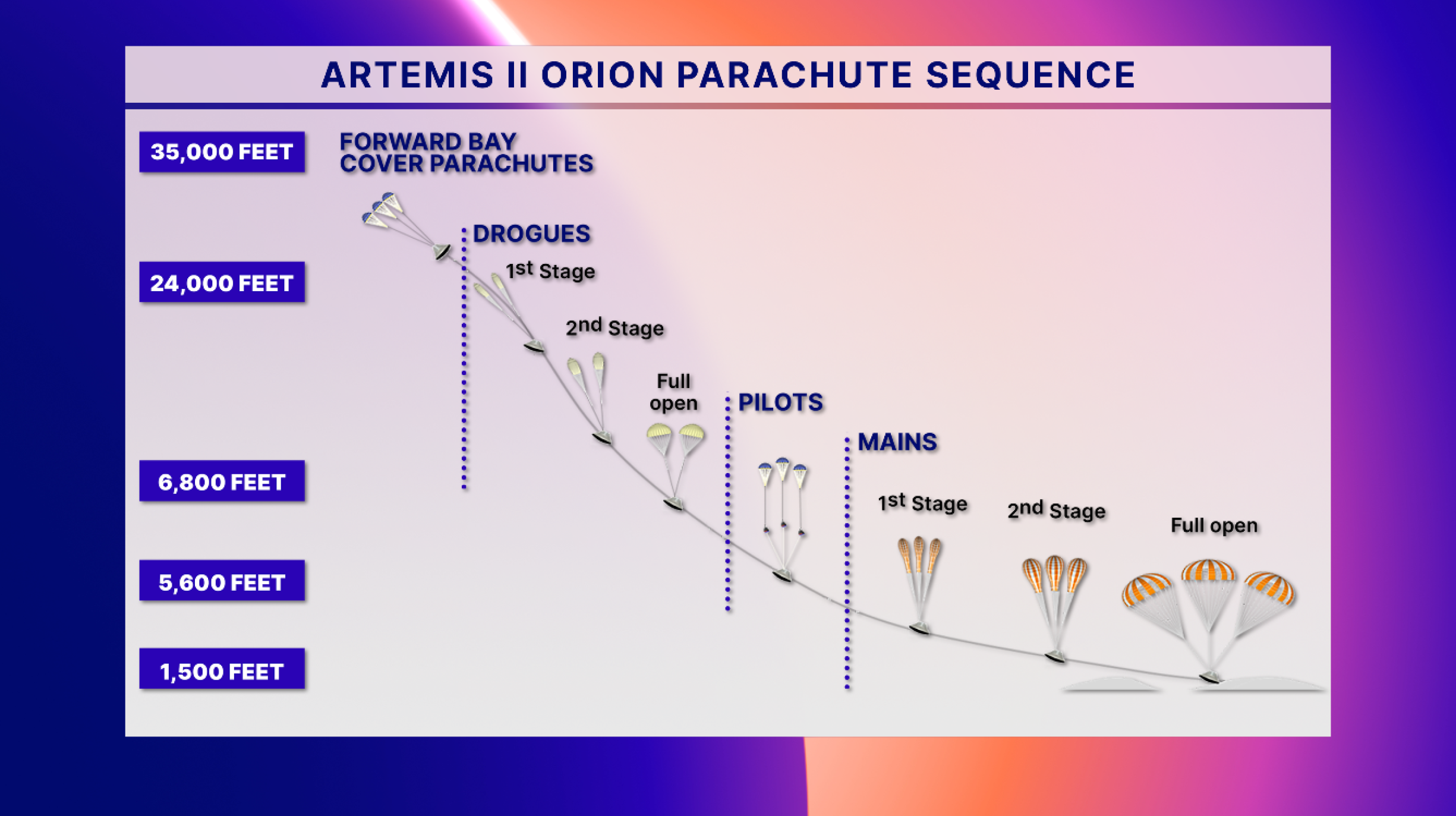 Parachute deploying sequence (Nasa)
Vishwam Sankaran10 April 2026 06:20
Critical events during splashdown
NASA teams on the ground are completing their final preparations for Orion’s re-entry and splashdown at around 8.07pm ET today off the coast of San Diego.
About 42 minutes before splashdown, the crew module and service module will begin separation.
Shortly after this, the crew module will begin an altitude correction burn at around 7.37 pm ET, and begin entering Earth’s atmosphere.
The parachutes begin deploying one after another, starting from an altitude of about 35,000 ft above Earth, culminating in splashdown.
After this, the main parachute is cut, and the Orion capsule’s upright positioning system deploys, followed by the recovery of astronauts.
Vishwam Sankaran10 April 2026 05:50
What to expect during Orion capsule’s ’13 minutes’ of fiery plunge
The Orion capsule is set to plummet through the atmosphere at a speed of about 25,000 miles per hour later today.
During these “13 minutes” of fiery plunge, the heat shield will encounter temperatures of more than 1,600C as the spacecraft decelerates rapidly.
Then the Orion will deploy 11 parachutes in succession to bring the capsule to a gentle 25mph splashdown off the coast of San Diego in California.
Focus will be on the capsule’s heat shield as it descends as NASA had already built and assembled it before it learned of the damage sustained to this part during the previous uncrewed Artemis I mission.
Instead of redoing the heat shield,NASA modified the path for the capsule’s re-entry to minimise risk to the astronauts.
However, the American space agency said it has “high confidence” in the spacecraft’s heat shield on the modified path.
“If we stick to the new re-entry path that NASA has planned, then this heat shield will be safe to fly,” NASA chief Jared Isaacman said in July.
Vishwam Sankaran10 April 2026 05:21
In case you missed it: NASA gives its final Artemis mission status briefing
Julia Musto10 April 2026 05:00
NASA Artemis II member Reid Wiseman provides an update
Julia Musto10 April 2026 04:40
Artemis crew is half way back home: Nasa
The Artemis II astronauts have hit the the “halfway” mark between the Moon and the Earth, Nasa announced in a post on X early morning today.
Their Orion capsule is currently travelling at about 3,000 miles per hour through space and is set to splash down in the Pacific Ocean around 8.07pm ET today, off the coast of San Diego.
The fiery splashdown as they enter the Earth’s atmosphere is expected to last less than 15 minutes.
“It’s 13 minutes of things that have to go right,” Jeff Radigan, NASA’s Artemis II flight director, said yesterday at a press briefing.
Vishwam Sankaran10 April 2026 04:18
Check out these cool pictures of the Artemis II astronauts on the Orion spacecraft The Artemis II astronauts laugh together in an interview (NASA)
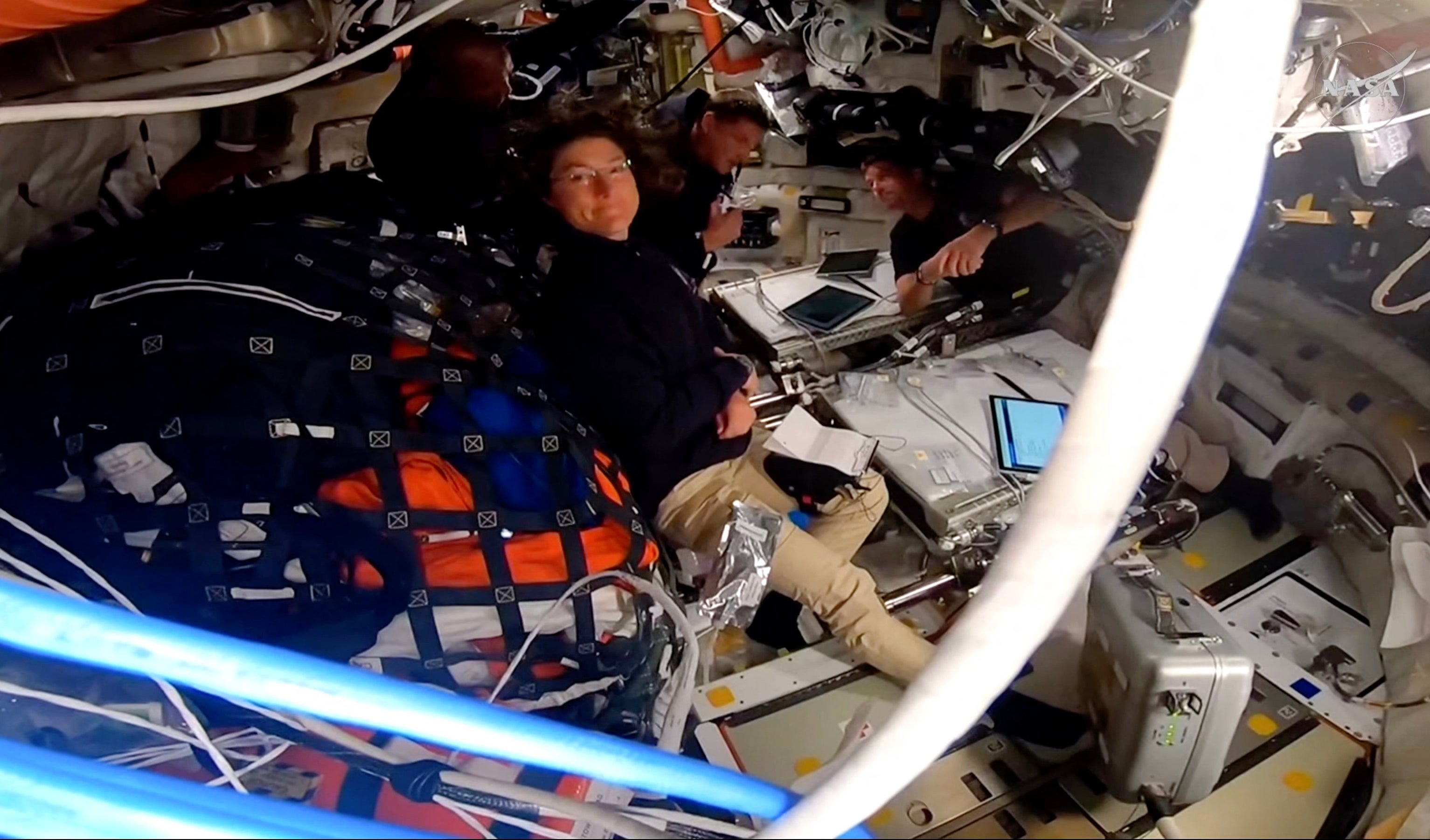 The Artemis II astronauts work hard on their Orion crew capsule (NASA/AFP via Getty Images)
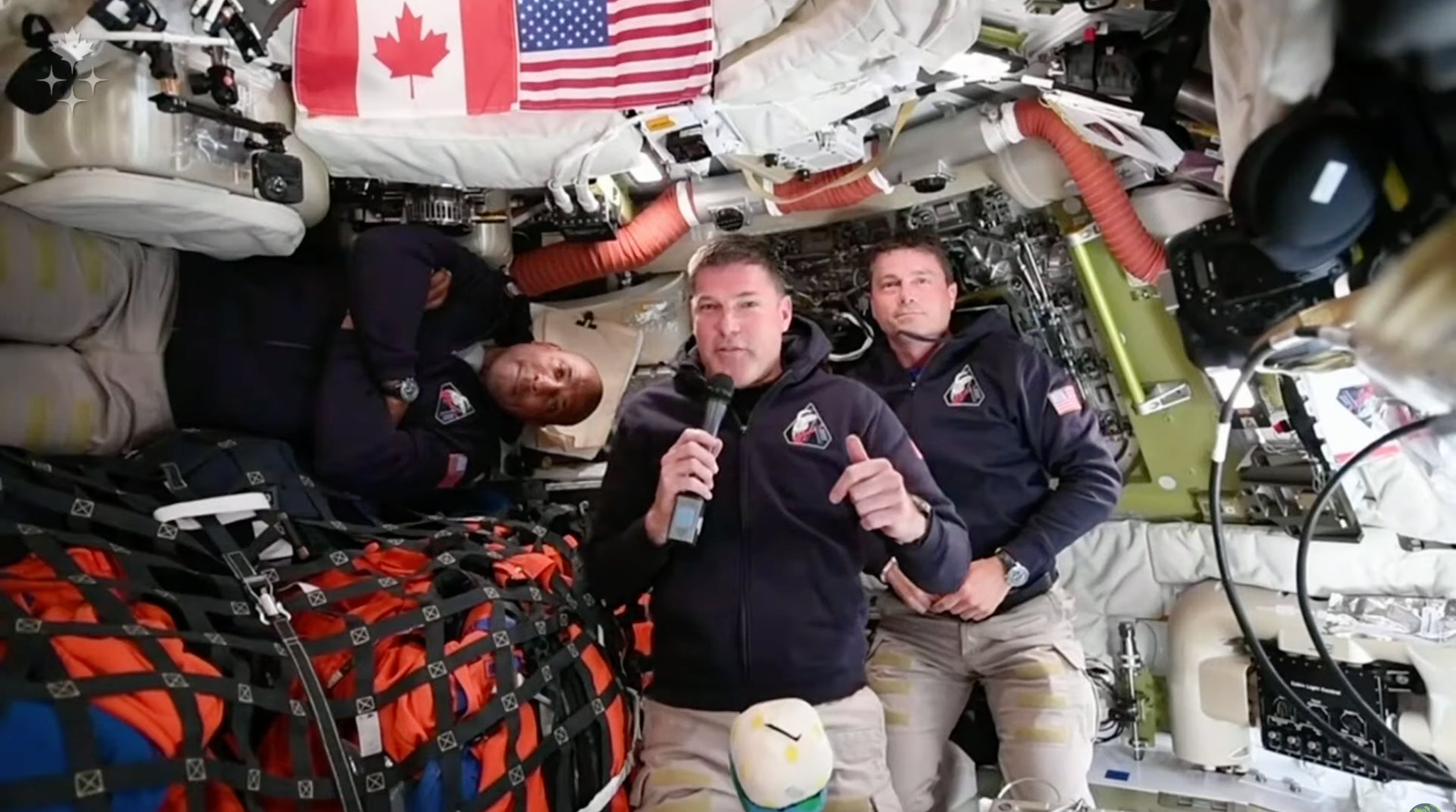 The Artemis II men are interviewed aboard their Orion spacecraft (AP)
Julia Musto10 April 2026 04:00