
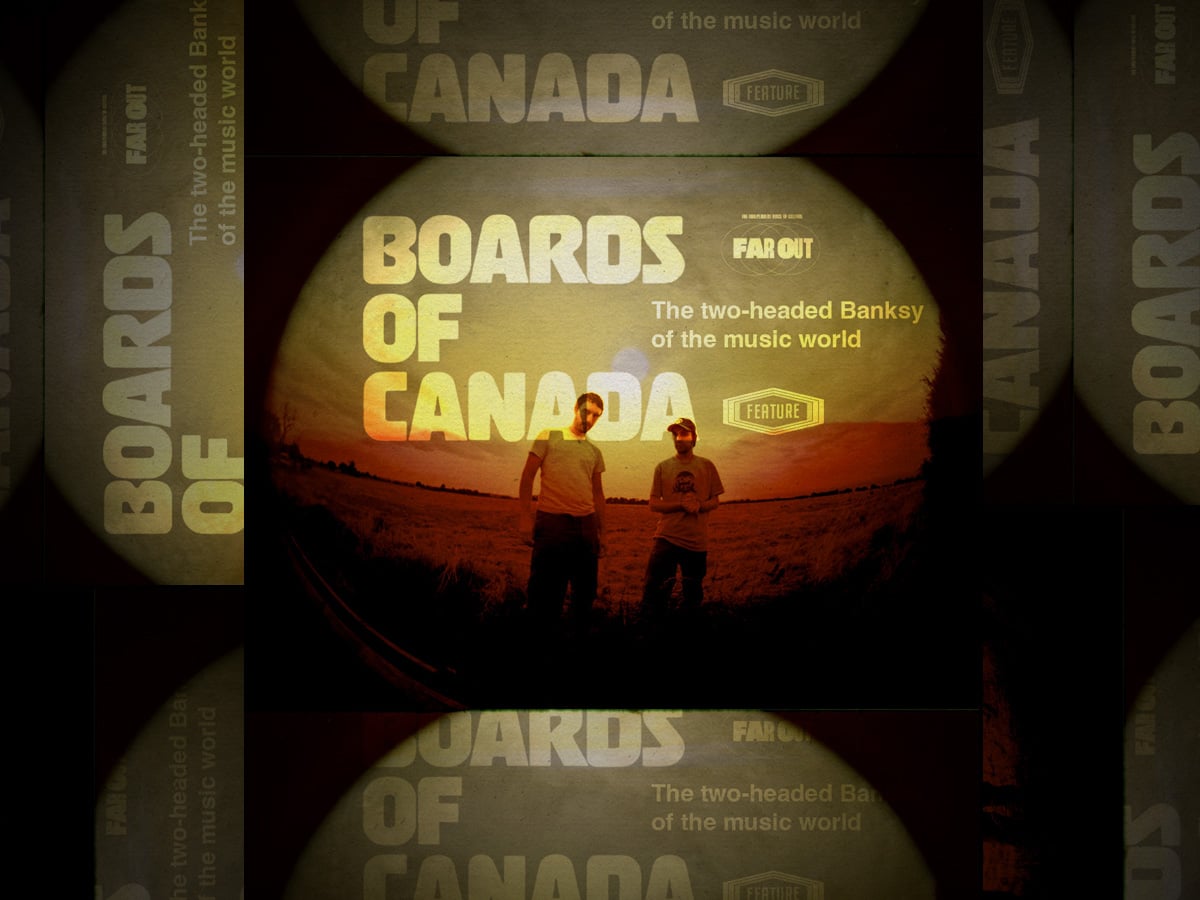
(Credits: Far Out / Boards of Canada)
Fri 10 April 2026 14:00, UK
Brothers Mike Sandison and Marcus Eoin were born in the early 1970s in the northeast corner of Scotland, right around the same time that a fellow named Robin Gunningham was born down in Bristol.
Gunningham, thanks to a depressingly unnecessary expose by Reuters, is now widely believed to be the hitherto unknown true identity of the world famous street artist Banksy, but for art-lovers who still long for the strange comfort of an unsolvable mystery, Sandison and Eoin are still out there, simultaneously bewildering and exciting their diehard fans with the stealth launch of the first new Boards of Canada album in over a decade . . . or so the rumour mill is saying, anyway. As has become the standard operating procedure for this pioneering electronic music project, nothing is ever quite as it seems with BoC, a group that skipped the anonymity gimmick in favour of something wholly immune to journalistic exposés.
Up until the Reuters report on Robin Gunningham, of course, it was a different ‘90s act who found themselves routinely linked to Banksy by supposed internet sleuths, as Massive Attack’s Robert Del Naja, aka 3D, fit the profile, hailing from Bristol and coming from a background in graffiti art. Del Naja always refuted the notion; he had personally known Banksy/Gunningham and influenced him back in the day, which kind of made for a cooler story anyway.
There were no comparable suspicions about either of the boys from Boards of Canada wearing the Banksy mask, as Sandison and Eoin were too notoriously reclusive to be bouncing around the world spray-painting buildings, but they did have a similar flair for the dramatic, delivering their latest wordlessly provocative creations to the world and then scurrying back into the darkness, refusing to offer too much additional context or explanation for why their distinctive brand of haunted, glitchy, analogue-electro music seemed to strike so many nerves.
 (Credits: Far Out / Boards of Canada)
There was no desire to be intentionally obtuse, as the goal seemed more akin to the artistic philosophy of David Lynch. “When you finish anything, people want to talk about it,” Lynch once told The Guardian, “And I think it’s almost like a crime. A film or a painting, each thing is its own sort of language, and it’s not right to try to say the same thing in words.”
In one sense, both Boards of Canada and Banksy were ideally suited to the rise of the internet age, as a new piece of street art in any random city could instantly be seen by millions of people around the world, and a cryptic social media post from the official BoC account could lead to a sudden impromptu gathering of hundreds of fans on the streets of Tokyo. Whether it’s all in good fun or intended to make a more serious point in the old guerrilla art tradition, the juxtaposition of viral fame without celebrity, a cult without the personality, instantly appealed to an online audience desperately in search of new art that invited interpretation, discussion, and a bit of DIY myth-making.
Pop in the 2000s was populated almost entirely by PR-trained stars, the kind who discuss their songs on talk shows and have their personal lives documented either on their own social media accounts or unwittingly in the pages of tabloids. Anti-pop removed the art from the artist so that you wouldn’t be faced with that dilemma yourself somewhere down the line.
The argument could be made that Banksy’s attempt to be anti-pop backfired in some ways, as the faceless man eventually became frustratingly more talked about than his work. Sandison and Eoin took a different approach. Rather than attempting literal anonymity or inventing some sort of alternative personas, they embraced a sort of old-school jazzman’s stoicism, serving their own quiet lifestyle preferences by rarely performing live and politely refusing 99 per cent of interview requests. It should have been a detriment to record sales, but the opposite proved true. They were, from early on, a fascinating curiosity.
 (Credits: Far Out / Boards of Canada)
When the members of BoC did choose to speak, including interviews with Pitchfork in 2005 and The Guardian in 2013, the expectation was that Sandison and Eoin would probably communicate in riddles or make up tall tales about their backgrounds à la Dylan or Tom Waits. But, in a weirdly more subversive move, they chatted quite openly and clearly like a couple of normal Gen X Scottish blokes with nerdy hobbies; the same sort that everyone was so oddly disappointed to see under Banksy’s mask.
At times, Sandison and Eoin even seemed genuinely surprised at how their own relative silence had affected how their fans interpreted their music. Boards of Canada’s most heralded, breakout record, 1998’s Music Has the Right to Children, and its 2002 follow-up Geogaddi, were drenched in ’70s and ’80s nostalgia, but were unavoidably interpreted through the lens of a paranoid new millennium: Y2K, 9/11, MP3 piracy, fears of the new surveillance state and a longing for the less threatening tech of the boxy television age. The music, sounding like a doomsday machine splicing through childhood memories, couldn’t just be an abstract Lynchian dream; it had to mean something.
Online forums sprouted up to discuss the ‘real’ messages of BoC’s work in the absence of any clear mission statements from BoC themselves, and like most Reddit discussions today, the craziest ideas gained the most traction.
“People were understanding things from our music that we didn’t put in there,” Sandison told Pitchfork in 2005, “[They] were saying there was an evil undercurrent to everything. And we are not like that at all. It was a theme that we wanted to pursue on [Geogaddi], but people have understood from that that we always put secret, dark, sinister, and satanic things in our music. And that became more important than the music itself.”
 (Credits: Far Out / Boards of Canada)
After more than a decade of recording, Sandison and Eoin finally found it worthwhile to pull back the curtain a little in the middle 2000s, acknowledging for the first time that they were, in fact, siblings, and that they were not, in fact, satanists. During an eight-year hiatus from 2005 to 2013, however, the group saw its mythology balloon exponentially, as their apparent ‘disappearance’ had provided a better form of marketing than any traditional press circuit could. There were rampant rumours of secret, unreleased BoC records floating around the internet. In other corners, obsessed bloggers shared their theories on the numerological references and hidden symbols in the group’s songs and album art. Some of it was true-ish, some of it was nonsense, and very little of it required any direct insights from the brothers themselves.
Ahead of the release of 2013’s Tomorrow’s Harvest, Sandison and Eoin, or perhaps their label Warp Records, recognised that the Banksy-like cult around Boards of Canada was more of an ally than a foe to be tempered. A fairly revolutionary viral promotional campaign was launched to spread word of the long-awaited record, feeding into the exact sort of underground Mr Robot channels that the most diehard segment of the BoC theory community would have hoped for: coded social media riddles, a mysterious 12-inch record dropped into a shop in New York, GPS coordinates enticing fans to meet at certain sites for further announcements, a secret listening party at the abandoned Lake Dolores Water Park in the Mojave Desert. This was brilliant, very Banky-esque stuff.
“Nobody really wants to accept that we’re just a colony of organisms hurtling through a void on a ball of rock,” Eoin told The Guardian in 2013, hinting at why Boards of Canada chose to balance out the actual ‘nihilistic’ themes of Tomorrow’s Harvest with a playful embrace of all the fringy mystical silliness their fan community had constructed for them. “The most rational individual doesn’t really want to have his beliefs completely confirmed. It’s in human nature to pursue spiritual, fantastic things, for whatever reason. That’s why we like art and escapism, isn’t it? Humans feel like there’s a purpose, even if there isn’t one,” he added.
If the eight years of silence before Tomorrow’s Harvest gave extra gravitas to that record, one can only imagine the reaction that will accompany its follow-up, now a whopping 13 years in the making. The latest rumours, as of the second week of April, 2026, have suggested that a cryptic promotional launch is already underway for the new album, as a select group of BoC fans have received strange VHS tapes in the mail from the Warp Records offices, featuring the group’s hexagon branding. The tape itself offers minimal clues, with roughly a minute of spliced together images and distorted sound effects; but isn’t that exactly what you’d expect from these guys at this point? Let’s just hope Reuters doesn’t ruin everything with a detailed, factual update on the record’s actual status.
