
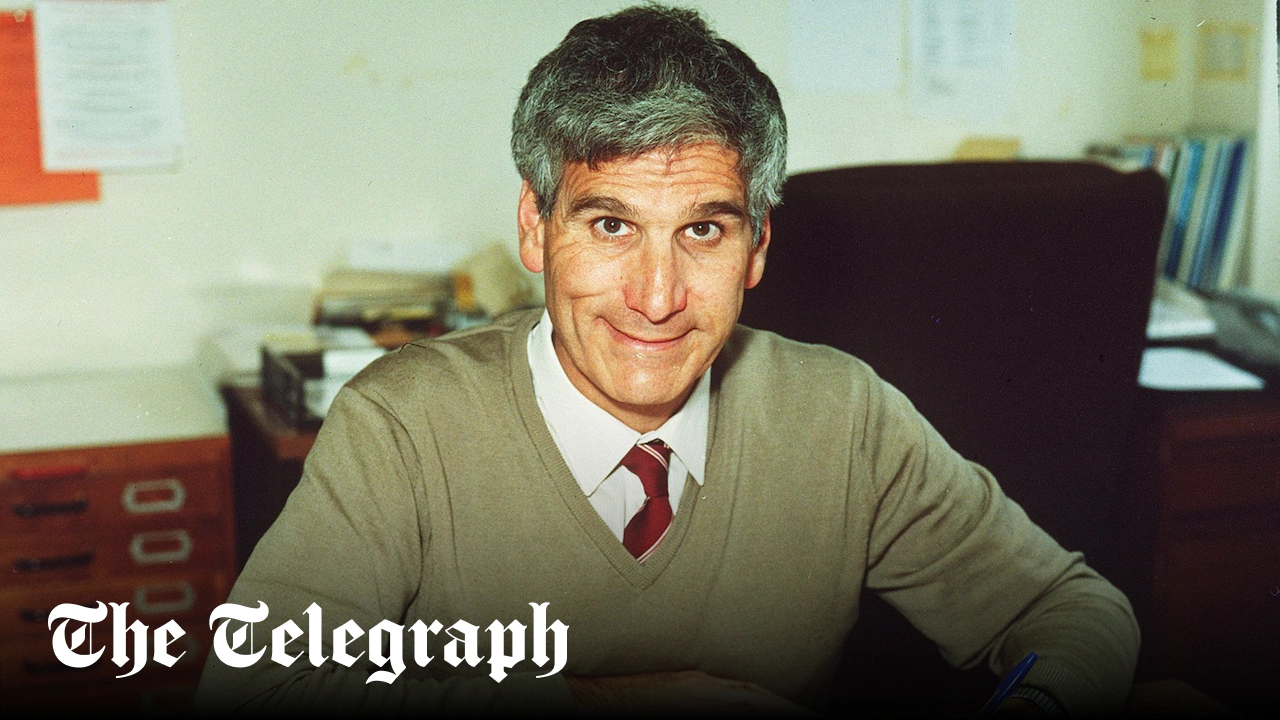
Robin Weiss, who has died aged 86, was a virologist who in 1984 led a team which identified CD4, a protein found on the surface of immune cells, as the primary “receptor”, or docking site, for HIV, the virus that causes Aids.
Subsequently he was one of the first to demonstrate that antibodies can neutralize HIV, a crucial step in the race to develop a vaccine, and collaborated on Britain’s first antibody test for HIV, helping to save millions of lives.
The discovery of HIV, and the development of drugs which have turned HIV infection into a manageable chronic condition, were great scientific achievements. But the consensus that HIV causes Aids has been persistently challenged by dissidents on the scientific fringe, leading to a major public health catastrophe in South Africa where President Thabo Mbeki’s refusal to accept medical evidence has been blamed for the avoidable deaths of more than a third of a million people.
Mbeki was influenced by Peter Duesberg, a contrarian biochemist who in 1987 argued that Aids is caused not by HIV but by long-term consumption of recreational or even antiretroviral drugs. As it was not infectious, he insisted, there was no need for safe sex, or for antiretrovirals.
In 1990 Weiss penned a merciless demolition of the Duesberg hypothesis for the journal Nature, in which he pointed out that in every country where Aids had appeared, HIV infection had preceded it. He was appalled 10 years on when the Duesberg hypothesis acquired a new lease of life: “The gay men in San Francisco who had lionised [Duesberg] went away sheepishly and got their drugs because they didn’t want to die,” he observed. “He lost his constituency. Now he is going to South Africa.”
In 2000 Weiss was among the 5,000 signatories of the Durban Declaration, warning that lives would be lost if South African politicians refused to accept the science. Yet the Mbeki administration refused to provide antiretroviral drugs until 2006.
Robert Anthony Weiss was born in London on February 20 1940 to secular Jewish parents who had arrived in Britain as refugees in the 1930s. From Abbotsholme school, Staffordshire, he read zoology at University College London and stayed on to do a PhD on the way that a retrovirus infection in chickens transforms normal cells so that they become cancerous.
He remained at UCL as a lecturer, publishing a landmark paper on endogenous retroviruses (ERVs)- DNA sequences that persist within the genome of host species as remnants of ancient infections and, in healthy individuals participate in immune responses. As a result it is now accepted that ERVs are widespread in nature and constitute nearly ten per cent of the human genome.
In 1970 Weiss moved to the University of Southern California to study ERVs in chickens, showing that they were present in the wild ancestor species, the Malaysian red jungle fowl. In 1972 he was recruited by the Imperial Cancer Research Fund to study the cancer-causing genes found in retroviruses, work which would lead to the publication (with others) of the two-volume RNA Tumor Viruses .
From 1980 to 1989 Weiss served as director of the Institute of Cancer Research, where he carried out his work on HIV and continued to work on oncogenes, after which he continued as director of research until 1998.
In 1999 he returned to UCL as Professor of Viral Oncology, his interests broadening to include ERVs in species including pigs. He was the first scientist to warn of the risk of transmission of viruses through pig-to-human transplants, leading the government to ban experimental transplants until proven safe.
The recipient of many prizes and honours, Weiss was elected a fellow of the Royal Society in 1997.
In 1964 he married Margaret D’Costa, who survives him with two daughters.
Robin Weiss, born February 20 1940, died February 27 2026